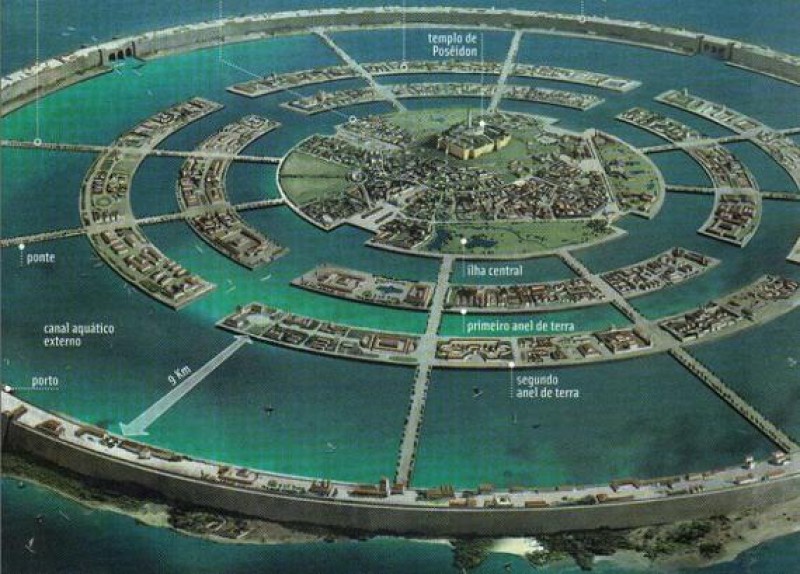
ARTISTIC RENDITION OF ATLANTIS
“Those who forget history are condemned to repeat it” *
“Let’s end hunger and poverty! Let the abundance of this bountiful planet Earth be freely shared by all who dwell in the fullness thereof!“

THE US ECONOMY IS TOP HEAVY. “The top 1% of American earners now control more wealth than the nation’s entire middle class, federal data show. More than one-quarter of all household wealth, 26.5%, belongs to Americans who earn enough money to rank in the top percentile by income, according to Federal Reserve statistics through mid-2023. The top 1% holds $38.7 trillion in wealth. That’s more than the combined wealth of America’s middle class, a group many economists define as the middle 60% of households by income. Those households hold about 26% of all wealth.” (USA TODAY)
In order to eliminate elitism and level the playing field, the 1% “haves” that own 99% of the nation’s wealth will need to stop taking from the 99% “have-nots” and less-fortunate in order to enrich themselves. It’s almost as simple as that — almost because there’ s always free choice in how we live life. Let’s take a look back at the origins of this post-diluvian modern civilization and recall some of our past we have been destined to repeat . . . and have done so.
I will enlist the assistance of a rather voluminous book I’ve just started reading by historian Susan Wise Bauer, THE HISTORY OF THE ANCIENT WORLD ~ From the Earliest Accounts to the Fall of Rome. The book itself is a pleasure to read as it is written more like a story or a novel than a college text book. For an example of what I mean by story, here are the opening paragraphs of Chapter One:
Many thousands of years ago, the Sumerian King Alulim ruled over Eridu: a walled city, a safe space carved out of the unpredictable and harsh river valley that the Romans would later name Mesopotamia. Alulim’s rise to power marked the beginning of civilization, and his reign lasted for almost thirty-thousand years.
The Sumerians, who lived in a world where the supernatural and the material had not yet been assigned to different sides of the aisle, would not have choked over the last part of that sentence. On the other hand, they would have found Alulim’s placement “at the beginning of civilization” extremely hard to swallow. In their own minds, the Sumerians had always been civilized. Alulim’s kingship, recorded in the Sumerian king list (perhaps the oldest historical record in the world), “descended from heaven” and was already perfect when it arrived on earth.
But looking back, we see the coming of the first king in different perspective. It is a sea change in the condition of man, the beginning of a whole new relationship between people, their land, and their leaders . . . . ” After kingship had descended from heaven,” the king list tells us, “Alulim reigned 28,000 years as king; [his heir] Alalgar reigned 36,000 years.” The length of these reigns may suggest that both of these kings are actually demigods, drawn from mythology rather than history; or perhaps, simply that Alulim and his heir ruled for a very long time. According to Sumerians, eight kings ruled before the enormous catastrophe of Sumerian history occurred and “the Flood swept over” the land.
Historian John Bright suggests that the Deluge took place before 10,000 BC, “when hunters migrated across the Bering Strait.” Skipping forward to chapter five, “The Iron Age,” I came upon the topic of this post. I’ll try not to make this too boring, as it is important, I feel, that we as a collective body of humanity account for our past errant ways and remember how we came to our present state of economic and social imbalance with debt being the basis of our current economy. You are well off if you have borrowing power granted you by a credit card enterprise. Well before credit cards became so freely available, I learned early in my chiropractic practice that I could not use my accounts receivable as collateral for a bank loan. Banks may be able to count loans out as part of their assets, but I couldn’t. The stark reality is this civilization is bankrupt. The rich are getting richer and the poor poorer, as we say these days. . . and as it’s been since the Fathers fell asleep. When and where did this imbalance have its start? Here’s what I came upon.
THE “WICKED” IRON AGE
The roots of elitism and poverty can be traced back to the prehistoric Iron Age of the fourth millennium, around 3102 BC. Spiritual awareness had begun to diminish by a quarter of its previous strength, according to Indian cosmology, as early as the ages of Gold, Silver, and Copper (Satya Yuga, Treta Yuga, and Duapara Yuga, respectively). The Iron Age, being the fourth (Kali Yuga), is when materialism began to corrupt the moral fiber of those who traded in these natural resources. It was “the most wicked of all.”
A Yuga lasts for a duration of 12,000 celestial years, so we are still in the Iron Age of Kali Yuga. The decline of morals, then, was rather gradual after man’s exit from Eden. The Great Deluge pretty much wiped out the ancient world, taking any remnant of Paradise with it:
There is no way of knowing what was destroyed by the waters. But like many other peoples, the Sumerians had a tale of a lost paradise. In the very ancient Sumerian poem “Enki and Ninhusag,” this paradise is described as a place where “the lion does not kill, the wolf does not seize the lamb, the wild dog, devourer of kids, is unknown, he whose eyes hurt does not say: “my eyes hurt.” He whose head aches does not say, “My head aches.” But this dream city, filled with fruit trees and watered by fresh streams uncorrupted by salt, is lost to man.
The water that covered the land was salt water which made the soil basically baren.
AFTER THE WATER, the earth dries out. Man starts again, in a world redder in tooth and claw than it was. Something has been lost. In Genesis, Noah is told that it is now acceptable to kill and animal for its meat; in the Sumerian flood story, the gods lament the destruction of the world that was: “Would that famine had wasted the world Rather than the flood. Would that pestilence had wasted mankind Rather than the flood.”
Floods occurred regularly in the Indus River Valley and water began to be greatly feared. The many and varied flood stories make for interesting reading; they are all comparable to the story of Noah and the Great Flood told in Genesis in the Bible. [We saw the recent Guadalupe River flood in Central Texas in which 135 perished, mostly children.) The Creative Force of Water, always active at the beginning of creative cycles, appears in all of these stories and myths.
As the population of the ancient post-diluvian world grew, a need for governance became apparent. This gave rise in the very distant past to the origin of Kingship in ancient Persia, and later of Aristocracy in Sumer (3600 BC), and later yet of Empire in the Nile river valley (3200 BC).
The villages near the Indus, in the Northwest, grew into towns first. The earliest houses in the Indus river valley were built on the river plain, perhaps a mile away from the river, well above the line of the flood. Mud bricks would dissolve in river water, and crops would wash away. The first reality of life in the Indus valley — as in Egypt and Sumer — was that water brought both life and death.
This was the setting in those ancient days when civilizations began to rise out of the flood waters, literally, and as man began to long for the Garden of Paradise and set about trying to recreate the bountiful and safe world the flood waters had wiped out so thoroughly and so finally. They began to harvest wood from the forests and to bake their clay bricks in kilns which made them more resistant to dissolution by the waters — and floods became less severe and destructive.
Turquoise and lapis lazuli, brought from the plains of Mesopotamia, lie in the ruins of the richest houses. The townspeople had left their valley to trade above the Tigris and the Euphrates, with those same merchants who supplied semiprecious stones to the kings of Kish an Nippur and Ur.
But despite the growing prosperity and reach of the Indus towns, the epics of India tell not of advance, but of decline. The floods had washed away the previous age and begun a new one; the age of towns was the Kali Yuga, the Age of Iron. It began when Manu Vaivaswata [the first king of India] descended from the mountain, and it was an age of wealth and industry. It was also an age in which truthfulness, compassion, charity and devotion dwindled to a quarter of their previous strength. In the Iron age, the sacred writings warned, leaders would commandeer the goods that belonged to their people, pleading financial need. The strong would take property from the vulnerable, and seize hard-won wealth for themselves. Rich men would abandon their fields and herds and spend their days protecting their money, becoming slaves of their earthly possessions rather than free men who knew how to use the earth.
Given the relatively late date at which these dreadful warnings were put down, they probably reflect the worries of a more mature society — one which had a large, unproductive bureaucracy draining the national coffers. But the storytellers themselves put the beginnings of this declination all the way back to 3102, the year when villages along the Indus began to grow into towns.
Note on sources of Indian history: Historians of India work in a fraught political arena. The written sources which we have, including those which tell of the mythological Manu and the Ages of Gold, Copper, Silver, and Iron, are oral traditions which were set down, much later, in the language Sanskrit . . . the Sanskrit writings represent the thought of a small, elite group of Aryan immigrants. In terms of history, this would mean that the written accounts of Manu and the Age of Iron have practically no continuity with the earliest civilizations of India. Manu is clearly mythological; his relationship to India in the fourth millennium remains extremely uncertain.
Manu himself, kneeling down by the water that will soon wash away the previous age and bring on the decline of the Kali Yuga, finds himself speaking to a little fish forced to beg for protection from the larger and stronger who prey upon the weak. In India, the journey towards civilization had just begun; but as in Sumer itself, it was a journey which took its people that much farther from paradise.
Mythologically speaking, we are still in the Kali Yuga, the Age of Iron (3102 BC – present). The biblical saying “The sins of the Fathers are visited upon the children unto the third and fourth generations” is applicable here — only the children of the Fathers, as fathers themselves, have been repeating the same old sins of greed and coveting stealth — and poverty continues to be the lot of those who lack the motivation to improve their lot, as well as the desire to accrue wealth. Balance must be restored and the practice of usury and the monetizing of just about everything of value on this planet and in this mind-made world — including human labor — must cease. The Earth is the Lord’s and the fullness thereof; the world and they that dwell therein.” (Psalm 24)
We cannot recreate the Paradise we lost eons ago. However, we can turn around and see the Paradise at hand and all around us — and begin taking better care of it than we have been. We can return to the LORD God awaiting our repentance in humility and ownership of our Fore Fathers’ original sin of separation from Him and our rejection of His ordinances for life on Earth in lieu of our own self-centered designs and fancies.
Let us remember our past lest we repeat it to our ultimate extinction. The virtues of the Fathers are passed down as well to future generations. Therefore, “Blaze forth pure virtue. Depart false ambition’s restless schemes.” — as Lord Martin Cecil commands in his sacred poem “Thus It Is“ — Let the hoarding of material wealth on earth cease! Let greed, usury, and coveted stealth cease! Let man stop monetizing the gifts of Mother Nature’s resources and the fruits of human labor — including human labor itself, which is bought for a ludicrous minimum wage, barely enough to live on in these days, and not enough in too many lives to afford even a place to call home. The homeless stand out as an indictment against this civilization. Let the elite share their hoarded wealth and restore balance to our economy and our top-heavy social structure. Let’s end hunger and poverty! Let the abundance of this bountiful planet Earth be freely shared by all who dwell in the fullness thereof! Let love, peace, and generosity reign in the hearts of men and women everywhere! “Let love command! Let wonders form. Let Heaven’s beauty shine. Let every living breath sing praise to Light Divine.” Selah!
I invite you to join me in sending forth this edict. Until my next post,
Be love. Be loved.
Anthony ~ tpal70@gmail.com
*CREDITS: “Those who forget history are condemned to repeat it.” —George Santayana, American Philosopher.
“Let love command! Let wonders form. Let Heaven’s beauty shine. Let every living breath sing praise to Light Divine.” From: SONGS OF PRAISE AND THANKSGIVING, hymnal of Emissaries of Divine Light.
 Healing Tones
Leave a comment