Creating the New Earth Together

Archive for March, 2017

The “Jesus of History” vs the “Jesus of Faith” part 3:3 – The Book of Enoch

Enoch was a name given to an ancient Jewish text that was written, according to religious historian Michael Baigent, by several authors. It stands as a testament to prior mystical traditions influencing Judaism, although many Jewish rabbis would not accept it. Early Christians in Ethiopia, on the other hand, accepted it as part of the Old Testament, especially the parts that tell of the coming of Jesus and a reference to it in the New Testament in a Letter of Jude (14). Ultimately, the Council of Nicaea in A.D. 325 sidelined the Book of Enoch and it was eventually banned by late-fourth and early-fifth-century theologians such as Jerome and Augustine.

According to Genesis, the first book of the Old Testament, Enoch was the seventh generation of Adam and Eve and the father of Methuselah, who lived 969 years and was the grandfather of Noah. In those days it was common to live several hundred years. Enoch didn’t hang around quit as long. As the story goes, “And all the days of Enoch were three hundred sixty and five years: And Enoch walked with God: and he was not; for God took him.” (Genesis 5:23-24). The story of Enoch, of course, is a travelogue of his visit to heaven–which greatly influenced the writers of the New Testament and contributed to much of the dogma of Christianity and especially Catholicism.

Michael Baigent gives a brief summary of Enoch’s visit to heaven in his book The Jesus Papers–Exposing the Greatest Cover-Up in History:

[The Book of Enoch] uses many of the motifs that are now familiar to us: Enoch has a visionary dream (13:8); he asks for an explanation of the Tree of Life (25:1-3); he mentions three eastern portals through which stars pass on the eastern horizon (36:3), in accordance with the Babylonian and Assyrian astrolabes, which date from around 1100 B.C.; and he also speaks of the actions of men as being weighed in the balance, like the Egyptian concept of afterlife judgment (41:1).

We are once again on familiar ground: we have esoteric matters taught to a seeker by means of dream visions of the Far-World—and in a Jewish context. As we have seen, these dream visions occur as part of an initiation, and the dreamer goes to a quiet, dark place, such as a cave or a temple crypt, and uses the techniques he or she has been taught to enter the stillness from which the Far-World is accessible. So we would expect, somewhere in the Book of Enoch, to find a reference to the experiential, the initiatory. We are not disappointed. (underscores mine)

“And it came to pass,” the text explains,”‘that my spirit was translated and it ascended into the heavens: and I saw the holy sons of God” (Enoch 71: 1). This report has all the appearance of being an account of something that truly occurred to the writer—a mystical experience that could be induced by someone seeking initiation into the esoteric tradition of Judaism.

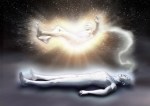
Enoch was taken up “from amongst those who dwell on the earth … he was raised aloft on the chariots of the spirit” (Enoch 70:2).  This image seems to be a Judaic equivalent of the Egyptian winged Ba. But there is no doubt that this event concerned an initiation, since the text explains what happened to Enoch after he had been raised to heaven but before his spirit became transfigured:

“And the angel Michael seized me by my right hand, and lifted me up and led me forth into all the secrets, and he showed me all the secrets of righteousness. And he showed me all the secrets of the ends of the heaven.” (Enoch 71:3 – 4)

The anonymous ancient writer continues, describing what then occurred: “And I fell on my face,” he recounts, “and my whole body became relaxed, and my spirit was transfigured” (71:11).

This is precisely the type of experience that we would expect to find among the Therapeutae, for example. And crucially, just in case we have failed to spot it, the text makes a point of explaining that this ascent into the heavens occurred while Enoch was still living – as the text puts it, “during his lifetime.” This is virtually identical to the explanation in the Egyptian Pyramid Texts that the king has “not departed dead” but has “departed alive.” It is hard not to see the two statements as describing an essentially similar experience, an experience deriving from an initiation into the mysteries of the Far-World.

These visionary texts cannot be any other than records of initiations—records gathered together under the name of Enoch in much the same way as in Egypt those attributed to Hermes Trismegistus were collected together in the Books of Hermes.

I don’t agree with the author’s conclusion that Enoch’s visit to heaven was an “initiation into the mysteries of the Far-World.” We’re talking about several thousands of years before the Egyptian Mystery Schools even existed. I rather attribute Enoch’s visit to the realms of light to the fact that heaven was still accessible by virtue of the yet uncluttered veil between heaven and earth in human consciousness and to certain vibrational factors that were still in place at the time that made visits Home possible. It rather seems more likely that this ancient story played an inspirational and intriguing role in the Egyptian’s efforts to visit the Far-World themselves, just as Enoch reportedly had done. Again, looking back to ancient times and events and attempting to understand and interpret them using a much evolved (or devolved) state of consciousness and set of values, is presumptuous at best and misdirecting at worst.

Given the visionary nature of this text, it is, at first sight, curious to discover that seven pieces of the Book of Enoch form part of the Dead Sea Scrolls. All were found in 1952 in the Qumran cave in the marl cliff face near the ruins of the community, now called Cave 4. So, on the face of it, it seems as though the Zealot group that produced the Dead Sea Scrolls and was so important a part of Jesus’s political milieu and the messianic Jewish group that gave rise to Christianity were both well aware of the Book of Enoch. But an analysis of it reveals an interesting fact.

The Book of Enoch, as we have said, is a compilation of texts from different authors. In fact, scholars have separated the text into five sections, each distinctive and different from the others. The section that contains the report of the mystical ascent and transfiguration is the second section, which is also known as “the Parables.” This mystical, initiatory section is completely absent from the texts found at Qumran.

The Dead Sea Scroll texts contain fragments, written in Aramaic, from sections one, four, and five only of the Book of Enoch. Not only is the mystical section missing, but so too is the following section on astronomical and calendar matters — in particular, the section providing the basis of the solar calendar, which, we will remember, was evidently used in the Jewish Temple of Onias in the Egyptian delta.

We can see here the same clash of traditions that we find expressed in the story of Jesus when he rejects the Zealot position on the payment of taxes to the emperor. Jesus took a mystical approach; the Zealots took a worldly approach. The Zealot Book of Enoch clearly rejects this mystical approach. This stands in further evidence that — as we have said before — Jesus could not have learned his skills among the Zealots of Galilee.

Mystical texts like the Book of Enoch, texts that would have been very dear to the Therapeutae, would also have been very dear to those who taught Jesus. With the Book of Enoch, we finally have a text that appears to issue directly from the Jewish milieu within which Jesus was nurtured and from a group concerned with initiation into secret teachings, with an ascent to heaven, and with an experience of the Divine Light. Of this there can be no doubt, for according to the Book of Enoch (96:3), “A bright light shall enlighten you.”

All of this, of course, is supposition and speculation on the part of Michael Baigent, admittedly so.  Joseph B. Lumpkin, author of The Books of Enoch published in 2009, shares some interesting insight into this ancient story and the book itself:

Of all the books quoted, paraphrased, or referred to in the Bible, the Book of Enoch has influenced the writers of the Bible as few others have. Even more extensively than in the Old Testament, the writers of the New Testament were frequently influenced by other writings, including the Book of Enoch. However, things are never easy when such a span of time is involved. Over the elapsed two-thousand years, three major works attributed to Enoch have been discovered. . . .

. . . However, recent discoveries of copies of the book among the Dead Sea Scrolls found at Qumran prove the book was in existence long before the time of Jesus Christ. These scrolls force a closer look and reconsideration. It becomes obvious that the New Testament did not influence the Book of Enoch; on the contrary, the Book of Enoch influenced the New Testament. The date of the original writing upon which the second century B.C. Qumran copies were based is shrouded in obscurity. Likewise lost are the sources of the oral traditions that came to be the Book of Enoch.

It has been largely the opinion of historians that the book does not really contain the authentic words of the ancient Enoch, since he would have lived several thousand years earlier than the first known appearance of the book attributed to him. However, the first century Christians accepted the Book of Enoch as inspired, if not authentic. They relied on it to understand the origin and purpose of many things, from angels to wind, sun, and stars. In fact, many of the key concepts used by Jesus Christ himself seem directly connected to terms and ideas in the Book of Enoch.

It is hard to avoid the evidence that Jesus not only studied the book, but also respected it highly enough to allude to its doctrine and content. Enoch is replete with mentions of the coming kingdom and other holy themes. It was not only Jesus who quoted phrases or ideas from Enoch, there are over one hundred comments in the New Testament which find precedence in the Book of Enoch.

Other evidence of the early Christians’ acceptance of the Book of Enoch was for many years buried under the King James Bible’s mistranslation of Luke 9:35, describing the transfiguration of Christ: “And there came a voice out of the cloud, saying, ‘This is my beloved Son. Hear him.'” Apparently the translator here wished to make this verse agree with a similar verse in Matthew and Mark. But Luke’s verse in the original Greek reads: “This is my Son, the Elect One (from the Greek ho eklelegmenos, lit., “the elect one”). Hear him.” The “Elect One” is a most significant term (found fourteen times) in the Book of Enoch. If the book was indeed known to the apostles of Christ, with its abundant descriptions of the Elect One who should “sit upon the throne of glory” and the Elect One who should “dwell in the midst of them;” then the great scriptural authenticity is justly accorded to the Book of Enoch when the “voice out of the cloud” tells the apostles, “This is my Son, the Elect One,”… the one promised in the Book of Enoch. . . .

. . . . The Books of Enoch, and especially 1 Enoch, seems to be a missing link between Jewish and Christian theology and is considered by many to be more Christian in its theology than Jewish. It was considered scripture by many early Christians. The literature of the church fathers is filled with references to this book. The early second century apocryphal book of the Epistle of Barnabus makes many references and quotes from the Book of Enoch. Second and third century church fathers like Justin Martyr, Irenaeus, Origin and Clement of Alexandria all seemed to have accepted Enoch as authentic. Tertullian (160-230 A.D.) even called the Book of Enoch, “Holy Scripture”. The Ethiopian Coptic Church holds the Book of Enoch as part of its official spiritual canon. It was widely known and read the first three centuries after Christ. This and many other books became discredited after the Council of Laodicea. And being under ban of the authorities, it gradually disappeared from circulation.

In 1773, rumors of a surviving copy of the book drew Scottish explorer James Bruce to distant Ethiopia. He found the Book of Enoch had been preserved by the Ethiopian church, which put it right alongside the other books of the Bible.

What emphasizes itself to me in all of this is the longing in the human heart to return Home to an Edenic heaven we somehow lost sight and experience of, and the human mind’s futile endeavors to devise ways of exploring higher levels of consciousness, as exemplified, for example, in the mind-altering drug culture. We rather believe that heaven is “up there” somewhere in the heavens, whereas Jesus clearly stated that the kingdom of heaven is within us and all around us–and that will be the topic of my next post in this series. Until then,

Be love. Be loved.

Antony

I invite you to read my HealthLight Newsletter online at LiftingTones.com.
The “Jesus of History” Vs the “Jesus of Faith” part 3:2 – Experiencing the Source

“Jars of spring water are not enough anymore. Take us down to the river.”—Rumi

Christianity, as it was conceived and brought forth as a religion–initially by the Jewish Zealots at the time of Jesus and three decades later by Constantine and the Council of Nicaea–interrupted a cycle of restoration that Jesus initiated with his life of unconditional love and compassion. In that sense, it was and is a failure. The kingdom of heaven remains only a belief, a concept in human consciousness, a place to go to after we die, but nevertheless a largely unrevealed reality behind the manifest world of human existence. I say “largely” because the Natural World continues to manifest the glorious revelation of the kingdom of heaven on Earth, especially in the spring. In a word, what we long for and seek is to go beyond belief and into a personal experience of God. This the Christian religion has failed to deliver. We’ve had to find it on our own by way of various transformational spiritual paths.

It also interrupted a much larger cycle of spiritual evolution that began with Abraham, the great patriarch of Judaism, and the children of Abraham, the nation of Israel. It ended with the collapse of Egypt as the world center of religion, mysticism and esoteric knowledge.

Actually, the cycle initiated with Abraham ended with the fall of King Solomon’s reign and empire. He had gathered and united many empires under one by taking their princesses and queens as wives, of which he simply had more than he could placate and still maintain stewardship of the cycle he was bringing to a potentially victorious climax and completion. His was a classic example, yet again, of the Man being distracted by  the Woman to the abandonment of his purpose in the divine scheme of restoration, a repetition of the same pattern of failure enacted by the parents of the human race in the Garden of Eden–a pattern that continues to be enacted between the men and women to this day. But not all was lost.

I ended the last post on a transitional note marking the end of the Egyptian era and the beginning of the Christian era. In this post, I will take a look at this transitional period and see how something great and significant did come out of Egypt besides Jesus, the Messiah. I will continue sharing religious historian Michael Baigent’s thought-provoking perspectives from his extensively researched book The Jesus Papers—Exposing the Greatest Cover-Up in History.

The Hermetic Texts

The Egyptian priests sought to preserve their secrets by learning the Greek language in which they wrote an entire collection of wisdom texts that circulated under the name Hermes, but for which they drew their essentials from Egyptian tradition. This collection of literature was attributed to the ancient Egyptian god Thoth, aka “Hermes Trismegistus” in the late classical world. Baigent raps up this chapter with this insightful overview of the Hermetic roots of Western civilization and of the pagan roots of Christianity:

Above all, and of most relevance to our investigation, the Hermetic concept of man is “as a cosmic rather than a terrestrial being.'” The Greek gold plate (see the previous post) put it well: “My race is of Heaven [alone].”

A particular value of this Hermetic literature is that, despite its late production, it comes from the very source of the mysteries of the ancients and so can be used as a lens through which to view the earlier texts, allowing us to gain a deeper understanding of their true concerns.” Significantly, at the very heart of the Hermetic texts is the concept of mystical initiation: “Then he [Poimandres] sent me forth, empowered and instructed on the nature of the universe and on the supreme vision.”

It is still more curious that the production of these books of Hermes began about the time of Jesus and paralleled the rise of Christianity. At the end of the second century A.D., Clement, the Christian bishop of Alexandria, referred to them as “containing the whole philosophy of the Egyptians.” The pagan philosopher Iamblichus, writing a little later, was also aware of their importance: “Our ancestors dedicated the inventions of their wisdom to this deity, inscribing all their own writings with the name of Hermes.'”

This collection of texts . . . has had an enormous and incalculable effect upon the Western mind. It is fair to say that the Western world would not have developed as it did without them. Science itself might never have evolved without the impetus given by men and women enamored of these works. For they were rediscovered in the Renaissance and translated by Marsilio Ficino about 1463 at the behest of the wealthy Florentine banker Cosimo de Medici.

(For a review of the Hermetic Principles that have come down us—such as the principle of cause and effect—and the most often quoted: “As above so below; as below so above”—visit this website: http://thirdmonk.net/knowledge/seven-great-hermetic-principles-teachings-thoth.html#)

Going Home NOW

We all want to return Home—some of us, myself included, would like to be able to do so now while we breathe the air of this world. Our prodigal sojourn on Earth has left us hungering and thirsting for Home—for eternal life. And we will go Home, even if we have to die to get there. This belief that one has to die in order to go to heaven is central to Christian doctrine. The only trouble is Heaven is not “there.” It is here, waiting to be revealed where we are, here on planet Earth—where we’ve rather made a hell of a mess. For this reason alone, going Home has been an escape, or at least a reprieve, from our miserable plight.

Herein lies part of the deception hidden within the “Greatest Cover-Up in History” Michael Baigent has boldly brought to the fore for our critical examination and honest review. The truth has been adulterated with fabricated lies and what has been handed down as “truth” has been horded and sold to the faithful by a false priesthood. Baigent speaks to this here:

No one individual, no culture, no civilization, has a monopoly on truth. For this reason, we should not make the mistake of thinking that the techniques of entering the Far-World were known only to the Egyptians or the Greeks. The gates to the Far-World have always been open to those whose world-weary longing draws them across the divide.

And there were few more world-weary than those who came to be baptized in the River Jordan by John the Baptist, a unique event that even Catholic editors of the Jerusalem bible consider to be an initiation. Was this perhaps the true meaning of John’s statement, “The kingdom of heaven is close at hand?” (Matthew 3:2)

Jacob’s Ladder

This doorway to heaven has been sought after throughout the history of mankind. Bagent cites the story of Jacob’s ladder in the Old Testament as an example. If you recall the story, Jacob had a dream of a great ladder connecting heaven and earth with angels ascending and descending on it.  Upon awakening from his dream, he realizes that he is in a sacred place and, externalizing his dream, he exclaims: “This is none other but the house of God, and this is the gate of heaven.” He then proceeded to build an altar with stone and he called the place “Bethel” which means “the house of God.” (Genesis 28: 10-19)  What he didn’t realize was that the ladder and “gate of heaven” were not out there but within himself, as was the dream.

Now, the context of this story as Baigent tells it has to do with “sacred sites.” There are places on the surface of the Earth that are known even today as being “sacred” by reason of their vibrational frequency and their historical significance to ancient civilizations, such as Stone Hinge and Easter Island, to name just two of many such places on Earth where the veil between heaven and earth seems to be very thin. Jacob may have well been in one such high place. This veil, of course, is within the individuals who make pilgrimages to these sacred sites. The energy of such places is such that it impacts the individuals’ electromagnetic biosphere raising their vibratory frequency to a height where they experience an intensification of energy. The “house of God” is none other than the body temple itself.  I know this is true from personal experience in such a sacred place where the energetic field was rare and uplifting. For me, it was a direct experience of God—of my own divine Self.

In this sense, Baigent is astute in saying “there are places where the Far-World and the terrestrial world are linked—places that serve as the perfect conduit between the two worlds.”

I resonate with his interpretation of Jacob’s dream:

More significantly, Jacob’s “dream” is better understood as a vision, and one that teaches us a number of important things. Perhaps the most crucial lesion lies in the report of angels “ascending and descending.” This is clearly a symbolic demonstration that the link between heaven and earth is dynamic, that the divine qualities are constantly flowing to and fro (underscore mine). This expresses the idea we have already seen in Egypt that the Far-World and the terrestrial world are intimately—and dynamically—interlinked. This is proof, should we need it, that Jacob’s vision emerged from a living tradition of which this Old Testament report is just a fragment, a glimpse of the lush landscape of the promised land.

The Way was Blocked

Throughout the Old Testament, Baigent suggests, the link between the two worlds is portrayed as being broken, making the passage to and fro difficult if not impossible.

“. . . angelic beings with flaming swords block the entrance to the Garden of Eden; Jacob is not encouraged to climb the ladder to heaven. Religious administrators had apparently taken over the tradition and restricted its message about the pathway to the Far-World—much as Vatican strongmen did later with regard to the teachings of Jesus.

More accurately, the angels with flaming swords, according to the story, only blocked access to the Tree of Life. We must remember that this is a metaphorical story told and written down by Moses. We have no written record of what actually happened. The point the author is making, I believe, is that the way to the kingdom of heaven has been obstructed and access barred to the uninitiated.

There’s an event in the Gospel of Matthew (23:13) where Jesus rebukes the false priesthood of the Temple: “But woe unto you, scribes and Pharisees, hypocrites! For ye shut up the kingdom of heaven against men; for ye neither go in yourselves, neither suffer ye them that are entering to go in.”

But how did they “shut up the kingdom of heaven?” And what was their understanding of the nature of the kingdom of heaven? Was it the Far-World of Egyptian/Judaic mysticism? And what “kingdom of heaven” was Jesus referring to?

Baptism, a Pagan Ritual

This concept of the intimate relationship between heaven and earth along with the crossing over to the Far-World was huge in Egyptian tradition, which left its mystical mark on Judaism. A second influence came from Babylon during the Babylonian exile, when King of Babylon, Nebchadnezzar, “seized and captured Jerusalem in 587 B.C. and deported the Jewish king, along with thousands of people. Many others fled into exile in Egypt.”

We can see, for example, the Babylonian rite of baptism as the origin of the Jewish practice of purification before rituals, the aim being to separate the person from the terrestrial world while at the same time establishing a pure relationship with the divine world.

This pagan rite is enacted in the Christian culture as a sacrament, only for a different and fabricated purpose: to wash away the stigma of “original sin,” a sin that was allegedly committed by Adam and Eve, both of whom are fictitious characters created by the author of the Book of Genesis to represent our first parents. This is all part of the hidden agenda Baigent is seeking to expose. There was no actual “original sin” committed by Adam and Eve. It was a story, an allegory, brought forward by Christianity as a means of bringing the faithful into submission to the Church’s rules and requirements for admission to the kingdom of heaven after they die. The reality is we are born into this world not with original sin on our souls but, to borrow a phrase from Catholic prelate and author Matthew Fox, with “original innocence.”

We all worship One God

The Jewish calendar also derives from a system used by the later Babylonians. Even the traditional incantation bowls used by Jewish rabbis were of Babylonian origin. The Babylonian Talmud too has medical information from earlier Babylonian lore, and Babylonian astrological texts have been found to have been used by Jewish groups as well. Even the belief in one god, which carried over into Christianity and Islam, has been seen by some scholars as deriving from ancient Mesopotamia: the name of the god of the Assyrians, Ashur (Assur), means the “One,” the “Only,” the “Universal God.”

It appears, then, that Islam and Christianity worship the same One God.

Mesopotamian influence can also be detected in the origin of the Tree of Life, now the backbone of the mystical Jewish practice known as the Kabbalah. The notorious “Tree of Knowledge of Good and Evil” in the Book of Genesis of the Old Testament also has its roots in the very early oral mythological teachings of humans well before the invention of writing.  The story of Ezekiel also comes out of Babylon and suggests that Ezekiel may have been involved with the esoteric mysteries of Egypt as an initiate himself. So, much of our Judeo-Christian heritage comes from pagan religions.

I will leave it there for now. In my next post I will give in depth consideration of the Book of Enoch. Until then,

Be love. Be loved

Anthony

I invite you to read my Health Light Newsletter online at LiftingTones.com.


The “Jesus of Faith” Vs the “Jesus of History” part 3:1– Initiation and Incubation

“Say, ‘I am a child of Earth and starry Heaven; but my race is of Heaven [alone]’”

I have been sharing a perspective of the eighteen missing years of Jesus’ young adulthood from religious historian Michael Baigent’s book The Jesus Papers – Exposing the Greatest Cover-Up in History. In my last post, we explored a possible scenario that Jesus spent those years in Egypt—possibly living in a community of healers called the Therapeutae. I will continue to share Baigent’s perspective of events in Egypt that Jesus might have know about and even explored experientially.

Pyramids for Soul Travel

The Egyptians saw themselves as keepers of the balance and harmony of our universe. The Pharaoh bore the primary responsibility in this keep and the pyramids were his means of traveling to the Far-World for wisdom from the gods. Michael Baigent gives details of this travel from information gained during several pilgrimages he made to the pyramids in Egypt and other sites of historical interest.

To ALL OF US “PILGRIMS,” it is evident that the Pyramids are more than just the extravagant tombs we have been led to believe they are. Stephen Quirke states bluntly that the Pyramids, along with many other buildings that disintegrated over time, formed part of an ornate complex dedicated to the cult of the pharaoh as a divinity, adding that “they are only secondarily tombs.” The Pyramid of Djoser and other buildings in the complex at Saqqara, he explains, provide “unambiguous evidence” for their ritual use—in this case, for the Sed festival, a great festival held every thirty years or so that aimed to renew the power of the pharaoh.”

The most significant study of the cult of the pharaoh has recently been completed by Dr. Jeremy Naydler and presented in his book Shamanic Wisdom in the Pyramid Texts. He explains that the Sed festival was conducted to allow the pharaoh to bring the physical world and the Far-World into harmony, a balancing that would benefit all of Egypt. The “central rite” of the Sed festival “involved the king crossing the threshold between worlds,” with the aim of bringing himself into a “direct relationship to the normally hidden spiritual powers.” To allow this to happen, during the most secret parts of the ritual ceremony it appears that the king had “an ecstatic visionary experience.” This experience was deliberately induced by those conducting the rites, who well understood the linkage between the two worlds and the importance of the pharaoh as a point of contact between the two.

Naydler is blunt: his conclusion from his study of the Pyramid Texts is that “far from being funerary texts, [these texts] were primarily concerned with mystical experiences of a type similar to those that the living king had during the ‘secret rites’ of the Sed festival, for they can clearly be seen to belong to a genre of archetypal human experiences at the crossing point between this world and the spirit world.”

One of these texts reads: “O king, you have not departed dead, you have departed alive.” Another reads: “I have gone and returned. . . .  I go forth today in the real form of a living spirit.” Yet another text is entitled “Ascending to the sky . . . . and becoming an Akh.”

The Akh is “the shining one,” a “being of light,” and is the root of the word akhet, or “horizon.” It describes the end sought by the Ba: to convert into pure spiritual radiance. In terms of the dead, it reveals that the person after death, following a period when he is free of his body in his Ba [soul] form, eventually ascends to enter a state of transcendence and merges with the radiant Source of all. Stephen Quirke explains that “the akh is the transfigured spirit that has become one with the light.” The word used in the texts for this process is sakhu—meaning “to make [the deceased] an Akh … a being of light.”

As Baigent points out, scholars would dispute this experiential approach to texts and rites and relegate it all to “millennia of imaginative speculation” by priests who may have believed what they were writing but didn’t ascribe to the actual possibility of such occurrences  Naydler nevertheless suggests that the experiences of crossing the threshold of death while yet alive were indeed possible and real. Baigent writes:

IT IS HERE THAT I am reminded again of the unique term “ahket of Khufu” applied to the Great Pyramid of the pharaoh Khufu at Giza, which I referred to at the beginning of the chapter. Could this name, meaning “to blaze, to be radiant,” and indicating the point of entry into the Far-World on the horizon, possibly suggest that the pyramid was the place from which Khufu passed into the Far-World? And the place from which he returned?

With the responsibility of maintaining Ma’at upon him, could it be that Khufu sought answers from the spiritual beings in the realm beyond on how to ensure harmony in this world? And if he did indeed cross the threshold into the kingdom of gods, how did he do it? What specific techniques were known to the Egyptian priests who assisted Khufu and other Egyptians before and after him?

It is quite possible that Jesus himself visited the Great Pyramid of Giza (pronounced jeeza) and went through the ritual by which he initiated the process of revelation of his radiant divinity, which he revealed later on with three of his closest disciples, as the Gospels of Matthew and Mark both record. Jesus apparently crossed over the threshold between heaven and earth and visited with two great beings, Moses and Elias, with whom he had a conversation. He was “transfigured before them: and his face did shine like the sun, and his raiment was white as the light.” (Matt 17:2) How did he do this? And when and where did he initiate this process of transfiguration and revelation of his radiant divinity? Could it have been inside the Great Pyramid of Giza? Was not his mission, like the pharaohs such as Khufu, to bring balance and harmony back to the relationship between heaven and earth? Perhaps to restore harmony and balance between the planet itself and the solar system – or Solar Entity, as I prefer to call it?

Rites of Initiation

Golden plates were found in graves in Thessaly, Greece, that speak of a celebration or ritual “performance by the ‘blessed ones” that took place underground. The “blessed ones” are written about as being  “’The Holy Ones, who understand the mysteries.’ Meaning, it is evident, those who had been initiated.” One plate reads: “O fortunate and blessed one, you are a god, no longer mortal.” Another plate reads: “Say, I am a child of Earth and starry Heaven; But my race is of Heaven [alone]”–advice given to a Far-World traveler to prepare him for any query about who he was.

We cannot avoid it: we are forced to take seriously the idea of initiation in underground chambers, and of initiates sharing with the dead secret rites and knowledge. This is a strange claim for a modern person to take seriously, but we must view the ancients in their own terms: this is how they explained what happens, and there seems to have been little ambiguity or doubt involved. Simply because we find it hard to believe is no reason to think that they misunderstood what was occurring, or worse, that they made it up as part of a “pious fraud.” All the evidence at our disposal leads to the conclusion that those who passed through the initiation ceremonies felt that they had been well served. There are no reports of disgruntled initiates demanding their money back.

Perhaps it is time now to look at how the priests did it—that is, how they helped initiates actually leave their bodies and travel to the Far-World.

Incubation

There was a ritual performed in underground chambers, facilitated by Egyptian priests, called the “initiation,” which included a process of “incubation,” whereby those who wished to cross over to the Far-World and “be introduced to the divine secrets” could do so and return safely. This was performed in underground sanctuaries accessible by way of tunnels. Baigent relates it to an interesting classic story:

These initiates, as they were called, would enter, take the right-hand path—which was always recommended in the ancient texts—and be rowed along an artificial river to reach the inner sanctuary, which served as the doorway or portal into the netherworld they sought and the kingdom of the gods. To return, the initiates could pass back across the river. In the meantime, the alternative tunnel provided the priests of the site direct access to the sanctuary, where they would wait for the initiates to arrive.

It was all rather reminiscent of the visits to the underworld that classical writers had described. They began with accounts of visitors to the infernal regions being rowed across the River Styx by the silent boatman Charon. Then, after entry into the sacred kingdom, the traveler experienced, as Vergil describes it, “places of delight, to green park land, Where souls take ease amid the Blessed Groves.”!

The author actually visited this site and describes in intriguing detail features he personally saw that are found in Vergil’s Aeneid, a scene where Aeneas visits the Sibyl of Cuma and asks for directions to the underworld. Vergil’s story turns out to be more fact than fiction. Homer also wrote stories about crossing over to the underworld:

THE VERY NOTION of crossing to the realm of the dead has had a long tradition in the Greek world. The earliest report of such a journey appears in the famous book XI of Homer’s great epic The Odyssey. Odysseus, on his complicated journey back to his home after the battles of Troy, is required by a witch, Circe, to descend into Hades, where Persephone is queen, in order to seek advice from the soul of a famous but dead Theban.

As I read Baigent’s description of what was called “incubation,” it sounded very much like what we know and practice today as meditation or contemplation — or even what today is known as a “sweat lodge.”  Only this ritual was performed by priests who knew the techniques and how to administer them. The question I am interested in having answered is whether or not Jesus had a personal experience of incubation during his sojourn in Egypt—perhaps as a preparation for his three-days in the sepulcher between his alleged crucifixion and his celebrated resurrection. Baigent alludes to this possibility but leaves us to our own conclusions and speculations.

THESE MATTERS MAY seem far too arcane to have any relevance whatsoever to our story, which, after all, concerns Jesus and the source of his teachings. Yet Jesus, as we shall soon see, also took an experiential approach to his mysticism. Could men like Parmenides have transmitted ideas to the classical world of the time of Jesus? Could they have added to the fertile mix of techniques that found a center in the great city of Alexandria and a Jewish expression in the Pythagorean-influenced group of Therapeutae whom Philo described living in a community outside the city?

Practice of Dying – Near Death Experiences?

Out of body experience

Plato explains through the words of Socrates that those who are involved in following philosophy correctly “‘are practicing nothing other than dying and being dead…truly, then, those who practice philosophy aright are cultivating dying.’” The only difference is that one returns to this world. It sounds very similar to a Near Death Experience.

At the point of death, Themistius informs us, “[the soul] has the same experience as those who are being initiated into great mysteries.”

This definitive assertion can be taken as a true expression of one who had himself been through the great mysteries. This is not just an intellectual belief but something learned from participating in such a journey to the Far-World.

Themistius continues:

At first one wanders and wearily hurries to and fro, and journeys with suspicion through the dark as one uninitiated: then come all the terrors before the final initiation, shuddering, trembling, sweating, amazement: then one is struck with a marvelous light, one is received into pure regions and meadows, with voices and dances and the majesty of holy sounds and shapes: among these he who has fulfilled initiation wanders free, and released and bearing his crown joins in the divine communion, and consorts with pure and holy men.

The Healer-Priests

In 1958 evidence was uncovered among the ruins of the ancient city of Velia in Italy of healer-priests of Apollo who survived the fall of that city. One of these was the Presocratic philosopher Parmenides. The date 446 A.D. was the latest date inscribed on the stone base of a destroyed statue, indicating a time somewhere around the beginning of the Christian period. Baigent describes their ritual practice:

These healer-priests were important: one of their titles was Pholarchos—“Lord of the Lair.” This is revealing, as these priests were specialists in an initiatory technique once well known in the ancient world as the technique of incubation.

In antiquity the best way of actually making contact with divinities of the underworld was through the practice of “incubation”—of awaiting a dream or vision while sleeping, as a rule, either on or even inside the earth.”

The ritual practice of incubation involves lying down in complete stillness and silence in an underground room, or perhaps a cave, in order to have a prophetic dream or to fall into a state of consciousness that is neither waking nor sleeping. It was here in the enclosed dark spaces that the seekers might have experienced passing across to the Far-world, where they could receive a vision from the Divine, the Source of all. The god of incubation was Apollo.”

. . . . The sacred journey was undertaken for healing or for a revelatory experience. These healer-priests of Apollo were experts in incubation and, as Kingsley explains, “used incantations to enter other states of consciousness.”

We can see here that the practices of ancient Greece, using such sites as found at Baia or the deep caves or underground sites that must have existed in Velia, were not so different from the uses made of the crypts beneath the temples in ancient Egypt. Such dark secluded places were chosen by seekers who, after dutiful preparation and appropriate ritual and incantation, lay in the stillness and entered another state of consciousness. We are left with little alternative but to seriously consider that they did indeed leave their bodies in their Ba form (according to the Egyptians) or in their psyche, or soul (according to the Greeks), and travel to the Far-World.

We can also see that by the time of Jesus the two traditions were drawing ever closer together. In fact, during the Greek and Roman domination of their country, the Egyptians despaired of their secrets surviving; the first-or second-century A.D. Hermetic text the Asclepius laments:

“A time will come when it will appear that the Egyptians paid respect to divinity with faithful mind and painstaking reverence to no purpose. All their holy worship will be disappointed and perish without effect, for divinity will return from earth to heaven, and Egypt will be abandoned…. When foreigners occupy the land … a prohibition under penalty prescribed by law (so-called) will be enacted against reverence, fidelity and divine worship. Then this most holy land, seat of shrines and temples, will be filled completely with tombs and corpses…. Only words cut in stone will survive to tell your faithful works.”

And so did it come to pass: Egypt became a land of darkness and stone-engraved mystery simultaneously with the rise of Christianity.  This ended the “First Sacred School” initiated by Abraham and cleared the way for the “Second Sacred School” initiated by Jesus.  I will leave it there for now. Until my next posts then,

Be love. Be loved

Anthony

Read my Health Light Newsletter online at LiftingTones.com


The “Jesus of History” vs The “Jesus of Faith” part 2: The Missing Years, page 3

My Chorale Pic

 The Secrets of Egypt

The veil is thinning. The veil of which I speak is the cloud in the human heart and the fixed structures in human consciousness that have obscured our vision of the oneness of heaven and earth and our oneness with one another. I see evidence of this thinning  among the gays and lesbians of the LGBT community who recently won their Supreme Court case for marriage equality in the state of California and in all 50 states. I was moved by the television show “When We Rise” watching these men and women embrace one another in a powerful display of unconditional love. The light of their unfettered joy in victory lit up the veil of judgment in my own heart as I felt the repulsion homosexuality triggers inside of me seeing men kissing men on the lips, while at the same time feeling a compelling spirit of joyful celebration in my confused emotional realm. Scars from thwarted encounters with homosexuality during my youthful years in Catholic seminar tearing loose from the fabric of my heart. The veil is definitely thinning. Healing is underway. The truth of human relations is being revealed. We are rising in love with one another.

With some there is no veil at all. Heaven is “so close as not even to be near,” as one poet put it – and we can enter in while we yet live. This is what  the Egyptians were into with their mysticism. What science fiction writer H.G. Wells proclaimed in 1895 in his story “The Door in the Wall” the Egyptians had discovered a way to go through that portal and enter what they called the “Far-World.” They had a secret ritual into which one could be initiated and guided through that would open a door into that world and allow one to visit for a while and then return. This ritual was called the “incubation.” More about that later in my next post.

This was a message that the Master Jesus brought: “The kingdom of heaven is at hand and all around.” He was even more specific than that: “The kingdom of heaven is within you.” We were instructed to “repent” – literally turn around – see it on every hand and enter in. Then he apparently went through that door himself and returned to say “Follow me.” I don’t think he was messing with us.  I believe he meant exactly what he said. I know he did.

I have a friend who had a near death experience (NDE). His impression was that the veil is very thin and heaven is indeed right at hand. His experience was so exquisite that he was terribly saddened upon being resuscitated and brought back to life on this plane.

Here’s another interesting NDE story: “Dead for 48 minutes, Catholic Priest claims God is female” .

Jewish Mysticism in Egypt

In his extensively researched book The Jesus Papers, religious historian Michael Baigent shares his exploration into the mysticism of Egypt in his chapter “The Mysteries of Egypt.” I read and re-read this chapter with a deep curiosity and desire to know what might have really transpired during those eighteen years of Jesus’ young adulthood that are peculiarly missing from the Four Gospels. Baigent places Jesus in Egypt, brought there by his parents, where he may well have received an education in Jewish mysticism, which was an adaption of Egyptian mysticism whose sole purpose was to potentiate and facilitate ecstatic union with God by way of a process called “incubation.” Michael Baigent describes this cultish practice in haunting detail.

THE MYSTERIES OF EGYPT

The Egyptians saw themselves as keepers of the balance and harmony of our universe.  I find this most fascinating and pertinent to our times of global climate crises.

In the beginning, according to the ancient Egyptians, everything was perfect. Any fall from this state of eternal harmony, called Ma’at, was due to mankind’s imperfections, and the greatest of these human imperfections were those caused by greed.

Greed is a human “imperfection” that continues to create an imbalance in our world to this day. We haven’t yet emerged out of those dark ages in our governance, which is based on greed for power and control. It’s all coming to a head, like a pimple on our collective forehead, with the 1% of our population that embody the focus of the spirit of greed, which the majority of the remaining 99% embody as well. The pimple is bursting, however, ejecting the pus of corruption out of the body of mankind; and what a stink that is making. Baigent continues:

It was the task of everyone, the great as well as the humble, to work toward maintaining this perfection and restoring any imbalance in it. But the ultimate responsibility lay with the pharaoh, aided by a network of temples that covered all of Egypt.

Every morning saw the same ritual of awakening the gods in the temples at the moment of sunrise, when the doors of the Inner Sanctum would be opened. The director of the Petrie Museum in London, Dr. Stephen Quirke, has likened the Egyptian temple, only half in jest, to “a machine for the preservation of the universe, a technical operation that requires technical staff or knowledge … in order to ensure that the crucial task of survival is never impaired.”

I am reminded of a passage from the 38th chapter of the Book of Job, a powerfully haunting passage: “Canst thou bind the sweet influences of the Pleiades, or loose the bands of Orion? Canst thou bring forth Mazzaroth in his season? Or canst thou guide Arcturus with his sons. Knowest thou the ordinances of heaven? Canst thou set the dominion thereof in the earth?”

We are supposed to know these things – and we once did. There was a Science of Mazzaroth at one time in our ancient past, a remnant of which lingers on today in what we know as astrology. It is the reality behind the Zodiac. The seasons of Mazzaroth still govern the cycles of creation in our Solar Entity, only without our conscious participation. We do continue to influence these cycles through our self-destructive behavior and are impacted by them. In our ignorance, we’re getting clobbered by their unalterable activity.

I believe what Michael Baigent has shed light on in this book in the last attempt of ancient civilizations to restore man’s engagement with the Science of Mazzaroth. Only the Egyptians couldn’t pull it off as mere humans living on the physical plane.  Greed for power and control spoiled the process of restoration of the governance of the ordinances of heaven upon the Earth through human beings.

Further, I believe Jesus was aware of their foolishness and failure – a failure that actually dated back to King Solomon and the failure of the “chosen people” of Israel to allow that restoration to occur on the physical plane by way of the cycle initiated by Abraham in that pivotal moment when he reportedly ended human sacrifice by not sacrificing his son – and Jesus set about to initiate a second opportunity for the cycle of restoration of human consciousness to its rightful place of dominion in heaven – a dominion founded in love rather than greed. The Egyptians were at least aware that they needed to rise to a higher mental plane in their earnest endeavors to travel to the Far-World to gain knowledge from their gods that would help them maintain a balance between the two worlds they knew at that time. But that opportunity was no longer available. Surely Jesus was well aware of their endeavors – and was not without compassion for their state of blindness.

Baigent goes on to elaborate on their cosmology and culture:

At the same time the temple was a gateway to the Beyond: it was the place where the earth and the sky joined as they seem to do on the horizon, and for this reason many texts refer to the temple as a celestial horizon. The ancient word for “horizon,” akhet, had a number of significant meanings: it referred not only to the joining of the sky and the earth but also to a specific part of the horizon where the sun god rose from the Far-World, the Duat, every morning and returned to it every evening.” Clearly, for the Egyptians, the horizon marked a portal into the Far-World.

Pyramids too were imbued with this quality: the Great Pyramid of the pharaoh Khufu at Giza was termed the “akhet of Khufu.” Furthermore, the root of the word akhet means “to blaze, to be radiant.” On one level this term referred to the blaze of light at sunset or sunrise, but it also had a much more secret meaning, which we will discover.

The primary role of the pharaoh was to serve as the guarantor of Ma’at. The only – and greatest – thing asked of human beings was to live in Ma’at, bringing the cosmos and the physical world into harmony This perfectly balanced state was personified by the goddess Ma’at, who was depicted with an ostrich feather in her hair. She brought truth and justice, the fruits of harmony, into the world.

Coexisting within this universal perfection were two worlds: the physical world, which we are born into and within which we live, and the other world to which we travel when we die, the Duat, or the Far­World. The Far-World was not seen as separate, as some heaven or hell far away from or unconnected with mundane existence. Rather, the Far-World was ever-present. It was believed to exist simultaneously with the physical world, intertwining with it like the two snakes around the caduceus of Hermes. It was with us all the time even though we could not normally see it or travel to it until we died.

These two worlds occupied the same space, in some mysterious and unexplained manner, except that the physical world remained within time whereas the Far-World existed beyond time. Time began with creation, but the Far-World was seen as eternal, not in the sense of being an infinite stretch of time reaching forever into the future and stretching from a past forever distant, but rather eternal in that it was outside of time. The ruler of the Far-World was the god Osiris, and the guide for the dead was Thoth, who led them up to the kingdom of the gods.

A further aspect of the Far-World is that it was understood to be the eternal background to everything in the visible universe. It was considered the divine source of all things, the source of all power and all vitality Life itself was believed to come from the Far-World, which seeped into the physical world and revealed itself in all the forms we see about us.

For the ancient Egyptians, the world of the dead was always very close to the world of the living – there was an intimacy between the two. Paradoxically, the world of the dead was the source for the world of life. Indeed, the dead were believed to be the truly living ones.

A tomb inscription dating from the New Kingdom (around 1550-1070 B.C’) reminds us that “a trifle only of life is this world, [but] eternity is in the realm of the dead.” An earlier Middle Kingdom (around 2040 – 1650 B.C.) tomb of the priest Neferhotep in Thebes-now Luxor-contains several “Harper’s Songs,” the second of which ends:

“As for a lifetime done on earth, it is a moment of a dream. It is said: ‘Welcome, safe and sound’ to the one who reaches the West.”

The “West” for the Egyptians was the land of the dead. Tombs and pyramids were always built on the west bank of the Nile, where it was thought that the sun vanished at night into the Far-World.

To understand this, it is useful to look at the ancient Egyptian concept of time: they understood that two types of time were operating simultaneously. There was the kind of time they called neheh, the cyclical time involved in natural patterns – the seasons, the movement of the stars, and so forth. The other was known as djet, which was no time at all – a state of being outside of time entirely. Only in neheh did time move; djet represented time in suspension. While neheh might be infinite, only djet was eternal; one inscription reads:

“The things of djet-eternity do not die.”

This dual perspective is very different from our modern concept of time in which we are ever tumbling onwards into a future that we can only hope will be perfect – a hope that for many religions rests upon the fulfillment of a promise that a messiah will someday appear to win the final battle against the forces of evil and in so doing will usher in a perfect world. Our political philosophy too is very dependent upon linear time, on a trajectory stretching from the past into the future where, if we manage our legislation correctly, we will achieve satisfaction for all citizens, as if legislation is something that does more than plaster over cracks.

And yet, those of our culture who have stepped out of time – the mystics – report, like the ancient Egyptians, that the world of the dead is indeed a world of the living, that it is ever-present and very close. Making allowances for the great differences in culture and language, we can see this same sense of proximity to the divine world stressed in the reports of the great sixteenth-century mystic Saint Teresa of Avila, who often fell into a mystical “rapture” wherein she was utterly “dissolved” into the divine kingdom. Speaking of God she stressed:

“There was one thing that I was ignorant of at the beginning. I did not really know that God is present in all things; and when He seemed to me so near, I thought that it was impossible.”

From what Baigent presents here, perhaps one can readily see how the roots of Christianity grew out of the soil of Egyptian and Jewish mysticism. Jesus’ attempt to initiate a new cycle of restoration with his disciples failed to interrupt the status quo. Christianity became simply a new name and practice of Egyptian and Jewish mysticism, with all of its mysteries, beliefs and cultish practices.  A third and new cycle was destined to be initiated at a yet higher spiritual level of consciousness and is already underway. But that’s getting ahead of our current exploration.

I will leave it there for now. There’s a lot here to ponder. I would love to share your thoughts on what I’ve presented here. For one thing, I would like to know if what I am bringing forward for consideration is of any value to my readers – and I note that there are many visitors to this blog after each new post. So, do drop me a line or two. Until my next few posts – which will come closer together as we approach the Easter Season,

Be love. Be loved

Anthony

Welcome to my Health Light Newsletter online.

Tag Cloud