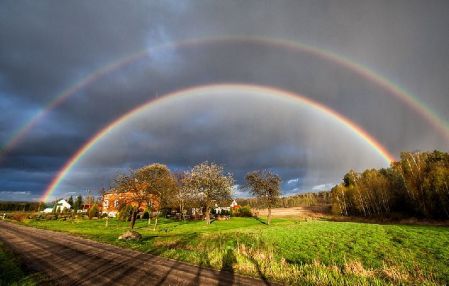
“And I saw a new heaven and a new earth, for the first heaven and first earth were passed away, and there was no more sea.” (Rev. 21:1)
MONDAY WAS ALBERT EINSTEIN’S BIRTHDAY: March 14, 1879 – April 18, 1955. This renown physicist searched in vain over the final fifty years of his life for a “Grand Unified Theory” that would tie the cosmos together. The obvious conclusion I come to is that Einstein was trying to find this all-encompassing theory with a transitory and finite human consciousness—and that brings me to the topic of this new series:
The Mystery of Consciousness
♦ ◊ ♦
 OF ALL THE THINGS SCIENCE HAS EXAMINED, it has never been able to get a grip on the phenomenon of consciousness. It’s as though human consciousness isn’t real and therefore not capable of being found and observed, much less understood. Biologists can describe neural architecture and pinpoint the exact location in the brain where the sensations of taste, smell and every sensory perception are controlled, but no one has a clue as to how the subjective experience of smell arises out of a physical process—or why a wood fire has its telltale scent, or how a beautiful sunset gives rise to an emotional sensation of awe.
This harkens me back to a statement a notable scientist made back in the 1970’s: “We may never find the seat of consciousness, because what we are looking for is who is looking.” What Einstein was looking for was his very Self. He couldn’t find his imagined “Unified Field” because his being, his Self, was one with it, and, based on a fundamental principle of physics, a state cannot observe itself. From another point of view, one could say that the seat of human consciousness resides in the human mind itself. From this perspective, one identified with one’s human mind and its educated intelligence, such as a scientist might well be, the same principle of physics applies. A state cannot observe itself.
All of which harkens back to a line in my previous post which states: “. . . if some thing’s experiences alter radically depending on conditions, that thing is not fundamental.” It isn’t a fundamental reality, It’s not causal, in other words, and is therefore in the realm of effects. That makes human consciousness transitory and mortal, doesn’t it? Of course this plays out at the time of death for the physical body from which the human mind arises . . . and goes the way of the body. Human consciousness evaporates at death. What ascends is the spirit, the immortal soul, the angel disincarnate; and the angelic spirit shares in the immortal spiritual consciousness of the One Great Spirit.
This fragile and transitory state of human consciousness is borne out by the prevalence of mental disease. If consciousness can be affected by the deteriorating conditions of the human brain, then it is not fundamental to life or to reality. It is only fundamental to the physical world and to the perception of the physical world, as I explored in my previous series on “Biocentrism.” Human consciousness, like the external world of form, is subject to change, and ultimately dissolution—and the reason for its dissolution, one might say, is to make room for something new, namely spiritual consciousness.
One does not have to die physically, however, in order for this dissolution to take place. Actually, it is undergoing dissolution constantly as it evolves, as I mentioned in my previous post. One state of consciousness gives way to another and another. This is so with individuals as well as collectively. As we move in the ascending spiral of transformation, the old gives way to the new. Our consciousness experiences the passing away of old ways of seeing the world and living in it. The world consciousness is far different today from what it was fifty years ago. We’ve become somewhat less centered in our own self-concerns and become more aware of one another’s concerns and wellbeing, even planetary concerns—albeit for self-preservation and survival of our species and that of the animal kingdom.
But that’s not the end-all-and-be-all. There are higher and more encompassing levels of consciousness. There’s the consciousness of the solar system, galactic consciousness, and Cosmic Consciousness. Ultimately, there is Divine Consciousness out of which the entire Cosmos—galaxies, solar systems, Earth and human beings themselves—are all born and ordered. So there is an ongoing passing away of the old ways of seeing and living life making way for new and higher levels of consciousness. Another word for consciousness is “heaven.”
This brings me to the passage in the Book of Revelation that has puzzled me for years, and keeps coming up in my thoughts, in particularly the phrase “and there was no more sea.” Here is the passage:
And I saw a new heaven and a new earth: for the first heaven and the first earth were passed away; and there was no more sea. (Rev 21:10
Recently I received a posting from a friend’s blog, “The Great Cosmic Story,” which was an excerpt from a talk by our mutual spiritual mentor, the late Martin Cecil, given back in April of 1979, before an audience of men and women on a path to spiritual transformation. His consideration centered around the above biblical passage, along with an insightful perspective on the “speed of light,” which I’ll share at another time. These are provocative thoughts that for me opened up a whole new vista of understanding the evolution of human consciousness—and the Way to Divine Consciousness through the heart not the mind . . . more about that in a later post. This consideration was entitle “Zero Dimension — Now Everywhere.”
♦ ◊ ♦
The first heaven and the first earth must pass away—and are passing away. “And there was no more sea.” That refers to the forms in which substance is held in human-nature consciousness. No more sea—no more human nature consciousness, because of the New Heaven and the New Earth. This is the true heavenly power, and the consequent true earthly power. Heaven and earth are one. These two powers are not in conflict, as they are insofar as the first heaven and the first earth are concerned—these are constantly in a battle, on the surface at least. They get together sometimes, but that isn’t very comfortable for anyone. The New Heaven and the New Earth are that to which our experience is dedicated—spiritual power, which allows for the emergence of a material power in alignment with it.
In thinking of spiritual power, it is often imagined that somehow it is going to work without regard to material things; they just get arbitrarily pushed around by this invisible magic of spiritual power. But heaven and earth are one; the movement of the spiritual power is the movement at the same time of the material power. They work together in unison, in oneness. Heaven and earth are indeed one. And this is known in the coming of the New Heaven and the New Earth, so that the expression in our experience may no longer be governed, consciously or subconsciously, by the powers of the first heaven and the first earth, by religious powers and by temporal powers as human beings have known them in human nature. We cease to be governed by these things, not because we rebel and object and fight against them, but because we find ourselves participating in the reality of the New Heaven and the New Earth.
Life is then withdrawn from the old in our own experience. It is not yet withdrawn from the old in the general patterns of the world, but in our own experience it is. And that withdrawing of life force relates to the structures that are present in human consciousness, our own specifically, because regardless of what we may have thought about it consciously we are all the product of what went before subconsciously. We all therefore have a residual state which is describable in terms of religious power and temporal power.
If you examine history you will see how these things have been so strong in human experience down through the centuries. Has that all just evaporated in this generation, do you think? No. It is right here. It is present in the human nature consciousness of everyone, ourselves included. And without realizing it, everybody is moved by what is there present as strings are pulled by the human nature state of affairs which activates these things in our subconscious human nature state, and we find ourselves reacting this way and that—we do not know exactly why.
That is uncomfortable, so we try to explain it. And we have considerable interest in psychology and all this sort of stuff, which is trying to explain something to make it more acceptable—something that is very uncomfortable until, of course, the human mind can get in there and give it a supposedly logical explanation. But it never is logical, because the premise is wrong, and the whole pattern of human nature mental experience is irrational. Those who participate most directly in this mental activity are the ones who usually claim it is very rational, because they base it, in their own imaginations at least, upon logic. “It’s all very logical. We follow this out. We’re not ruled by emotion. We see the thing is here and here and here.” But the logical process is all based in a fanciful premise that has no reality, and so no matter what derives from that, it is going to be as fanciful as its point of origin. It is an excellent exercise at times to look at something that has been firmly established in the human nature consciousness as being irrefutable and see if you cannot find an alternative explanation.
It’s good to be honest about these things and to see how they exert themselves in the way we see the world, and in particular how we habitually express with old emotional patterns of judgement, complaint, criticism and resentment, just to name a few patterns that get triggered up automatically in the moment. It takes deliberate and mindful presence to abort these negative attitudes when they pop up and replace them with more positive and constructive ones.
An elder mentor of ours developed a habit of saying “Thank you Father” when something unpleasant or painful happened. One day a car door got slammed shut on his hand and he immediately said “Thank you Father.” In only a few seconds the crease across his fingers made by the door filled in and evened out, and the healing took place even as I sat there and watched it. Someone might have said it was a miracle, but it was simply the natural healing process at work empowered by the spirit of life released by an attitude of gratitude. There’s a popular saying: “An attitude of gratitude brings altitude.”
In celebration of the Spring Equinox, I leave you with this poem fresh out of the heart and heaven of Poet Don Hynes:
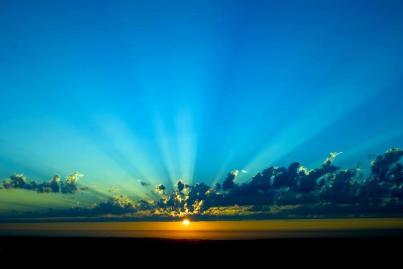
Light rises in the east,
the sky a blush of orange and pink
to greet the earth with morning.
Winter’s peace yields
to the cleansing spring,
the melt of mountain snows
swelling the rivers
with the joy of high water.
This may be a season like no other
when fear is swept from the land,
the corrupt in a flood of purification.
The gods of earth and sky
have only rested,
the season of renewal
coming like the dawn.
Those who love will love still
as the long genuflection to death
is forgotten beneath surging waters.
The sun has not forsaken us
nor the earth our humble prayers.
Let us rise with the light
and take a breath of the redolent air.
You’re not mistaken,
it is the taste of freedom.
Until my next post,
Be love. Be loved.
Anthony
tpal70@gmail.com

 IT IS SAID THAT FOOLS RUSH IN where angels fear to tread . . . and so it may well be. The self-active mind foolishly speculates about reality. The Christened mind walks gingerly but confidently upon this sacred ground with humility and intent to offer insight and blessing. Emerson said it more poetically:
 That’s my take-away after reading chapter 11 of Robert Lanza’s insightful book BIOCENTRISM, “Space Out.” Following up on my

 THE SECOND HALF of the ninth chapter of BIOCENTRISM — How Life and Consciousness are the Keys to Understanding the True Nature of the Universe, authored by globally respected scientist Robert Lanza, MD and renown astronomer Bob Berman, delves into the perspective of a likely pre-existent universe in an indeterminate state of formless, vibrationless wave of potential, possibility and probability — and the necessity, therefore, for a universe that accommodates and supports both life and consciousness . . . simply because of the need for an observer to collapse its wave-function and bring the universe out into particle-form reality.


 AS AN ENGLISH LITERATURE STUDENT, I loved poetry that took me to the heavens. I wrote my first and only sonnet about “A myriad of worlds and worlds of heavenly dust, In splendor clad with awe-inspiring grace.” We had to memorize this poem by Victor Hugo, in French, and all I can recall today is the caption under the picture above. I found a translation of this first line of the second stanza on Google search. I just had to share this fond memory from seminary days.
 I WILL CONTINUE from where I left off in the
  GOD DID INDEED CREATE the Universe out of nothing. In fact, we’re creating our worlds out of nothing all the time, that is according to quantum physics theory and biocentrism. Atoms, the invisible, intangible and essential energetic building blocks of the visible, tangible, material world of creation are not “things.” They are nothings from which all things are made. It is, therefore, accurate to say that God created the Universe out of nothing. What God did do, according to the Genesis story of Creation, was speak a command “Let there be light” and the Universe proceeded to unfold out of light.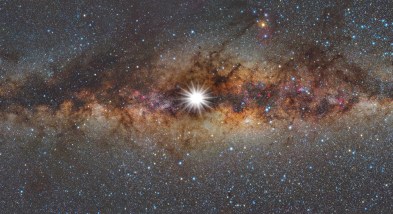
 THIS ENTIRE CONSIDERATION reminds me of something a scientists once concluded at the end of his article: “We may never find the seat of consciousness, because what we are looking for is who is looking.” An axiom of ontological studies is “A state cannot observe itself.” If you can see it and observe it, then it isn’t you, no matter how close it is to you or how pleasant or unpleasant. We really can’t “work on ourselves.” We can only work on changing our expression and our behavior, as well as our opinions and beliefs about ourselves. The truth of you is that you are perfect, made in the image and likeness of the Creator — which fact makes you a creator who has a free will and choice about what you will create. We cannot change who we are, nor escape the responsibility for our creations. We are who and what we are: a Human Being — a creator Being incarnate in a Human form, come here from the Creator in the Heaven to create beauty on the Earth. These words by my spiritual mentor, the late Martin Cecil, shared by Jae Hyoung Lee on Facebook today, express this truth in a more specific way:
 Healing Tones