Creating the New Earth Together

Archive for the ‘Man-Woman Relationship’ Category

Status

Masculine-Feminine Energy, part III: A Balancing Act

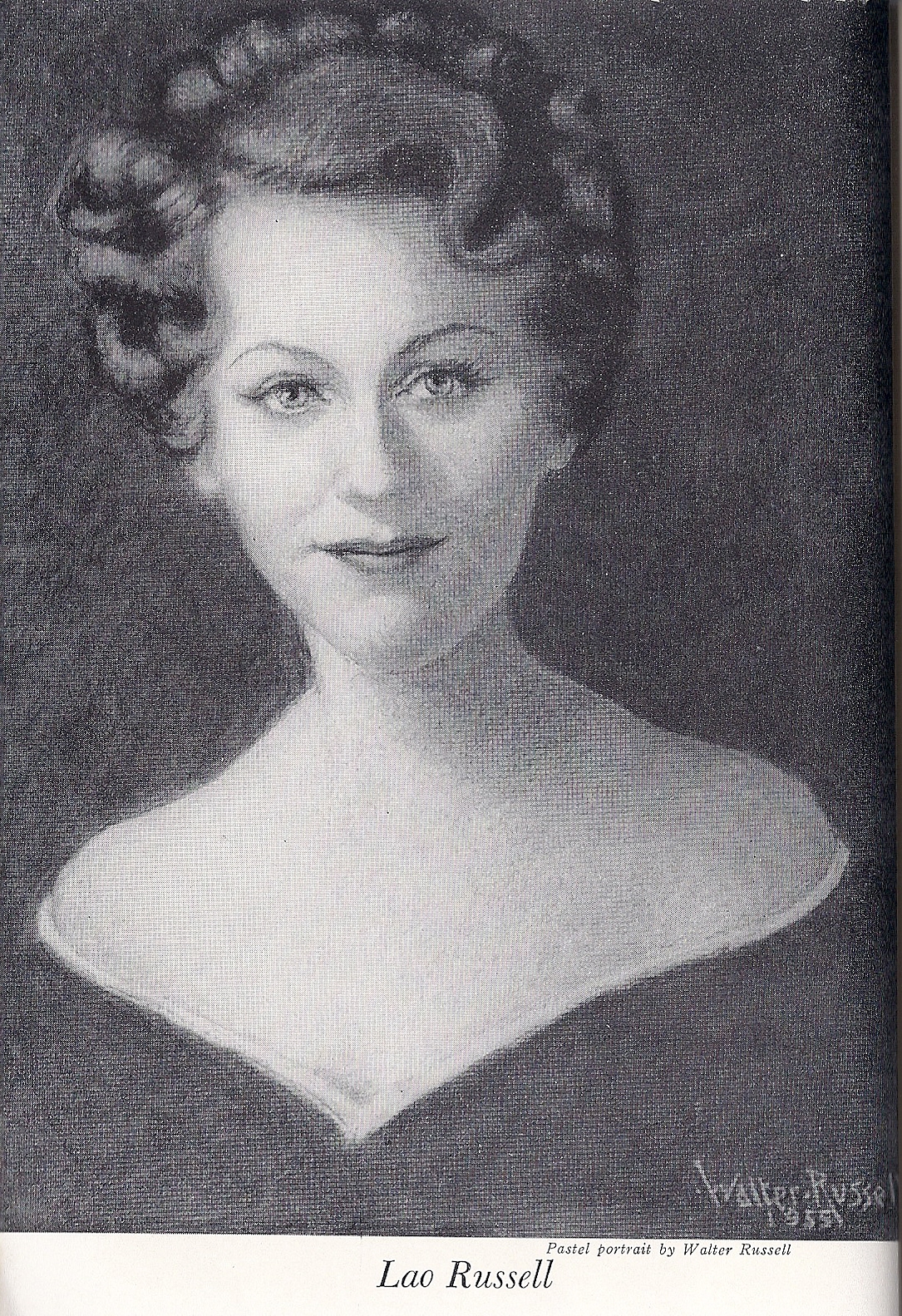
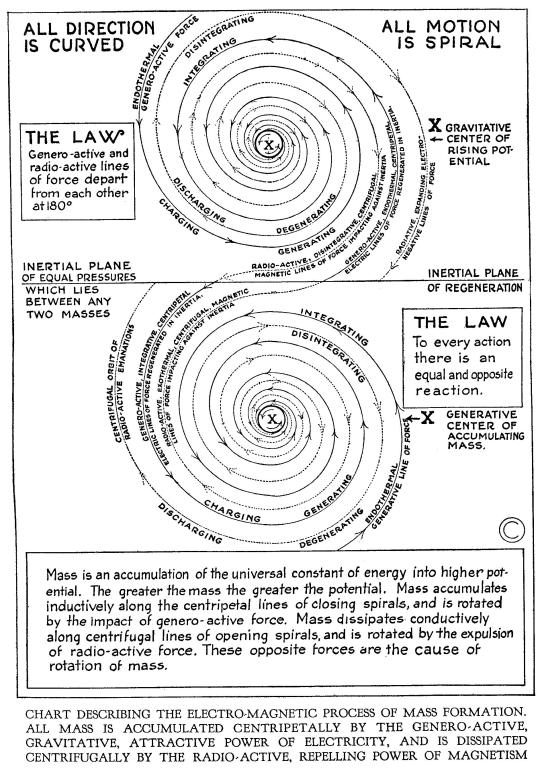
Masculine and Feminine forces balance one another in the “Creating Universe” of Walter Russell.  In this third post of the current series, he expands his consideration of electricity and magnetism to include the balancing act performed by the masculine and feminine forces.  I shall excerpt this chapter in its entirety, along with graphics, from his 1927 signature work THE UNIVERSAL ONE.

(Note: you can open the graphics in a new tab by right clicking on the image for a drop down window and a bit larger image. Also, all underscores are mine.)  

CHAPTER IV

POSITIVE AND NEGATIVE ELECTRICITY

Again it must be repeated that in this universe of motion-in-equilibrium all energy equalizes itself in two equal and opposite swings of the cosmic pendulum, no matter where in the cycle those opposites of motion appear.

The cosmic pendulum swings forever between positive and negative electricity, eternally transferring its constant of energy from one dimension to another, but never changing that constant.

The opposing energies of the two swings, added together, make one equalized unit of the universal reproductive constant.

More than this, these opposing swings are simultaneously equalized at corresponding points in each of the ten octaves.

Electric action and its magnetic resisting reactive flow are simultaneous and in equilibrium at all times.

Positive electricity is an endothermic, contractive force which is actively absorbing a comparatively large quantity of generative light units of heat which raises its potential, and is expelling a smaller number of them, devitalized into magnetic radio-active emanations, thus slightly lowering its potential.

Negative electricity is an exothermic, expansive force which is reactively absorbing a small quantity of generative light units of heat which slightly raises its potential, and is expelling a greater number of them, devitalized into magnetic radio-active emanations, thus lowering its potential.

In the term “negative electricity,” the word “electricity” is used in the generic sense, as the inclusive word “man” is used to represent both sexes.

Electro-positive systems are preponderantly charging systems, while electro-negative systems are preponderantly discharging systems.

Charging systems are in the positive half of the octave, the tones of which are generatively dominant. These systems are forcing magnetism out, and because of this they grow more compact. They therefore grow smaller, tone by tone to the fourth tone of the octave. Their atomic volume lessens and their density increases as magnetism is squeezed out, just as a sponge lessens in volume and increases in density as water is squeezed out.

Now must it be clearly understood that magnetism, expelled by electricity from within a charging system, did not enter that system as magnetism or as negative electricity. It entered as positive electricity and became devitalized into negative electricity by nucleal absorption of its positive charge. It was then expelled from the higher inner pressure to the lower outer pressure of the system.

Discharging systems are in the negative half of the octave, the generative tones of which are weakened. Weakening genero-activity results in weakening radio-activity which causes the systems to grow less compact. They, therefore, grow larger, tone by tone, from the fourth to the master tone. Their volume increases and their density decreases as magnetism is allowed to return, just as a sponge increases in volume and decreases in density as water is allowed to return.

By a study of the charts, pages 17, 83 (See chart), it will be seen that when magnetism returns to negative systems it does not return as negative electricity. It impacts against the inertial plane between itself and the system, is regenerated and reconverted into negative electricity after it has made its centripetal journey to the apex of its spiral orbit with ever increasing pressure, and started on its centrifugal run with lowering pressure back to the inertial plane.

Charging systems are simultaneously discharging but their positive charges become increasingly preponderant and dominant until the consequent increase of potential changes the dimensions of the system. They then appear to be another substance.


Discharging systems are simultaneously charging, and their negative discharges become decreasingly dominant until the consequent lowering of potential changes their dimensions. When they have readjusted their various dimensions, they in their turn appear to be another substance.

Charging systems are preponderantly generative, male systems, while discharging systems are preponderantly radiative, female systems. Charging systems are exactly balanced by discharging systems.

For example, exercise discharges energy. It is thus a female activity. At the same time it triggers an increase in muscle mass, a male activity of contracting energy, which in turn radiates discharged energy, a female activity — and the cycle is ongoing, one force giving itself to and empowering the other.  My young son used to say “Let’s go for a walk to get some energy” — and he was right-on.  While we expend energy exercising we increase the potential of our core energy. One can also think of this as the “Breath of Life,” which is twofold in its function and activity: inhaling and exhaling.  But it’s one breath.

TEN OCTAVES OF SEVEN TONES 

All systems are divided into seven tones of energy.

One charging tone, and its exact mate in a discharging tone, balances as one unit constant of energy.

There are four exactly equal unit constants of energy in each octave.

An octave is one universal reproductive constant. Ten octaves constitute one cycle.

Tone 1+ is a charging system exactly balanced in all its periodicities by tone 1−.

Likewise tone 2+ is balanced by tone 2−, and tone 3+ by 3−. Tone 4± is a double tone which is neither positive nor negative. It is bi-sexual.

These seven tones of four unit constants make up the total universal constant of energy which is omnipresent throughout the entirety of this universe of Mind.

Consider, for an example of positive charge attracting positive charge, the sun of our solar system.

It is the nucleal center of this system, the point of maximum positive charge. It is therefore the high potential point of the system.

Consider this planet. It is a doubly charged mass, which means that it is both positive and negative.

Its preponderance of positive charge is always toward the nucleal center, which means that it is always toward the light.

Its preponderance of negative discharge is always away from the nucleal center, which means that it is always away from the light.

The positive charge of this planet is therefore preponderant in that portion which is in daylight and the negative discharge is preponderant in that portion which is night.

The daylight portion of the planet is generative and endothermic, which means active, contractive and heat absorbing.

The daylight portion is that in which the potential is increasing, where flowers open their petals and relive, where life is regenerative and wide awake.

The dark portion of the planet is radiative and exothermic, which means inactive, expansive and heat expelling.

The dark portion is that in which the potential is lowering, where flowers close their petals and become dormant, where life is devitalized and fast asleep.

Well, not all of life is dormant at night, as one reader pointed out in a recent comment. There are flowers that open at night only. The Moonflower comes to mind, as well as Four-o-clocks, the Evening Primrose and Casablanca Lily.  One may well explore as to whether nighttime bloomers are female plants and daytime bloomers male. All flowers are Mother Nature’s creations using Father Sun’s energy. Unlike in man’s world, there is no competition in the Natural World of the Creating Universe. There is only cooperation, co-creation, and beauty.

Russell explains how the light rays and heat of the sun do not travel to the planets directly but pass trough a very dark and cold space on their way to the surface of our earth, for example. In other words, we do not feel the heat of the sun directly. This is fascinatingly rectifying of common belief and orthodox thinking.  

Just so with all of the other planets.

The positive charge moves around them as they revolve, ever keeping as near as possible to their positive nucleus, the sun.

It is a well known fact that high potential discharges into lower potential.

Consider the radiative rays of the sun as negative light units expelled by positive contraction, which forces them to seek lower pressures and lower potential.

It might be argued that these negative rays are attracted by the positive charge of the daylight portion of the planet.

Consider the law of pressures as stated elsewhere which says that between any two masses is a line or plane of equalized pressures.

As the light units which constitute the rays circle spirally and centrifugally around the sun in their search for lower pressures exactly as this mass of light units which is our planet circles around the sun, they continue to expand and become increasingly negative the farther they recede from the sun.

It must be interpolated right here that “light rays” do not proceed directly from the sun to a planet in straight lines. They follow the orbital lines of lowering pressures exactly as does this planet.

All direction is curved and every curve is a part of an orbit.

When the light units which we familiarly term “light rays,” reach the inertial plane of equalized pressures between the mass of the sun and the mass of this planet, their expanded masses impact against it and continue beyond it in an ever increasing state of solidity.

These expanded, negative particles which have reproduced themselves in transit then become positively charged as they impact with, and plunge gravitatively through the pressures which increasingly rise as they near the mass of this planet.

Eventually they impact against the planet as positive charge attracted toward another positive charge. The potential of each is increased by this impact and the heat generated by magnetic resistance to the impact is absorbed as accumulated energy until it becomes devitalized and is released by the turn of the planet away from the light.

For another example, consider the familiar lightning flash which we know as “forked lightning.” Lightning is a highly generative, positive charge seeking its own pressure and potential.

The maximum positively charged high potential and high pressure of this planet is that part which is nearest its center.

Lightning and all the forks of lightning are gravitative. They always seek the planet. Never do they proceed in the opposite direction toward negative discharge except in rare instances where a minor charge leaps upward toward a cloud of higher positive charge, or higher potential.

This latter effect is exactly analogous to that of an iron nail leaping upward toward a magnet.

Lightning seeking its own potential and an apple falling to the ground are effects of exactly the same cause. Gravitation is the cause of each.

Each is taking a “short cut across lots,” through intervening pressures, to find its equal pressure.

Later it will be seen that the cause of rotation and revolution, together with all of their respective variations and periodicities, can only be solved through the understanding that positive charge attracts positive charge, and negative discharge repels both positive charge and negative discharge.

Well, there you have it – or maybe you don’t and have to read it a couple of times, as I had to. In my next post, I will attempt to apply all this newfound knowledge to our experience and handling of our masculine-feminine creating energy.  This will admittedly be a challenge — and I do have a dawning sensing as to how I will proceed in such a delicate thinking process, especially in the wake of a recent in-depth and insightful conversation my wife and I had with one of our sons and his wife during their richly nourishing visit from Ashland, Oregon, this week — a couple who, for me, exemplify the grounding of masculine-feminine energy in the dance they do together in their shared creative field. We shall see how this unfolds in my final post of this series. Until then, 

Be love. Be Loved.

Anthony 

tpal70@gmail.com

Masculine-Feminine Energy, Part II: Opposing Forces

It is not the negative “charge” of the female which is attracted to the positive charge of the male, but rather the positive charge of each attracts the other.” (Walter Russell)

In his comprehensive work and captivating book THE UNIVERSAL ONE, Walter Russell lays out a scientific foundation for understanding how the “Creating Universe” works energetically. In sharing excerpts from his book, my hopes and intentions are to offer insight into the way we see and experience out sexuality. We incorrectly identify with our male and female genders, saying “I am a man” or “I am a woman.” However, these are not our identities. On the physical plane of life, the words “male” and “female” identify the gender of our human capacities. But we are not our human capacities. We are Human Beings inhabiting these earthen forms, endowed with mental, emotional and spiritual capacities for the expression of our creativity.  
Russell says we are “creating” human beings, and the energy that empowers our creativity is twofold in nature: masculine and feminine.  However, it is One energy, not two different forces. It is the energy of the Universal One — what Russell calls “Mind” (with a capital “M”) throughout his book, and what we have come to call “God.” This energy moves in two different and opposing directions: inward and outward, toward and away from the apex of a spiraling vortex of creating energy.  On the spiritual level, the words “masculine” and “feminine” identify the nature of our singular creating energy. Note that I use the singular “energy” with a hyphen between the words masculine and feminine to call attention to this reality of singleness. 

In this post, I share Walter Russell’s explanation of the opposing manner in which this singular energy moves and interacts within itself as it creates and dismantles form through a creative process. I find this explanation, and all of Russell’s thought processes and concepts, both fascinating and rectifying. I hope you do as well. (Tip: if you don’t understand what he’s saying, just keep moving as he’ll say it another way the next few lines.) So, with no further ado, I give you the genius himself, Walter Russell. 

TWO APPARENTLY OPPOSITE FORCES

Walter Russell

It must be remembered that electricity is the attractive force and that magnetism is the repellant force. The attractive force attracts only attractive force, which is itself.

Electricity attracts electricity. Electricity does not attract the repellant force.  Neither does electricity repel the repellant force.

On the other hand, magnetism, which is the repellant force, does nothing but perform its function of repelling. It does not attract itself. A repellant force cannot be an attractive force, nor can the attractive force be a repellant force.

Each can but fill its own office; one attracts, and thus gathers light units together into an appearance of solids of matter. The other repels, and thus pries light units apart into the dissolution of solids of matter, into gases and vapors.

Magnetism is that force within the universal Mind substance which tends to preserve the Oneness of universal uniformity.

Magnetism desires a formless and dimensionless universe, just as electricity desires a universe of form and dimension.

Magnetism prevents the apparent separation, or division, of divine Mind into parts as electricity attempts this apparent separation.

All the force of electricity is exerted in the attempt to create the illusions of form and dimension.

All the force of magnetism is exerted in the attempt to destroy all illusion, all form and all dimension.

Neither force completely fulfils its desire, for each partially thwarts the other.

The energy of magnetism is the elastic energy of expansion, a straining energy ever pushing toward the inertial line of equalized pressures which lies between any two masses, while the energy of electricity is ever pulling toward the pulsing heart, the gravitational nucleus of every mass.

ELASTICITY

One of the outstanding characteristics of motion is elasticity which also appears to be an attribute of the One substance.

Elasticity is due to opposition.

Elasticity is that force developed in the One substance of Mind as a reaction to the action of electricity.

It is this quality of elasticity which gives magnetism its rebounding force.

This elastic, magnetic reaction which is forever and eternally pressing against electric action, is that force which surely restores all opposed motion to inertial equilibrium.

Imagine electricity as a compressed spring, with magnetism eternally ready to take advantage of any let-up in the contractive force which is holding it in compression, no matter how slight a relaxation that may be.

If one could imagine such a thing as an absolutely complete and sudden withdrawal of all electric contractive energy, the instantaneous response from this elastic counter pressure would cause a cosmic explosion which would instantly destroy all appearance of form. The universe would then be one of equalized pressures, and opposed motion would be at an end.

This sudden expansion is exactly what occurs when man combines two or more elements which desire to get away from each other because they are tonally too far removed from each other to be possible mates. The elasticity of magnetism takes advantage of the sudden letup in the process of generation and rebounds so swiftly that it instantly tears apart form which otherwise might take a million years to disintegrate.

It is this force of elasticity in magnetism that is constant in its resistance to any appearance of integration into any form whatsoever.

ELECTROMAGNETIC OPPOSITION

Magnetism is radiative and repellant, as electricity is gravitative and attractive. Magnetism repels, electricity attracts.

That which electricity integrates through gravitation, magnetism disintegrates through radiation.

Magnetism is the brake upon the wheels of electricity resisting its generation of higher potential and registering that resistance in heat.

Electricity is the accelerator which speeds magnetic radiation, the expansion of which is registered in cold.

Electricity and magnetism are actually opposing forces which leap away from each other in exactly opposite directions.

Forces which depart one from the other do not attract each other.

Opposing forces oppose each other.

To say that positive charge and negative discharge attract each other is to say that electricity and magnetism attract each other.

This would be equivalent to saying that centripetal force attracts centrifugal force, or that generation attracts degeneration, or that a charging body attracts a discharging one.

One might as appropriately say that life attracts death.

Electricity and magnetism are opposites, and opposites move in opposite directions.

One is accustomed to thinking that male, which is preponderantly positive, attracts female which is preponderantly negative.

It is not the negative “charge” of the female which is attracted to the positive charge of the male, but rather the positive charge of each attracts the other.

In youth, when the attraction of opposite sexes is at its maximum, the positive charge of each sex is at its maximum.

In age the negative discharge increases, the disintegrating magnetic force dominates, the positive charge decreases, and as a result the attraction of each sex for its opposite decreases until it disappears and repulsion takes its place.

The apparent attraction of each action to its reaction is due to the desire of the active force within each for accumulation, and the consequent continuance of the evolving idea of itself through that accumulation.

When action is preponderant as positive charge, form of idea evolves. When reaction is dominant as negative discharge, form devolves. The record of the idea of both action and reaction is registered in inertia.

The chemist, when breaking up compounds, is accustomed to seeing a negative element seek the positive pole, and a positive element seek the negative pole.

He would know better how to interpret this if he would think of his elements in terms of sex, and also consider the process of regeneration of negative discharge by impact against the inertial plane between a discharging and a charging mass.

When the positive charges of negative reactions are attracted to positive poles, centrifugally dominant force is conquered by centripetally dominant force. The negative reaction then becomes a positive action. The equalization causes reproduction. The union of an action with its reaction is always followed by the reproduction of separate actions and reactions. These reproduced actions and reactions are rebounds of the union.

Magnetism opposes electricity in its desire to transform this universe into one solid, motionless, non-elastic ball of positive electricity. Electricity opposes magnetism in its desire to transform the universe into one of equalized pressures where opposites disappear into dimensionless non-opposition, Positive electricity is preponderantly electric. Positive charge attracts positive charge.

Negative electricity is dominantly magnetic. Negative discharge repels both negative and positive charge, for both are electric and magnetism repels electricity.

Again must it be written down that electricity and magnetism are not opposites, nor are they two forces. There are no opposites of anything in this universe of the One Thing.

Mind is the One substance. Thinking Mind is the One force.

If Mind were not a thinking substance the universe would be without force. It would be without life. It would indeed be a dead universe.

Thinking is a positive action. To every action there is an equal reaction which is the opposite or negative matrix, of that action.

The minus charge of the reactive negative matrix is equal to the plus charge of the active positive form of idea.

The positive form of an idea is stored in inertia as a negative matrix of that form.

There is but One active force of thinking Mind and that is the father force. Man calls it electricity.

Electricity appears as the first action of the process of thinking and disappears, like temperature, in motion-in-inertia.

Electricity therefore has no existence. It belongs to motion, and not to substance.

It is desire which causes the One substance to appear to change in state as it performs its function of recording form of idea.

Opposites are born of attempted division of unity or Oneness.

The very first action which attempts division of unity develops the reactionary apparent opposite reaction which opposes that attempted division.

The father force, acting upon the desire of Mind to create, finds that as Mind is the only substance, idea and its form must be developed out of that One substance of Mind.

The father force which is the image making faculty of Mind, proceeds to create idea and then to fashion the form of that idea out of the One substance.

The opposing magnetic force is then born to prevent the fashioning of the substance of Mind into form. For a time it vainly opposes such formation, but eventually it succeeds.

Electricity and magnetism are the two major dimensions of the universal constant of Mind.

Therefore the beginning of creation is the beginning of an attempted separation of the One substance by the One force of the substance.

The very attempt to divide the One substance gives the appearance of, but does not make, two substances.

It only develops two equal and opposing states of motion which man calls “forces.” It but creates two illusions.

Part of the energy used in the attempted division into two is given to each, and the sum total of this energy is the exact amount of the energy of the One.

Electricity and magnetism are attributes of motion only and as separate entities they are but illusions of the substance of matter.

Form, or solidity of matter, is an electromagnetic record of states of motion. Therefore solidity of matter is but an illusion which is measurable by electro- magnetic dimensions which, in themselves, are but illusions.

Out of the father force then, is born the mother force, which man calls magnetism. The symbolism of the creation of Eve out of Adam is basically sound.

The father force creates all idea and gives it the appearance of form; but that idea cannot be perpetually held as idea in the appearance of form, nor can it be reproduced without the union of the father with the mother force from which the father force has parted and with which it makes an equilibrium of unity.

Both idea and the form of idea return to motion-in-inertia as memory and remain there for a time as formless idea.

A union of the father force with the mother force brings it back again into the form of idea, for the united energies of these apparent opposites make the total required by the One.

Just so with positive electricity and negative electricity. They are not two forces. They are but two aspects of One force attempting to separate, each by its own opposite method, thus becoming two forces.

They never succeed in so doing. Each is charged with the other, permeated more or less in accord with its periodicity.

I love the dynamic creative tension he describes between these two opposing aspects of the One force.  I hope I am making us think outside the traditional box of scientific knowledge.  In my next post we’ll see how these two opposing forces balance one another. Until then,

Be love. Be loved.

Anthony


“Fifth Way” Love: A Romantic Path to Transformation

I will open this post with the excerpt from Cynthia Bourgeault’s signature work, The Meaning of MARY MAGDALENE – Discovering The Woman at the Heart of Christianity – with which I closed my previous post, and will continue quoting her commentary in its entirety. She quotes here a passage from the Gospel of Philip:

“The one who creates objects works outwardly in the external world. The one who labors in secret, however, works within the icon, hidden inwardly from others. The one who creates makes objects visible to the world. The one who conceives gives birth to children in the Realm of the Unseen.”

In this complex distinction . . . Philip insists that begetting must come “from above”. . . .  It requires a free and conscious regeneration in the Spirit. “Begotten” is an alchemy in which spirit actively participates, and its fruit is the anthropos, or completed human being. 

THE SPIRITUAL KISS THAT BEGETS

From Philip’s point of view, then, lineal descendents of Jesus, even if they existed, would not be “anointed ones,” unless this claim were to be validated by their own spiritual transformation. The kingdom over which the Anointed One reigns is beyond the space/time continuum and cannot be inherited lineally (that technicality consistently overlooked in the literal-mindedness of The Da Vinci Code); it can be entered only by becoming a new kind of human being–what Philip actually describes as “a new race of human be­ings . . . . Only true sons and daughters can gain immortality,” he writes in analogue 56, “and no one can gain it without becoming a true son and daughter.” Progeny cannot be fashioned out of flesh and blood; they are the fruit of an alchemy of consciousness.

Philip makes it clear that this is the kind of spiritual procreation that Mary Magdalene and Jesus were chiefly about. As we discussed in chapter 10, his symbol for this type of richly engendering spiritual love is the kiss, which (as is universally the case throughout the Near Eastern culture) is seen as a sign not of sexual attraction but of spiritual begetting. When he indicates in analogue 37 that “the Master loved her more than the other students and many times would kiss her on the mouth,” he is not describing an illicit romance but rather a sacred exchange of their deeply commingled beings. The spiritual kiss is the symbol par excellence of Fifth Way love.

From a Fifth Way standpoint, this kind of intense and trans­forming love, “which is really the birth-pangs of union at a higher plane,” will indeed bear fruit. But the fruit may not be human children so much as an energetic sphere of pure creativity, in which reality is touched at the core and love itself is the progeny.

As analogue 66 points out, “The one who creates objects [i.e., literal offspring] works outwardly in the external world. The one who labors in secret, however, works within the icon, hidden in­wardly from others.” In other words, the work goes on at the imaginal (or causal) level, and its potency is made manifest not by producing new people but by engendering transformed people­ giving birth to children “in the Realm of the Unseen,” in the words of the text. (Underscores mine)

“FIFTH WAY LOVE”:  AN EROTIC PATH TO TRANSFORMATION

The “Fifth Way” is a spiritual path based on relationship. Cynthia Bourgeault calls it “conscious love” rather than “tantric love” so as not to put a stumbling block before her parishioners. She is an Episcopal priest whose passion is to restore the romantic love affair between Jesus and Mary Magdalene as the center piece at the heart of Christianity. The term itself is a deliberate spin-off from George Gurdjieff’s “Fourth Way,” the “Way of the Conscious Man.” Boris Mouravieff (d.1966), a little known Russian esotericist who studied Gurdjieff’s system intimately, coined the phrase and used it in his three-volume Gnosis to represent “courtly love as a spiritual path and of the way of transformation through mystical union with one’s ‘polar being.'” Cynthia’s comment:

“While he [Mouravieff] stops short of saying that Jesus and Mary Magdalene practiced this path, he makes it clear that its headwaters lie deep within the marrow of Christianity itself, and he insists that it represents “The purest and most sublime realization of the Christian spiritual path.” 

THE “SONG OF SONGS”

More commonly known in Protestant circles as “The Song of Solomon, Bourgeault associates this erotic book of the Old Testament Bible with Mary Magdalene, seeing it as an ancient testament to the practice of “Fifth Way Love.” I will share my favorite passage from the Biblical texts and then offer a commentary on it. The song opens with the kiss that begets love:

The song of songs, which is Solomon’s. Let him kiss me with the kisses of his mouth: for thy love is better than wine. 

Because of the savor of thy good ointments thy name is as ointment poured forth, therefore do the virgins love thee.

Draw me, we will run after thee: the king hath brought me into his chambers: we will be glad and rejoice in thee, we will remember thy love more than wine: the upright love thee…. 

The voice of my beloved! Behold he cometh leaping upon the mountains, skipping upon the hills.

My beloved is like a roe or a young hart: behold, he standeth behind our wall, he looketh forth at the windows, shewing himself through the lattice.

My beloved spake, and said unto me: “Rise up, my love, my fair one, and come away.

For, lo, the winter is past, the rain is over and gone; the flowers appear on the earth; the time of the singing of birds is come, and the voice of the turtle is heard in our land;

The fig tree putteth forth her green figs, and the vines with the tender grape give a good smell.  Arise, my love, my fair one, and come away.

Our winter is currently at the door in mid October, not a time to be leaping and skipping. Perhaps, then, we could see this passage metaphorically as describing the nature and character of Life itself and of the Beloved who abides within us each one, peaking out through the windows of our eyes and showing himself through the lattice of our veiled and guarded hearts. The Beloved is always there, “standing behind our wall,” when our world gets dark and seemingly impossible to navigate.  Always there to turn to for assurance that all is well and as it should be. Always there to love in passionate embrace and simply say: “I love you with all of my heart, with all of my mind, and with all of my body. With Solomon I sing . . .

Place me as a seal on your heart, as a seal on your arm. Strong as Death is love; intense as Sheol is its ardor. Its shafts are shafts of fire, flames of Yah (Yahweh). Deep waters cannot quench love, nor rivers sweep it away.”

AN UNLIKELY BIBLICAL TEXT

Like Mary Magdalene herself, the Song of Songs has had a long his­tory of both admirers and detractors. It has been called, with some justification, “the most unbiblical book in the whole Bible,” and there are those who feel that its inclusion in among the wisdom writings of the Old Testament was a grand mistake. But others see it as nothing short of scripture’s mystical highpoint, an inexhaustible fountainhead of beauty and spiritual wisdom. Among this latter group was Rabbi Aqiba (d. 135), one of the most influential of the early rabbinic commentators, whose celebrated words eventually carried the day: “All the ages are not worth the day on which it was written for all the writings are holy, but the Song is the Holy of Holies.”

At the heart of all this consternation, as you might expect, is the fact that this text is a love song–and not just a mild-mannered, “spiritual” love song, but an unabashed celebration of erotic pleasure. From its opening salvo, “Let him kiss me with the kisses of his mouth,” to its parting affirmation, “Love is as strong as death,” it never breaks stride, In eight canticles of stunningly evocative imagery, it sings the glories of carnal desire in exquisite and scintillating detail. 

KENOTIC LOVE

Kenosis is the act of emptying oneself, a characteristic applied, by Paul specifically, to the path that Jesus took in his life of service. It was the path Mother Theresa took and other saintly souls.  Cynthia writes: 

As Paul so profoundly realizes, self-emptying is the touchstone, the core reality underlying every moment of Jesus’s human journey. Self-emptying is what  brings him into human form, and self-emptying is what leads him out, returning him to the mode of glory. The full realization of Jesus’s divine selfhood [our divine Selfhood] comes not through concentration of being, but through voluntary divestment of it. . . . Stripping oneself and standing naked: this is the essence of the kenotic path.

KENOSIS IN THE FIFTH WAY

We have already seen that kenosis is the tie-rod of Jesus’s entire teaching, connecting the inner and outer realms of our human experience in a single, unified gesture. “Greater love has no man than to lay down his life for his friend” (John 15:13) is one of his most celebrated dictums. But when that “friend” happens also to be one’s uniquely beloved, one’s romantic partner or spouse, kenotic practice takes on a particularly intense and even a sacra­mental character. This is because the root energy it works with is the transformative fire of eros, the energy of desiring. That messy, covetous, passion-ridden quicksilver of all creation is tamed and transformed into a substance of an entirely different order, and the force of the alchemy accounts for both the efficiency of this path and its terrifying intensity.

Vladimir Solovyov, that great nineteenth-century philosopher of love, was among the first to grasp the enormous implica­tion of this point, which defines both the modality of the Fifth Way and its ultimate destination:

The meaning and worth of love. .. is that it really forces us, with all our being, to acknowledge for another the same ab­solute central significance which, because of the power of our egoism, we are conscious of only in our own selves. Love is important not as one of our feelings, but … as the shifting of the very center of our personal lives. This is characteristic of every kind of love, but predominantly of sexual love [erotic love]; it is distinguished from other kinds of love by greater intensity, by a more engrossing character, and by the possibil­ity of a more complete overall reciprocity. Only this love can lead to the real and indissoluble union of two lives into one; only of it do the words of Holy Writ say: “They shall be one flesh,” that is, shall become one real being.

In the path of “Fifth Way Love,” as Cynthia Bourgeault presents it in her book, and as she portrays the intimate companionship of Mary Magdalene and Jesus, the eros is transformed and transmuted to a higher level so as to become an erotically ecstatic bridge between the physical and the spiritual worlds, making the oneness of heaven and earth an actual and tangible experience.  The ultimate transformation takes place between “polar beings” who become one blended substance, so that one cannot tell where the boundaries of one’s own body stops and the other’s begins. For there is no “other” and no boundaries. There is only the One I Am.  

We will shift gears in my next post, leaving the realm of the “Holy of Holies” to explore the mysteries of the Universe–as Walter Russell understands and explains them anyway. We are in for a profoundly intellectual roller coaster ride. So, sharpen your mental focus before you read my next post. The theme will remain in the domain of the masculine and feminine energies at work within us and throughout the illusory universe.  Until then,

Be love. Be loved.

Anthony     (tpal70@gmail.com)

And the “Rock” Comes Tumbling Down


It was inevitable. Founded, not on the solid rock of Truth, but on the quicksand of fabricated lies and deception, along with redactions of scriptures, the Church of Rome is teetering on the edge of utter collapse – its existential crisis being triggered by cumulative disclosures of the irreparable harm its clergy has inflicted upon innocent children over the decades. 

(Note: a redaction is done when a scribe or editor replaces what is written with what he/she understands it to say rather than what it actually says; to slant or frame its meaning or simply remove the text before publication or release.)

Suppression of women at the core

The suppression of women is at the core of this crisis. By denying and suppressing women – and thereby the Divine Feminine – which it has done since its inception – the Catholic Church has denied and shut out the Holy Spirit. For the Holy Spirit of God is the Divine Feminine, as we considered with excerpts from The Gospel of the Beloved Companion in my previous post

I wrote about this current “breaking news” and disclosure of the criminal activity on the part of Catholic clergy and the cover-up by the Catholic hierarchy, all the way up to the “Holy See” in the Vatican, back in the 1990’s when I was creating the first draft of my book Sacred Anatomy.  Under the chapter heading “Sacred Sex” and subheading “The Holy Grail” I wrote:

The suppression of the mysteries of feminine sexuality may well be at the root of the scandalous turbulence we are witnessing today in the Catholic Church relative to pedophile priests. Thwarting the natural design and purposes of life for human beings can only lead to distortions in behavior. The Divine Feminine cannot be left out of human experience without repercussions. She will find her way into human relationships at the most intimate levels without respect to gender, and those who attempt to deny Her will find themselves seeking union with Her in the shadows of deviant behavior with the same irresistible passion that drives them to seek union with the Divine, for She is divine.

Historically, the Feminine Principle was once the centerpiece of much controversy and, as we have noted, persecution–strangely enough focused in a hatred and fear of midwives who posed a threat to the status quo of civilized decency because of their knowledge and skills in minimizing the pain in childbirth, when painful childbirth was taught by the Church to be the punishment for original sin. During the early centuries of the Christian era, women’s sexuality was regarded with fear. Knowledge of the secrets of the Feminine was considered to be so fiercely powerful that it posed a unique threat to Christian thinking and to the authority of the Church itself. This gave rise to the atrocities perpetrated by the Church against the Cathars during the Albegensian Crusades in thirteenth century France when over a hundred thousand, mostly women, were massacred.

Quest for the “Holy Grail”- The Divine Feminine

Like in the Arthurian Legend of the quest for the Holy Grail, in my opinion it is their own Divine Feminine, suppressed by their imposed vow of celibacy, that these pedophile priests seek to reclaim and have union with, a quality so expressive in young boys and girls. I myself was cuddled and molested by a priest when I was an altar-boy. My impression even then was that this Dutchman needed to be married and have children to love and wrestle with on the floor – or shower with, as one priest, my spiritual advisor no less, had me do while in seminary. I was fourteen then, and sexually fondled my very first day in seminary by a church deacon, who was directly relocated after I reported the incident to the Rector.  Weird stuff I thought back then. Not so weird as I see it today. The feminine and masculine energies belong together and function naturally when allowed to be together as equal partners in co-creation. Finding these dual energies in ourselves as individuals and allowing them to emerge and balance one another is a worthy spiritual path to take toward true Self emergence. To ignore this essential aspect of our Humanity can only lead to an eruption and take over of the shadow side of our human nature.  

Dissolution the only solution  

There is one solution to the Catholic Church’s crisis that could avert its demise: dissolve the dishonest foundation upon which it was built — the patriarchal “rock” of Peter, the apostle who openly despised women.  This could easily be done by the Church recognizing Mary Magdalene as the Apostle of apostles and the Beloved Companion of Jesus and sanction the Gospel of Mary Magdalene and the Gospel of Thomas by including them in the Codex of Holy Scripture – then by eliminating the Acts of the Apostles and all of Paul’s letters and gospels, basically eradicate Paulism altogether, which is what Christianity is in reality. 

The next step would be to allow priests to marry and have a family, just as the Episcopal Church does, and allow women to become priests.  Canon Law would have to be abolished along with all the laws that the Church has held over the heads of the faithful, including its dogmas relating to “original sin,” not mentioned once by Jesus, not even in passing as he admonished us to humble ourselves and become like little children in order to enter the Kingdom of the Spirit. He didn’t say “Oh, by the way, they have to be baptized to wash away original sin so they don’t end up in Limbo.” No, all that came with the Council of Nicea along with the doctrines of mortal and venial sin, punishment in hell and reward in heaven, along with its “Apostles Creed.” That all has to be abolished – in my humble opinion and righteous judgement anyway. 

In essence, the Church of Rome must undo itself as a legitimate entity sanctioned by God and established by Jesus.  The Vatican must be dissolved and liquidated, its enormous wealth distributed among the poor and those innocent ones its clergy has violated.  Following the undoing of the Roman Church, Christianity and all of its denominations need to be purged of all its fabricated doctrines and fear-based theology then renewed by adopting the Gospel of Mary Magdalene and the Gospel of Thomas as providing the true accounting of the life of Yeshua/Jesus and his message of love and compassion to the world. 

The Church of Rome, not of Jesus 

Christianity was established as the religion of Rome by the Emperor Constantine and the Council of Nicea in the fourth century AD, which laid down the infalible laws by which all professing Christians were to be governed.  This in contrast to the one law that was given by Jesus to his apostles: the commandment to Love the Lord our God with all and each other as our self. In fact, Jesus instructed them to make no laws other than the one He had given them.

Tell others of what you have seen, but do not lay down any rules beyond what I appointed you; and do not give a law like the lawgiver, lest you be constrained by it. (The Gospel of the Beloved Companion).

Such a sensible guideline and simple instruction he gave to those simple men and women as they set out to tell the world about what they had heard and seen.

What really went down after the crucifixion and resurrection of Jesus

What happened after the crucifixion and resurrection of Jesus is alluded to in the Gospel of Mary Magdalene. This excerpt follows on the heels of my previous post wherein I share Mary Magdalene’s account of what Yeshua/Jesus showed her in a vision of a great tree whose roots he said are in the earth of her body and whose trunk extended upward through the “five regions of Humanity to the crown which is the Kingdom of the Spirit.” This tree had eight boughs and eight gates, upon which she ascended and through which she entered respectively, eventually finding herself at the crown where she beheld the Spirit in the form of “a woman of extraordinary beauty, clothed in garments of brilliant white,” who embraced her and freed her soul from the world.

Sounds like a description of the Tree of Life embodied by the Seven Endocrine Glands and the seven chakras – of which there are thought to be eight or more. You can read what happened after that in my previous post

This is how the disciples reacted to what Mary Magdalene had told them of her encounter with their Rabbi:

Many of the disciples did not understand what she had said, and grumbled against her amongst themselves. Andreas therefore answered and said to the brethren, “Say what you wish to say about what she has said. I at least do not believe that the Rabbi said this, for these teachings are certainly strange and complicated ideas.”

Shimon Kefa (Peter) answered and spoke concerning these same things. He questioned them about Yeshua and said, “Did he really speak privately with this woman and not openly to us? Are we to turn about and listen to her? Did he prefer her to us?”

Then the Migdalah [Mary Magdalene] wept and said to Shimon Kefa, “My brother Shimon Kifa, Think that I have thought this up myself in my heart, or that I am lying about Yeshua? Only from the truth again I tell you that what I have said is the truth.”

And Levi answered and said to Shimon Kifa, “Shimon Kifa, you have always been hot-tempered. Now I see you contending against this woman like the adversaries. But if the Rabbi made her worthy, who are we indeed to reject her? Surely as his companion, Yeshua knew her better than all others. That is why he loved her more than us.

Rather, let us be ashamed and do as she says. Let us put on perfect Humanity and acquire it as she has done, and separate as he commanded us and preach the testimony of the Son of Humanity, not laying down any other rule or other law beyond that which he gave us.”

Here’s the clincher:

And when they heard this, they were divided, and argued amongst themselves. And therefore they began to leave separately, and go forth to proclaim and to teach what they understood of the words of the Rabbi.

“…what they understood…” and not what Mary Magdalene told them what Jesus had said. In other words, they refused to listen to a woman, even the very companion of their Master, who alone witnessed his resurrection from the dead and spoke to him “privately.” That was just too much humility for their male egos to yield to and take on.  And that moment was the beginning of the end of Christianity before it ever became the religion of Rome. It was doomed to failure.  And we are witnesses to that failure today, God help us. 

I will close with these words of the author of The Gospel of the Beloved Companion, Jehanne De Quillan – yes, a woman, no less and fittingly so:

My question is this: when will orthodox Christianity grow up? Surely it is time to put aside these antiquated, man-made principles, and start to look for the real treasure that Yeshua left us two thousand years ago–the Kingdom of God that lies within each one of us–a treasure that requires no pope, bishop, priest, pastor, or preacher for us to discover the treasure he defined in a single saying:

“…BE STILL AND KNOW THAT I AM…” 

Be love. Be loved.

Anthony

Read my HealthLight newsletter online at LiftingTones.com

For a copy of Sacred Anatomy, and/or for my recently published Third and Revised Edition of Attunement with Sacred Sound, simply email your request to me at tpal70@gmail.com.

On Human Relations . . . . part 6: The Path of Romantic Love, page 4

My Chorale PicIn chapter seven of her powerful book MARY MAGDALENE – Discovering the Woman at the Heart of Christianity, “Reclaiming the Path of Romantic Love,” Episcopal minister Cynthia Bourgeault paints a much different picture of the spiritual path Jesus walked than the one painted by Christian orthodox interpretations of the four gospels. Continuing from where we left off in the previous post, Cynthia speaks to the question “Were Jesus and Mary Magdalene lovers.” I will let you read directly from the final two pages of this chapter.

Having described Jesus’s spiritual path as being anything but celibate, an “enstatic” path of conserving pranic energy, Cynthia makes her case against traditional Christian concepts and beliefs to the contrary.

By contrast, the path that Jesus himself seems to teach and model in his life, and particularly in his death, is not a storing up but a complete pouring out. His pranic energy is quickly depleted; on the cross, as all four gospel account affirm, he does not hold out even until sunset, but quickly “gives up the ghost.” Shattered and totally spent, he simply disappears into his death. The core icon of the Christian faith, the watershed moment from which it all emerges, is not enstatic but ecstatic — love completely poured out, expended, squandered. In contrast to clarity, it is the arche­typal image of purity, the complete self-giving of the heart.

THE PATH JESUS WALKED

And right here, I believe, we come to the fundamental problem with these celibate models of transformation. It’s not merely their monochromatic viewpoint or the implicit devaluing of a whole other stream of Christian spiritual wisdom whose roots are in passionate human love. Rather, it is the fact that at key points they seem to be slightly out of kilter with the path of transformation that Jesus himself walked and taught. One might say that this model points us toward John the Baptist rather than Jesus: to­ward those ancient and time-honored practices of renunciation, asceticism, and self-concentration through abstinence, whereas if we really look closely, we see that Jesus himself seemed to be con­stantly pushing the envelope in the opposite direction — toward radical self-abandonment, reckless self-outpouring, and the trans­mutation of passion in complete self-giving.

But it is right there, at the center of that cognitive dissonance, that a window of opportunity opens up. Rather than trying to smooth it over and pretend it does not exist, as the church has done for nearly two thousand years, we need to tune in and listen to it very carefully, for it gives us exactly the tool we need to proceed.

Were Jesus and Mary Magdalene lovers? To date, nearly everyone seems to be trying to solve that riddle from the outside, like good investigative journalists. It’s all about finding new evi­dence: secret documents and societies, new gnostic gospels, purported lost tombs, hidden mathematical messages embedded in the lines of existent texts — some new piece of data that would settle the issue one way or another. Equally, those who are ap­palled by the very notion of a romantically involved Jesus build their case by recourse to doctrines and templates that did not exist until three or four centuries after he had left the planet. It’s all external logic.

But there is another possibility, which has been sitting there right under our noses all along yet so far seems to have been consistently overlooked. That is to evaluate the evidence from the inside, on the basis of the path itself. For Jesus was, after all, a teacher, and the teaching itself is there to be consulted. Once one has compensated for the negative set and drift of the celibate current, it is merely a matter of asking a single question: In the light of what Jesus actually seems to have been teaching, is there anything in the teachings themselves that would have precluded such a love relationship?

If Jesus were indeed walking the path of classic monastic brahmacharya, then the answer is obviously yes; celibacy is an essential requirement of this path, and to diverge from this requirement would violate his integrity and sabotage his spiritual power.

But what if in fact he was walking a different path? A path difficult to identify because it was so close to its own headwaters that it was missed by nearly everyone both then and now? What if he was not an ascetic at all, but was in fact following a whole new trajectory, previously unknown in the West and with its own ways of understanding integrity and purity? Along this other trajec­tory, it might indeed be conceivable for him to be in a human love relationship, although that love would probably not look like what most of us are familiar with.

Let’s see what the teachings themselves have to say.

Thus ends chapter seven with a segue to chapter eight, and to the rest of Cynthia’s provocative treatise, for that matter. The title of chapter eight is “The Great Identity Theft.” Who was Jesus and how was his presentation of himself perceived by the world he came to save from itself?  There are two brief paragraphs midway through this chapter that speak to these questions.

In the Aramaic language of Jesus’s immediate followers, one of the earliest titles given to him was Ihidaya, “the Single One,” or the “Unified One.” In context, it speaks unmistakably of this state of inner oneness; it designates the anthropos, the fully realized human being: the enlightened master of Eastern tradition, or the monad or “undivided one” of hermeticism.

The “great identity theft” to which the title of this chapter refers is that in remarkably short order this term, which was so clearly intended to designate Jesus’s attained state of inner oneness, should come to be interpreted as “singleness” in the sense of being unmarried, “the celibate one.”

Jesus was not necessarily monastic nor ascetic, which leaves him available to a romantic relationship. Actually, according to Islamic scholar Ibrahim Gamard, monasticism was not mandated by the Koran. In a letter to the author in 1998, Gamard shared the insight that “in the Islamic tradition monasticism was disapproved of in the Qur’anic verse which states that the monasticism of the followers of Jesus was invented by them and was not something commanded by God.” As I said, this leaves Jesus with the option at least of having a romantic relationship with Mary Magdalene as his wife and partner in a shared service to Humanity: personal transformation via a path of romantic love.

I will leave it there for now and continue with “The Path that Jesus Walked” in my next post . . . . or not. This series seems to be complete, so I may let this be the concluding post to the series on Human Relations. We’ll see what the Current of Inspiration brings us for exploration. Thanks for sharing this consideration with me. As always, your comments are welcome.  Until my next post,

Be love. Be Loved

Anthony

Read my Health Light Newsletter online at LiftingTones.com for helpful information about health and wellness.


On Human Relations . . . . . part 6: The Path of Romantic Love, page 3

“Without the quicksilver of eros nothing transforms . . .”

My Chorale PicIn the previous post I presented and considered the first two of four propositions, or myths, that are all “firmly rooted in the soil of celibate spirituality–that together have subtly sabotaged our ability to see romantic love as an authentic path of spiritual transformation” presented by Cynthia Bourgeault in her boldly provocative book The Meaning of MARY MAGDALENE — Discovering the Woman at the Heart of Christianity.  In this post I will present and consider the third and fourth myths and share some of Cynthia’s thought provoking views and commentary from her book — which I highly recommend to my readers.

Myth Number Three: Human love is inherently different from divine love

This is what has been handed down through Christian church teachings. Actually, it was Plato who classified love by types: agape and eros — although he didn’t attribute agape exclusively to divine love nor eros exclusively to human love. After all, the Greeks had their riotous gods who were capable of both human and divine passions. Rather, agape love to Plato was impartial, disinterested love and eros desiring love, which both the gods and humans were capable of experiencing. Plato’s delineation, non-the-less, set the foundation for such discussions for two-and-a-half millennia since, writes Cynthia Bourgeault.

It was a Swedish Protestant theologian in the 1930’s by the name of Anders Nygren who relegated eros to human desiring. His “monumental” three-volume work Agape and Eros, in which he writes “eros is man’s way to God; agape is God’s way to man,” had a powerful and pervasive influence on contemporary Christian spirituality. Cynthia writes:

According to Nygren, eros is by its very nature filled with desire and neediness, hence impure; by contrast, God’s way of loving is free, clear and impartial, motivated only by the goodness of the giver. With one deft stroke of the theological scalpel, Nygen essentially divided the core energy of love into two separate species and assigned to erotic love (the only love humans are by definition capable of) a permanent second-class status that essentially negates its value as a spiritual path. It is hard to escape the implication that if one is following a path of passionate commitment to a beloved, one is on an inferior spiritual track, or no track at all. This despite love’s unassailable record as the most potent force at our disposal to unify the heart and transform the soul.

Fortunately, the damaging pronouncements of Nygren has impacted only the modern era. Earlier generations of Christian teachers considered eros a “wellspring” of transforming energy that one simply had to learn to work with in one’s spiritual path. Cynthia quotes John Climacus’ sixth-century writings to exemplify this historical fact:

“I have seen impure souls who threw themselves headlong into physical eros to a frenzied degree. It was their very experience of that physical eros that led them to interior conversion. They concentrated their eros on the Lord. Rising above fear, they tried to love God with insatiable desire. That is why when Christ spoke to the woman who had been a sinner he did not say that she had been afraid but that she had loved much, and had easily been able to surmount love by love.”

The goal of “surmounting love by love” for a thousand years formed the heart of the Christian mystical program of transformation, culminating in the twelfth century in the magnificent “monastic love mysticism” of St Bernard of Clairvax and those following in his wake (and notice that whenever eros is mentioned in a text, the figure of Mary Magdalene hovers right in the background). To the extent that it still conceives of God as an object that one can “concentrate one’s eros” on, it ultimately falls victim of that same dualistic fallacy we have already seen in the first myth. But it is far, far better than what has been served up today in the name of religious and psychological health; a gutless, passionless numb “agape clone” that goes nowhere at all. Without the quicksilver of eros nothing transforms: a secret which I believe Jesus himself knew and worked with in his teachings in a profound way, only at a unitive rather than a dualistic level.

Now, of course, if you were fortunate enough to escape such indoctrination in your upbringing, then none of this serves you very much, excerpt perhaps as an educational piece at an intellectual level. I am intrigued by perspectives on historical events that shed light on the path I have traveled over the last seventy plus years. You see, I was born into a Catholic family, groomed for a priestly vocation — which was more my father’s desire for me than my own — and educated in the hallowed halls of Roman Catholic seminary. Only the halls of Catholic seminary were not so hallowed as they were hollow and empty of any transforming energy. Eros was a path to a life of mortal sin, the punishment for which was eternal damnation and separation from God. So, it thrills me to have someone like Cynthia Bourgeault articulate so eloquently some of the undercurrents that were churning beneath the turbulent and confusing terrain upon which I spent the formative and developing years of my life, as well as their origins in history.

Don’t worry for me, however, for the Church’s brain-washing, for some strange reason, seemed like water poured over a duck’s back. It didn’t penetrate the core of me. My guardian angel was apparently protecting me. However, I did not escape the damage to my human psyche and the spoiling of my physical enjoyment of a fully enfleshed life of healthy sexuality as a young man. That came later after awakening to the truth of love and of life.

But enough about me. Let’s look at the fourth myth, the one that lured me into the seminary and, ironically, disillusioned me at the age of 21 and sent me in search for the truth of love in human relations, both with the divine and with one another, a search that would last only seven years. Let me share some of her thoughts and perspectives right from her powerful book.

Myth Number Four: Celibacy is a state of greater purity.

The mistake here–and it is one commonly made in spiritual teaching — is to confuse purity with clarity. Clarity has to do with attuning the mind. Purity is about awakening the heart. The two can overlap each other, but they are not synonymous.

I enjoy her distinction between purity and clarity. She goes on to give a little history of the practice of celibacy.

In Hinduism, where the practice of celibacy as an applied spiritual technology (known as brahmacharya)  arose more than three thousand years ago, the objective has to do with conserving and concentrating prana, the vital energy or life force, so that it can be utilized for spiritual transformation. The modern Hindu master Swami Chidananda has restated the traditional wisdom by explaining it in this way: “Prana is the precious reserve of the seeker. Any sense activity or sense experience consumes a lot of prana [the sex act most of all, he claims] . . . The highest of all goals in life, spiritual attainment, requires the maximum pranic energy on all levels.”

For Swami Chidananda, the practice of celibacy harnesses pranic energy much like a dam harnesses the force of water for the purpose of turning huge turbines, and like a lens concentrates the rays of the sun to burn whatever they are focused on. Cynthia continues:

In the most ancient and powerful understanding of the practice, celibacy belongs among practices that can be classified as enstatic — those that have to do with conserving, collecting, concentrating. The positive side of this kind of practice is a significantly enhanced clarity — a relative freedom from the energy-consuming turmoil of the physical lusts and emotional passions and thus a greater capacity to stay present to the higher frequencies of spiritual energy.

For exactly this reason — that celibacy is a “storing up” process — its shadow side is avarice. One must be alert to a subtle tendency to withhold or “preserve”oneself, to hold oneself back from full engagement in the human sphere in order to have access to those higher realms of truth and light. Under all the aura of “selfless giving” with which the practice of celibacy generally cloaks itself, there can be a subtle spiritual acquisitiveness at work, betrayed in the very phrase “spiritual attainment.” Which “I,” one wonders, is this “I” who attains?

Cynthia gives her reader pause to consider what’s really at work in spiritual attainment. She then turns toward the life and death of Jesus in a most remarkable portrayal of him as being anything but enstatic in his public ministry.

By contrast, the path that Jesus himself seems to teach and model in his life, and particularly in his death, is not a storing up but a complete pouring out. His pranic energy is quickly depleted; on the cross, as all four gospel accounts affirm, he does not hold out even until sunset, but quickly “gives up the ghost.” Shattered and totally spent, he simply disappears into his death. The core icon of the Christian faith, the watershed moment from which it all emerges, is not enstatic but ecstatic — love completely poured out, expended squandered. In contrast to clarity, it is the archetypal image of purity, the complete self-giving of the heart.

Such is the character of unconditional love: “. . .the complete self-giving of the heart.” This reminds me of Jesus’s words to his disciples during his sermon on the vine and the branches: “Greater love hast no man than this; that he lay down his life for his friends.”  He was giving them all that he had to give, and for a truly selfless reason: “. . . that my joy might remain in you, and that your joy might be full.” (John 15:13)

The joy of giving fully of oneself is like no other joy.  It’s a joy that utterly sets one free. This, I believe, is what’s really behind the mad rush to buy presents for loved ones and friends at Christmas time every year. We do get much joy out of giving.  I’ve actually read of a tribal community where there is no word in their language for “Thank you.” Such is their awareness that the pleasure and joy of giving are the giver’s as much as, if not more than, the receiver’s. I love Cynthia’s portrayal of this great Teacher as one who spent himself fully during his three-and-a-half years of public ministry. It is the Jesus that I can easily hold as a hero and model of true manhood.

In my next post I will share Cynthia Bourgeault’s view of and commentary on “The Path Jesus Walked.” So, stay tuned for more inspiring posts on my Healing Tones blog.

Wishing for you a Happy New Year and a healthy and happy 2016!

Anthony

Read my HealthLight Newsletter online at LiftingTones.com.


On Human Relations . . . . . part 6: The Path of Romantic Love, page 2

My Chorale PicFar from keeping one earthbound, romantic love, not celibacy, was exemplified and touted by Jesus as the highest path to spiritual enlightenment and union with the divine. From the very Genesis we were created male and female so that through our union as one flesh we could bring forth life. That was the original template.  We’ve obviously altered and thwarted the original template for the creation of human beings and produced a species of human doings who put achieving ahead of being and compete with one another in a “battle of the sexes.”

I’m in my second reading of THE MEANING OF MARY MAGDALENE – The Woman at the Heart of Christianity, a most provocative book written by episcopal priest Cynthia Bourgeault, in which she weaves the scenario of a romantic human relationship between Jesus and Mary Magdalene. That alone should give you a clue about its provocative subject matter. To write this series of posts I dove right into the book to share poignant excerpts from chapter seven: “Reclaiming the Path of Romantic Love.”

In my last post I left my blog followers and readers with four options offered by the author to consider and choose from. They are:

1. That Mary Magdalene was Jesus’s mistress;

2. That theirs was a politically arranged marriage, strictly for dynastic purposes;

3. That they were sexual consorts in some Gnostic Mystery religion, ritually reenacting the sacred hieros gamos, or union of the opposites;

4. That the whole story is purely archetypal, a great Sophianic myth depicting the integration of the masculine and feminine within the human soul.”

I chose the third option. Here’s what Cynthia offers:

Sex, power, cult, or myth: not a great set of choices.  I have yet to see considered what in a sexually healthy culture would surely seem to be the obvious possibility: that they were faithful beloveds, whose lives were joined together in a fully enfleshed human love which was a source of strength and nurturance for both of them; which far from diminishing their spiritual integrity, deepened and fulfilled it. Why is it so hard to go there?  Well, obviously: because that is the one possibility our celibate template will not allow us to consider.

The “celibate template” of which she speaks is the scenario handed down to us by a patriarchal church and its celibate priesthood that portrays Jesus as a celibate bachelor, who had a virgin birth, and who gave himself utterly and completely to God and his mission without the “distraction” and high maintenance of a human relationship. Obviously, human sexuality has been a problem for the church for the past two-thousand years.

In this post, I will present the author’s four “propositions” or “myths”– all “rooted in the soil of celibate spirituality — that together have subtly sabotaged our ability to see romantic love as an authentic path of spiritual transformation.” Handed down as “gospel truth,” these myths in fact have “little or no scriptural authorization in the teachings of Jesus himself but instead draw their credibility entirely from the circular logic of his presumed celibacy.”

MYTH NUMBER ONE — Celibacy is the preferred means of giving oneself entirely to God

This myth as been promulgated and fostered by the church almost from the beginning of priesthood and monastic life.

Like so much else in church’s teachings on human sexuality, its scriptural origins lie in Paul’s oft-cited admonition, “The unmarried man cares for the Lord’s business; his aim is to please the Lord. But the married man cares for worldly things; his aim is to please his wife; and he has a divided mind” (Corinthians 7:33). Clearly this is a highly effective recruitment tactic for the religious life. Virtually every Christian monastic I know has entered upon the vocation espousing some variation of Thomas Merton’s impassioned outpouring: “I want to give God everything.” Of course, from an operational standpoint Paul is quite correct: being in partnership makes the logistics of spiritual discipleship a good deal more complicated.

But the theology underlying this principle, if you really consider it, is monstrous. In fact, it seems to be saying that the wholehearted love of God and the wholehearted love of another human being cannot coincide; as our love for a particular human being increases, our love for God is proportionately diminished. Not only is this a theological nightmare; it is also a flat-out contradiction of Jesus’s own dual commandment: “You shall love the Lord your God with all your heart and with all your soul, and with all your mind . . . and you shall love your neighbor as yourself” (Matthew 22:37-39). Whatever the difficulty in juggling these sometimes contradictory demands, collapsing the tension between them is not an option.

I love her articulate way of stating the obvious in her writing style.  What she writes next, and the way she turns the usual perspective on its head, sends a delightful burst of sunshine into my heart:

The real solution to this paradox, I believe, comes in the gradual discovery that one cannot love God as an object. God is always and only the subject of love.  God is that which makes love possible, the source from which it emerges and the light by which it is recognized. Thus, “love of God” is not one love among others, not love for a particular “one” to whom my saying “yes” requires that I say “no” to another. Rather, God is the all-encompassing One who unlocks and sustains my ability to give myself fully to life in all its infinite particularity, including the excruciating particularity of a human beloved.

. . . God is the divine giving, who flows out and through our human expression to manifest love in all its fullness.  And so the way to give oneself fully to God would be to give fully of oneself

MYTH NUMBER TWO — Love divides the heart

The notion that erotic love divides the heart is so deeply engrained in monastic spiritual formation that renunciation becomes not only the imperative course of action but even a spiritual opportunity: the direct route to spiritual wholeness. The modern Jesuit John S. Dunne reflects this traditional view when he writes: “If I set my heart upon another person, then I cannot live without that person. My heart becomes divided. On the other hand, if I give my life to the journey with God, then my heart becomes whole and I can be whole in relationship with another.’ [Dunne, Reasons of the Heart].

. . . And yet the question remains: does love divide the heart? If God is considered an object of one’s love vying with other objects, then the crucial premise on which this theology hangs is true: yes, love would divide the heart. But if God is the subject of love, the place from which love emerges, then one could more reliably claim—as poets, mystics, and lovers have claimed throughout the ages—that love does not divide the heart, but is in fact the sole force strong enough to unite it. What divides the heart is not the love relationship itself but the passions: the strong emotions and shadow side that are always present when love runs strong. But these are not grounds for renunciation; rather, they are grounds for purification.

This story Cynthia shares next my wife and I can personally relate to, as she has spent the larger part of this year undergoing chemo therapy for breast cancer. Our hearts have been opened wider by this crisis so that we have been able to easily and gratefully give fully of ourselves to one another in a mutually loving and caring way. We have both been transformed in this challenging crisis so that we don’t see cancer as an enemy to fight against and conquer. Rather, by embracing it, the tumor has become a messenger bringing us an opportunity to grow spiritually and more intimately together in life . . . as well as to realize how many wonderful friends we have surrounding us and holding us in their love and prayers.

In closing this consideration, Cynthia writes:

What this purification might look like is captured with wrenching power in the memoir “Grace and Grit” by the contemporary philosopher Ken Wilber. In this remarkable autobiography he shares the story of his own love and transformation as he and his wife . . . wage a five-year battle against her ultimately fatal breast cancer. As their ordeal intensifies, one watches them each being melted down and refashioned in the refiner’s fire of their love for each other. Egotism, clinging, resentment—and other, darker shadows—rise to the surface and are released. Particularly in the last six months of [her] life, Wilber writes, “We simply and directly served each other, exchanging self for other, and therefore glimpsing that eternal spirit which transcends self and other, both ‘me’ and ‘mine’”

If this sounds like something you recall Jesus saying in the gospels, you’re right.

I do enjoy Cynthia’s style of writing and her bold expression of truth in the face of her own congregation and of the larger religious field in which she ministers. Fearless is perhaps the appropriate word to describe her writing. She is clearly in love with love leaving no room for fear of criticism and sanction.

The next two myths: “Human love is inherently different from divine love” and “Celibacy is a state of greater purity” I will leave for the next post. See you in a couple of weeks. Until then,

Be love. Be loved.

Anthony

Read my Health Light Newsletter online at LiftingTones.com. 

On Human Relations, . . . . . part 6: The Path of Romantic Love

My Chorale PicAn intimate, romantic, and sexual relationship with another human being, far from distracting one from spiritual attainment, can open a fast-track path to spiritual transformation: the path of romantic love.

This path is cluttered with signposts bearing moral Christian doctrines that warn of a sinful destination for those who seek erotic pleasure in natural sex drives that were designed to bring couples into a state of ecstatic union, along with the function of propagating the human species — sex solely for gratification not withstanding. The church is solely responsible for the degradation of sex from sacrament to sin in human relations, using Jesus, the celibate divine redeemer, and Mary Magdalene, the human “sinful prostitute,” as models upon which to base its thwarted and therefore false premise.

I’m in my second reading of Cynthia Bourgeault’s profoundly insightful and thought-provoking, if not controversial, rendering of  “The Meaning of MARY MAGDALENE – DISCOVERING THE WOMAN AT THE HEART OF CHRISTIANITY.”

This is unequivocally the most powerful book I have yet read on the story of Mary Magdalene and her role in the life and ministry of Jesus. The author, an Episcopal priest, literally plumbs the depth of my soul and awakens dreams of a “perfect world,” almost to the point of disturbing my default inner peace by arousing once again that painfully familiar longing for a seemingly unattainable state of “singleness” as a whole human being — ironically, a singleness that can only be obtained, according to her insight and perspective, in the state of holy matrimony. Cynthia’s Jesus came to “reclaim the path of romantic love” and to uplift marriage between a man and a woman to its original state of “one flesh” that no man can “put asunder”– and he walked his talk. He was not celibate by any connotation of that word. Nor did he recommend celibacy as the higher path to spiritual transformation. His was a life fully “enfleshed” as a whole human being, and that’s what made him such a powerful magnet and lightning rod. The people loved him for his authenticity. The governing religious leaders of that time hated him for the same reason.  Actually, in their gross darkness, they simply did not comprehend his light, and it frightened them and threatened their self-serving authority.

This book has a Voice. One that speaks from out of the ancient past, spanning time from the “beginning”– the Edenic origins of Man and Woman — up to and including the life, public ministry and death of Jesus the Nazarene, only not the Jesus introduced to us when we were children and foisted upon the Christian world since the fourth century Council of Nicea.  Cynthia’s Jesus is a whole human being who “emptied” himself fully of both his humanity and his divinity, leaving no part of his soul and body unused in service to his heavenly Father and to Humankind. And it was his intimate relationship with Mary Magdalene to which Cynthia attributes the fulfillment of his mission and purpose for incarnating on the planet when he did. I should say the fulfillment of their shared mission and purpose.

That said, I don’t think that I can do Cynthia’s book justice in a blog-long book review. So, with the thought in mind that my readers may be inspired to read Cynthia’s book to fully enjoy her viewpoint on these timely issues, I will simply share a few passages from her book that moved my soul to the point of shouting “YES! That rings so true!” I will share and comment on them as they come up in my second reading. Enjoy and be blessed.

I will start at the beginning of Chapter 7, “RECLAIMING THE PATH OF ROMANTIC LOVE,” just to give you a sense of the tone of Cynthia’s voice, along with the context in which she writes. Here she speaks to the issue of celibacy in a priesthood supposedly modeled after Jesus and his celibate apostles — or were they?

NEARLY TWENTY YEARS ago, long before The Da Vinci Code uproar broke, I was serving as parish priest in a small Episcopal congregation in Colorado. When the gospel appointed for one particular Sunday in August was Luke’s account of that anonymous “sinful” woman with her alabaster jar, I decided to take the risk of breaking open some of the insights that even back then were beginning to emerge from a growing spate of Mary Magdalene studies. My parishioners were a bright and intellectually curious bunch, so why not? During my sermon, I gently presented Margaret Starbird’s assertion (in her book The Woman with the Alabaster Jar, named after this very gospel passage) that the anointing of Jesus’s hands and feet described in the text was not simply a random act by a penitent woman, but an exquisitely symbolic ritual enacted between two lovers about to be separated.

The fire storm was predictable.

I had tried to pave the way as carefully as I could. My point in raising those issues, as I made clear both in the sermon itself and in the discussion that boiled over afterward, was not to argue the case one way or another, but rather to get at some of the attitudes underlying the way we Christians do theology — and more important the way we do love. “How do you feel about the possibility that Jesus had a human beloved?” I asked these parishioners. “Does it make you feel uncomfortable? Why?”

The responses were pretty much what I expected: “But if Jesus had sexual relations with a woman, he couldn’t be sinless.” “If he loved one in particular, he couldn’t love us all impartially.” “How could he be the son of God unless he gave himself completely to God?” The overwhelming consensus was that if Jesus had known erotic love, he could not possibly have also been the full embodiment of divine love. It would somehow disqualify him as the divine redeemer.

I could hardly blame the congregation for feeling that way.

After nearly two millennia of reinforcement, these assumptions have become so much of the landscape of Christianity that they appear to be part of the seamless structure of revealed truth. But in fact, assumptions are what they really are — not core tenets of the faith, not anything that Jesus himself taught, but superimpositions of a male, celibate, priestly theology which for nearly two thousand years has been the only game in town.

The complicated history of how this situation came to be could fill a book in itself (and in fact has several times over). The short version is basically this: during those first four centuries of Christian life, as leadership moved from a charismatic eldership model to the threefold sacramental ministry we know today (bishops, priests, and deacons), part and parcel of this evolution was an increasing tendency to view both Christ and his apostles through the prototype of celibate priesthood. This is of course a flagrant anachronism in light of the unambiguous scriptural references to Peter’s mother-in-law (Matthew 8:14) and the only slightly more ambiguous allusions in Luke to the other disciples’ “companions.?”

But counterbalancing the testimony of the gospels themselves was a growing discomfort with conjugal intimacy, a discomfort whose roots probably lie in the extreme Essene asceticism out of which Jesus himself most likely emerged (we will be exploring this topic in greater detail in the following chapter). Beginning as early as Paul, this unease was magnified in each succeeding generation by a chorus of Christianity’s most influential thinkers including Marcion, Tatian, Jerome, and Augustine. The consensus grew stronger and stronger that sex and the sacraments simply didn’t mix. By the fourth century edicts were in place forbidding married priests to have conjugal relations with their wives. Not long thereafter married priesthood itself dropped astern in Western Christendom, and celibacy became the entrance requirement for admission to the power structure of the church.

It gives one a bit of a start to realize that for the better part of two millennia, Christian theology has been written, shaped, formulated, and handed down almost exclusively by celibates talking to other celibates. In that respect, it is extraordinarily monolithic. And from this exclusively celibate template emerges the only image of Christ our tradition has allowed us to entertain: of a celibate renunciate whose “sinless” purity would necessarily entail sexual abstinence.

At the age of twenty-one, this very requirement barred my own entrance into the Roman Catholic priesthood after seven years of seminary life, during which I tried in vain to suppress my body’s natural erotic urges and my soul’s longing for a feminine soul mate.  Cynthia goes right to the heart of the highly emotionally charged premise that in addition to all the roles attributed to Mary Magdalene — apostle, visionary, healer — “there is still one remaining to her, which may just be the most important of them all: soul mate.”

Were Jesus and Mary Magdalene lovers? Were they secretly married? That, of course, is the claim laid out in  The Da Vinci Code and a number of other books and documentaries and which the church angrily refutes.

The question would never have a fair hearing in Christian circles, she goes on to say, where the “mote” has not yet been cast out of our own eyes while we dare to pass judgement on those who entertain a different view from our own.

It is one thing to argue the case for reclaiming Mary Magdalene as apostle and wisdom-bearer, purveyor of a sorely needed feminine presence in the church; it is quite another to tie this claim to the theologically taboo subject of a romantic involvement with Jesus. Two-thousand years of dogma and tradition have left the field so thoroughly land-mined with negative assumptions and stereotypes that it is virtually impossible to see anything other than red, like my congregation that morning. The question will inevitably be heard as an attack on Jesus and as an act of sabotage upon the Christian faith itself.

After two-thousand years of programming that celibacy is the highest Christian way when compared to the second-rate path of committed spousal love, “it is hardly surprising that our Western anthropology of human sexuality is abysmal.”

In the secular version relentlessly foisted upon us by contemporary culture, it’s all about pleasure, performance, gratification. In the bedroom of the faithful, it’s still all too often about duty and shame: a begrudging debt to future generations which, even when carefully managed, is still tainted with carnal sin. Mention “erotic love” and people will immediately hear “sex,” then immediately thereafter, “dirty.” The idea that there could be anything holy about this kind of love is too alien to even consider. That’s simply the way our ears have been trained to hear it; we are all children of a cultural stream whose vision of human love  has been shaped by the shadow side of celibate spirituality.

From the gutter, the view of the gossip and speculation around Mary Magdalene and Jesus in various studies is less than holy and rather “scandalmongering,” Cynthia writes.

We are really presented with only four options:

1. That Mary Magdalene was Jesus’s mistress;

2. That theirs was a politically arranged marriage, strictly for dynastic purposes;

3. That they were sexual consorts in some Gnostic Mystery religion, ritually reenacting the sacred hieros gamos, or union of the opposites;

4. That the whole story is purely archetypal, a great Sophianic myth depicting the integration of the masculine and feminine within the human soul.”

With that, I will leave you to ponder these options for yourself and return in two weeks to compare your choice of options to Cynthia’s in my next post as we continue to explore romantic human love as a path to spiritual transformation. I will present four “propositions” or “myths”– all “rooted in the soil of celibate spirituality — that together have subtly sabotaged our ability to see romantic love as an authentic path of spiritual transformation.” Until my next post, then . . .

be love ~ be loved.

Anthony

Read my Health Light Newsletter on-line at LiftingTones.com.


On Human Relations, part 3, page 4: Man-Woman Equality

I think what we see here is more about cosmic energies, driven by love, seeking a balance in human relationships and affairs and equal partnership in co-creating a beautiful world.

My Chorale PicIn my last post, I offered my perspective and take on the seemingly phenomenal explosion of same-sex relationships. Much of the “explosion,” however, seems to be more about public awareness due to social media than actual increase in terms of numbers. Homosexuality has likely been around since the separation between man and woman in the Garden of Eden. Biblical references abound in both Old and New Testament scriptures. I think what we see here is more about cosmic energies, driven by love, seeking a balance in human relationships and affairs and equal partnership in co-creating a beautiful world.

As I understand their nature, cosmic energies are both positive and negative, or masculine and feminine, and that is by divine design in order to foster Creation itself. It is the Law of Love at work. Positive energy is by nature radiant, a masculine characteristic, and negative energy is by nature responsive, a more feminine characteristic. Creation involves equal partnering between masculine and feminine energies.  It is governed by the Law of Balance, which Walter and Lao Russell wrote so eloquently about in their books I’ve been reviewing and referencing in this blog series. If that partnering is prevented between men and women — as is surely the case in today’s male-female relationships where the man lords it over the woman yet in a social order that denies women equal privilege, pay and participation in decision making and governance — then these cosmic energies, which obey only divine order and the cosmic laws of Creation, will rise up to partner in same-sex relationships. Ideally, these co-creative energies seek to partner in a balanced way in each individual human being, where they are equally operative, and will do so as the individual pursues and completes a spiritual path that leads to true Self awareness and activation.

Mind you, these individuals are “same-sex” only in physical appearance and not in spiritual or vibrational essence and reality. These energies have no persona, no respect of person. Nor do they have ego, either male or female.  In other words, they are not the person. They are cosmic energies, pure and simple, and they belong together bringing forth Creation as equal partners in a balanced relationship.

The problem arises out of our insistence on identifying with them. Our correct identity is as a Human Being. I am a Human Being incarnate in a male form. My wife is a Human Being incarnate in a female form. We were drawn together by Love, as are most couples. It has been our conscious choice to find a balance in our relationship and to learn what it means to partner in life. This “Work” is an ongoing process.

This balance is obvious between Walter and  Lao Russell when you read their writings. They worked at it and succeeded in achieving man-woman equality. Jesus and Mary Magdalene established the pattern of spiritual intimacy and equality that manifested itself in their mental and physical relationship. They were full partners in their shared ministry — and it was a shared ministry, as I will write about when I review Cynthia Bourgeault’s timely and provocative book The Meaning of MARY MAGDALENE — Discovering the Woman at the Heart of Christianity

But let’s read a little more from Lao’s chapter on Man-Woman Equality. At the end of this chapter, Lao takes an action step toward creating a movement in the USA that could change the status quo.

In her own words . . .

Portrait of Lao Russell

Portrait of Lao Russell

Our present unbalanced civilization is scientifically impossible to endure. It is fast disintegrating even now and its decay has accelerated very dangerously since 1900. It is so badly unbalanced in so many departments and institutions that any attempt to balance all of them simultaneously would not be effectual, besides which there is not time to do it that way. The most necessary and the most hopeful one of the unbalanced conditions is man-woman equalization.

This essential to world happiness could become a living flame which would illumine the whole world with a new light if every woman started immediately to “do something about it,” aided by every man who believed in it. Such a movement can succeed only if organized into strength of numbers. One alone can do but little but if everyone joined together in a multiple ONE UNIT of twenty millions or more before the next election, it might be quite possible to make the first great step in that direction by electing many women senators and congresswomen, and even the Vice President for the next Presidential term. Such a world innovation adopted in this country would arouse the whole world of women in other countries where such an innovation would be impossible at the present time. This country should lead the world in this respect as it has in so many respects.

The way to do this speedily and powerfully is for you and every woman everywhere, to call a few friends to gether and form themselves into a unit of the Man-Woman Equalization League. It must be started by
women but every man who is in sympathy with the movement should become an equal member of it. Every truly great man will immediately realize its import and become an enthusiastic working member of it. That UNITY is its very purpose

The League never got off the ground. However, one can go to the Foundation website and find there ways to participate in various programs and projects. I will end this excerpt with a few final words from Lao.

The appeal for this organization is so strong that its growth would become millions in one year if every woman would but realize that women have the power to save the world from another chaos by merely asserting themselves as equal inheritors of the earth and of the business of managing all earthly affairs equally with men. . . . 

When women once realize this saving power which is theirs, and the responsibility which is theirs, this movement will become the mighty crusade which it ought to be. . . .

It is hardly necessary to call your attention to the power which is vested in so many million votes.Unless something of this nature is initiated at once we shall go farther and farther into the chaos which a man-made world is so fast falling into. It is scientifically impossible for peace and happiness to come to such an unbalanced world as this is, where the physical values are so preponderant over spiritual values. We have either got to balance the FatherMother basis of Creation or perish over and over again until we dobalance it.

I therefore say to every woman who reads this book: Will you start today to dedicate yourself to this world service? And I also say to every man: Will you help woman to give birth to this man-woman equalization movement for world unification and peace, and become a member of the Man-Woman Equalization League?

I will leave you with this video interview of Lao Russell.

You can also view it at : Lao Russell Interview PM Magazine  https://youtu.be/mTCQf3iVssQ

Reference: “GOD WILL WORK WITH YOU BUT NOT FOR YOU” By Lao Russell.

Read my Health Light Newsletter online at http://LiftingTones.com

On Human Relations, part 3, page 3: Man-Woman Equality

My Chorale Pic

In GOD WILL WORK WITH YOU BUT NOT FOR YOU, Lao Russell writes to the inequality between man and woman in high places where women’s spiritual nature would offer a depth of perspective that would help bring about a balanced approach to decisions that impact both men and women, such as decisions about war and environmental issues. It is not enough simply for men to see women as physical objects for his comfort and pleasure and for the purpose of procreation, child rearing and homemaking.

(Clearly, society’s view of homosexuality and lesbianism has undergone radical transformation since Lao wrote and published these words in 1955. This was just prior to the sexual revolution of the 60’s. Bear this in mind as you read this first paragraph.)

Lao Russell

Lao Russell

No great achievement of world import ever comes from countries where women are openly denied any approach to equality with men and they stand still for centuries. Physical interchange with women, unaccompanied with mental interchange, holds a nation to a physical level, just as it does with an individual. Neither individuals nor nations ever progress through physical interchange alone. Miscegenation ruined Greece. Thallic worship ruined many cities and countries while homosexuality, which resulted from such unbalanced conditions, created many a Sodom and Gomorrah.

My take on this view of homosexuality is, first of all, that it is outdated, but nevertheless based on historical and Biblical rocord. In the days of Sodom and Gomorrah, man had devolved to a lower animal nature, having lost sight and experience of his spiritual nature. Over the eons of time, man has evolved from his purely physical identity to a more integrated sense of identity.  In other words, physical man has given birth to Spiritual Man during the current phase of our evolution and awakening in consciousness to the multi-dimensional nature of the Whole Man. What we as a race of Human Beings are experiencing is the integration of the masculine and feminine energies in both men and women — along with the imbalances that appear in the evolutionary process. Let me elaborate on what I mean by imbalances.

Spiritual Man is both male and female, made in the image and likeness of the Creator.  Form notwithstanding, whatever sexual energy is dominant in an entity will determine the individual’s sexual orientation. There will be confusion and incongruencies in form until Spiritual Man fully emerges as a Light Being. These human bodies are temporary, substitute forms and they are giving way to the emergence of our original forms for incarnation. These were spiritual forms made of pure light. Evolution is leading to the restoration of our true state of being as co-creators with God on this physical plane. In the transitional phase, which we are currently undergoing and have been for some time, imbalances are experienced. This necessitates a non-judgmental state in our hearts and minds. We cannot judge what is emerging.

This was the original condition we were given in Eden if we were to have access to the Tree of Life: that we not judge the Creative Process that brings forth good out of evil–or evol, if you will.  The Tree of the knowledge of good and evol is the Creative Process, and that tree belongs to the Creator. We were told not to eat of its fruit lest we should die. Of course we disobeyed the Creator and ate of the “forbidden fruit”—which is simply judgement. The rest is history — or his story; the story of the rise and fall of the man-made, mind-made world. As I said, this is my take on these matters of very current concern, considering the recent Supreme Court decision on same-sex marriage.

Lao writes with a woman’s understanding heart about the primary and pivotal imbalance in this man-made world.

Within the last fifty years, countries like Turkey, Lebanon, Egypt, Iran and Japan which gradually added to the status of woman by giving her greater dignity, progressed very rapidly from almost static levels. The countries which have risen to the highest levels in culture, invention, science, industry and engineering are the ones in which its women interchange mentally with men as well as physically. Middle Europe and the United States have given almost all of the world’s great
achievements to the world, while the Slavs, Mongols, Arabs, and other Asiatic and African nations have given practically none of it. Whatever scientific, engineering, industrial or inventive advancement has come to Slav countries has been subsidized from Anglo-Saxon countries.

The advancement of women to mental esteem has been encouraging but there has been too little of man-woman equality in high places, such as industry and government. In these important departments of life the world is still a man’s world, made by man for man, and in man’s image. It is not a peaceful world, or a united one in any of its many departments, and it never will be as long as it is a man’s man-made world. Until women become the acknowledged mental equal of man and share with him the executive management of industrial and national responsibilities, it will be impossible to have an enduring civilization of happy, peaceful, successful people.

An unbalanced civilization is as operatively impossible as it would be for a man to continually walk and work while even three degrees away from perpendicular. Wherever one sees world and national affairs being discussed and weighed for decisions which affect all peoples, both men and women, you see great rows of men occupying the seats of judgment as to how the world must act. Everyone is familiar with pictures of man-groups in such high places as Senate and Congressional gatherings, the great conferences of The United Nations, the international assemblies at world conferences, the English Parliament or the cabinet of the President of the United States. With but few exceptions here and there all these managers of world affairs are men, all engaged in making a man’s unbalanced world which is as divided against itself as Man and Woman are divided against each other in a home where man is “master in his own house.”

I am quite sure that present-day man has not given serious thought to this man-woman equality in high places—especially here in the United States where men revere their women so highly. I feel that those thinking ones who read this book and remembering the great import of their wives in their work will do all in their power to commence what could be the greatest movement the world has even known. This action would be the spiritual rebirth the world is seeking and which all thinking men have been desiring to come into being to save it.

Our present state of world affairs is not in harmony with God’s One Law. That means that the whole human race is endeavoring to build a civilization by working against God instead of working with Him. It is a defiance of God’s command which Nature will not tolerate. Man alone can never manifest His Creator. Every creation of God or man springs only from unity, not from separateness. Creation stems only from united Father-Mother-hood. Man can no more create an enduring civilization without woman than he can create a baby without woman.

All ideas of the Mind, as well as all created bodies which manifest Mind, must have a mother as well as a father. The great error of man in this respect lies not so much in selfishness and ego as it does to the hold-over of his pagan memory of woman’s value to him as being purely physical. Until man and woman can equalize their mental relations and work together for spiritual unity, a balanced civilization is impossible.

We have long heard the hackneyed phrase that woman’s place is in the home. To organize, beautify and manage a home requires a great deal of executive ability which women perform with great credit when they must do it alone, but gloriously so when mates work together. Women have been called upon in war emergency meassures and asked to fill places unfamiliar to them, places which none but men have ever filled. They not only did the work with equal skill and merit but very often with greater efficiency than men.

When women fought for equal suffrage, one of the most familiar criticisms used to ridicule the idea of women as voters was the claim that they would vote for the man who had nice curly hair rather than the one who had brains. Then there was the ridicule of woman as statesman or as industrial director. “What would a woman know about government? What would she do in a conference of trained diplomats?”

Looking upon the results of our all-men world conferences since the end of World War I is it not fair to ask if the present dreadful plight the world finds itself in could not have been avoided if the balancing influence of women’s spiritual nature had been present? Every man and woman must realize that it is not in woman’s nature to kill, for her purpose on earth is to give life, not take it.

That alone is crucial to the survival of the human race. Women would find a more civilized way of settling issues between nations than war. Indeed, there would likely be fewer issues to settle between world nations if the feminine nature of Mankind was given equal place at the table of governing bodies.  More on this in my next post.

Read my Health Light Newsletter online at LiftingTones.com. The current topic is “The Cholesterol Myths.”

Tag Cloud