Creating the New Earth Together

Archive for the ‘Mythology’ Category

Cataclysms: Velikovsky Revisited


Venus and Earth in comparison

Venus: The Morning Star/Mazzaroth/Lucifer/Satan/Baal/Beelzebub

We inhabit a planet that has undergone radical and traumatic change in the past, and we are in the danger zone chronologically for a revisit of comet debris from outer space. Things have not always been as quiet and stable on Earth as they appear now. In our historical past, for example, Venus was once a comet that legends tell horrific stories about. All of the names listed in the caption above are names by which the once-comet-now-planet Venus, thought to be born out of Jupiter, was called.

The story – as told in ancient legends and retold by Immanuel Velikovsky in his 1950 heavily documented masterpiece of exhaustive research Worlds In Collision – tells of swarms of flies and other insects that plagued, not only the Egyptians in the story of the Exodus, but peoples everywhere on the planet in the wake of comet Venus’ tail as it passed so close to the earth that it scorched its surface and wreaked havoc to the planet.  Venus was thus dubbed “Beelzebub, Lord of the flies” for this reason.

When Venus sprang out of Jupiter as a comet and flew very close to the earth, it became entangled in the embrace of the earth. The internal heat developed by the earth and the scorching gases of the comet were in themselves sufficient to make the vermin of the earth propagate at a very feverish rate. Some of the plagues, like the plague of the frogs (“the land brought forth frogs”) or of the locusts, must be ascribed to such causes. Anyone who has experienced a khamsin (sirocco), an electrically charged wind blowing from the desert, knows how, during the few days that the wind blows, the ground around the villages begins to teem with vermin.

The question arises here whether or not the comet Venus infested the earth with vermin which it may have carried in its trailing atmos­phere in the form of larvae together with stones and gases. It is significant that all around the world peoples have associated the planet Venus with flies. . . .

Modem biologists toy with the idea that microorganisms arrive on the earth from interstellar spaces, carried by the pressure of light.  Hence, the idea of the arrival of living organisms from interplanetary spaces is not new. Whether there is truth in this supposition of larval contamination of the earth is anyone’s guess. The ability of many small insects and their larvae to endure great cold and heat and to live in an atmosphere devoid of oxygen renders not entirely im­probable the hypothesis that Venus (and also Jupiter, from which Venus sprang) may be populated by vermin.

Baal Zevuv (Beelzebub)

The beautiful Morning Star was related to Ahriman, Seth, Lucifer, name equivalents of Satan. It was also Baal of the Canaanites and of the Northern Kingdom of the Ten Tribes, the god hated by the biblical prophets, also Beelzebub or Baal Zevuv, or Baal of the fly. 

In the Pahlavi text of the Iranian book, the Bundahis, describing the catastrophes caused by celestial bodies, it is written that at the close of one of the world ages “the evil spirit [Ahriman] went toward the luminaries.” “He stood upon one-third of the inside of the sky, and he sprang, like a snake, out of the sky down to the earth.” It was the day of the vernal equinox. “He rushed in at noon,” and “the sky was shattered and frightened.” “Like a fly, he rushed out upon the whole creation, and he injured the world and made it dark at midday as though it were in dark night. And noxious creatures were diffused by him over the earth, biting and venomous, such as the snake, scorpion, frog, and lizard, so that not so much as the point of a needle remained free from noxious creatures.” 

Then the Bundahis proceeds: “The planets, with many demons [comets], dashed against the celestial sphere, and they mixed the constellations; and the whole creation was as disfigured as though fire disfigured every place and smoke arose over it.”

A similar plague of vermin is described in the Scriptures, in Exodus, Chapters 8 to 10, and also in Psalm 78 where it is told that there were sent “divers sorts of flies among them [the people of Egypt], which devoured them; and frogs, which destroyed them. (From Worlds In Collision)

Fear reigned in the hearts of the people

Comet Venus, which cycled back toward Earth about every fifteen years, was greatly feared by the people who had survived the first cataclysmic upheaval in the second millennium before the present era and had begun to rebuild their lives and human civilization. Venus was watched by astronomers and fearful humans across the globe for changes in its movement in the heavens. I’ll let Velikovsky tell it in his own words:

Velikovsky

“The earth and the water without which we cannot exist suddenly turned into enemies and engulfed the animal kingdom, the human race included, and there was no shelter and no refuge. In such cataclysms the land and the sea repeatedly changed places, laying dry the kingdom of the ocean and submerging the kingdoms of the land.” (Velikovsky, Earth In Upheaval) 

 The movements of Venus were carefully watched by the ancient astronomers of Mexico, India, Iran, and Babylonia. Temple observatories for the cult of the planets were built in both hemispheres. The bamot or “high places” so often mentioned in the Scriptures were observatories as well as places for offerings to the planet-gods, chiefly Venus (Baal). On these high places idolatrous priests, ordained by the erring kings of Judah, burned incense to Baal, to the sun and the moon, and to the planets. . . .

As long as Venus returned at regular intervals, fear of the planet was kept in bounds, when the star passed without causing harm, as it had already done for a few centuries, the people were calmed and felt themselves out of danger for another period. But when Venus, for some reason, began to move irregularly, fear grew intense.

The priests of Iran prayed:

We sacrifice to Tistrya, the bright and glorious star, for whom long flocks and herds and men, looking forward for him and deceived in their hope: When shall we see him rise up, the bright and glorious star Tistrya?

The Zend-Avesta answered for the star:

If men would worship me with a sacrifice in which I were invoked by my own name then I should come to the faithful at the appointed time.

The priests responded:

The next ten nights, 0 Spitama Zarathustra! the bright and glorious Tistrya mingles his shape with light, moving in the shape of a golden-horned bull.

They glorified the star that made “all the shores of the ocean boiling over, all the middle of it boiling over.” They heaped up sacrifices to the star, imploring it not to change its course.

We sacrifice unto Tistrya, the bright and glorious star who from the shining east moves along his long winding course, along the path made by the gods. . . .

We sacrifice unto Tistrya the bright and glorious star, whose rising is watched by the chiefs of deep understanding.

The star of Venus did not appear in the prescribed seasons. In the Book of Job the Lord asks him: “Canst thou bring forth Mazzaroth in his season …? Knowest thou the changes of heaven?” 11

11 Job 38: 32-33. The King James translation has, “Knowest thou the ordinances of heaven?” The Septuagint has “the changes of heaven.”

The Science of Mazzaroth

The ancients read the stars and governed according to the signs and seasons – the ordinances – of the heavenly bodies, their risings and their settings. That science was generally lost, only later to be replaced by what we know today as astrology, a rather distorted and poor imitation of this ancient astronomical science and art. This may be the reason, as the author indicates below, for the uncertainty of its meaning.

There exists an extensive exegetic literature on this Mazzaroth from which it can be concluded only that “the meaning of Mazzaroth is uncertain.”  But the Vulgate (Latin) translation of the Bible has Lucifer for Mazzaroth. The (Greek) translation of the Seventy (Septuagint) reads: “Canst thou bring forth Mazzaroth in his season and guide the Evening Star by his long hair?” These words of the Septuagint seem very strange. I have already mentioned that the Greek word komet means “the long-haired one,” or a star with hair, a comet. In Latin, coma is “hair.”

Venus ceased to appear in its seasons. What had happened?

Venus Becomes the Morning Star

Since the latter part of the eighth century before the present era, Venus has followed an orbit between Mercury and Earth, which it has maintained ever since. It became the Morning and Evening Star. Seen from the earth, it is never removed more than 48 degrees (when at its eastern and western elongation) or three hours and a few minutes east or west of the sun. The dreaded comet became a tame planet. It has the most nearly circular orbit among the planets.

The end of the terror which Venus kept alive for eight centuries after the days of the Exodus was the inspiration for Isaiah when he said:

“How art thou fallen from heaven, 0 Lucifer, son of the morning! How art thou cut down to the ground, which didst weaken the nations! For thou hast said in thine heart, I will ascend into heaven, I will exalt my throne above the stars of God.”

Septuagint [Greek Bible]and Vulgate [LatinBible] both translate Morning Star or Lucifer. What does it mean, that the Morning Star was assailing the heavens and rising high, and that it was cut down low to the horizon, and would weaken no more the nations?

More than a hundred generations of commentators have occupied themselves with this passage, but have met with failure.

Why, it is also asked, should the beautiful Morning Star, called Lucifer, the Light Bearer, live in the imagination of peoples as an evil power, a fallen star? What is in this lovely planet that makes her name an equivalent of Satan, or Seth of the Egyptians, the dark power? In his confusion, Origen wrote this question to the quoted verses of Isaiah: “Most evidently by these words is he shown to have fallen from heaven, who formerly was Lucifer, and who used to arise in the morning. For if, as some think, he was a nature of darkness, how is Lucifer said to have existed before? Or how could he arise in the morning, who had in himself nothing of the light?”

Lucifer was a feared prodigy in the sky, and its origin, as illuminated in this book, explains how it came to be regarded as a dark power and a fallen star.

After a great struggle, Venus achieved a circular orbit and a permanent place in the family of planets. During the perturbations which brought about this metamorphosis, Venus also lost its cometary tail.

In the valley of the Euphrates, “Venus then gives up her position as a great stellar divinity, equal with sun and moon, and joins the ranks of the other planets.”

A comet became a planet.

Venus was born as a comet in the second millennium before the present era. In the middle of that millennium it twice made contact with the earth and changed its cometary orbit. In the tenth to eighth centuries of the first millennium, it was still a comet. What caused such further changes in the motion of Venus in the first millennium that it became a planet on a circular orbit? (From Worlds In Collision)

The answer is Mars, which I will write about in my next post. Until then, here’s wishing you a Happy and Healthy New Year !

Anthony

Read my HealthLight Newsletter online at LiftingTones.com.

Velikovsky’s References for this excerpt :Schiaparelli, Astronomy in the Old T’estament, p. 74; Cambridge Bible, Book of Job, by A. B. Davidson and H. C. Lanchester; J.S. Suschken, Unvorgreifliche Kometen-Gedanken: Ob der Kometen in der’heiligen Schrift gedacht werde? (1744); and Isaiah 14 : 12-13); The Writings of Origen, “De principiis” (transl. F. Crombie, 1869), p. 51.; A. Jeremias, The Old Testament in the Light of the Ancient East (1911). I, 18.; Zend-Avesta (transI. Darmesteter ), Pt. II, pp. 94 ff. The belief sometimes expressed, that Tistrya is Sirius, is an obvious error: Sirius does not travel in a winding course. The star in the shape of a golden-homed bull was Venus. Also, inaccurate movements of Sirius could not occur without similar irregularity on the part of all the stars; Job 38: 32-33. The King James translation has, “Knowest thou the ordinances of heaven?” The Septuagint has “the changes of heaven.”

The “Jesus of Faith” Vs the “Jesus of History” part 3:1– Initiation and Incubation

“Say, ‘I am a child of Earth and starry Heaven; but my race is of Heaven [alone]’”

I have been sharing a perspective of the eighteen missing years of Jesus’ young adulthood from religious historian Michael Baigent’s book The Jesus Papers – Exposing the Greatest Cover-Up in History. In my last post, we explored a possible scenario that Jesus spent those years in Egypt—possibly living in a community of healers called the Therapeutae. I will continue to share Baigent’s perspective of events in Egypt that Jesus might have know about and even explored experientially.

Pyramids for Soul Travel

The Egyptians saw themselves as keepers of the balance and harmony of our universe. The Pharaoh bore the primary responsibility in this keep and the pyramids were his means of traveling to the Far-World for wisdom from the gods. Michael Baigent gives details of this travel from information gained during several pilgrimages he made to the pyramids in Egypt and other sites of historical interest.

To ALL OF US “PILGRIMS,” it is evident that the Pyramids are more than just the extravagant tombs we have been led to believe they are. Stephen Quirke states bluntly that the Pyramids, along with many other buildings that disintegrated over time, formed part of an ornate complex dedicated to the cult of the pharaoh as a divinity, adding that “they are only secondarily tombs.” The Pyramid of Djoser and other buildings in the complex at Saqqara, he explains, provide “unambiguous evidence” for their ritual use—in this case, for the Sed festival, a great festival held every thirty years or so that aimed to renew the power of the pharaoh.”

The most significant study of the cult of the pharaoh has recently been completed by Dr. Jeremy Naydler and presented in his book Shamanic Wisdom in the Pyramid Texts. He explains that the Sed festival was conducted to allow the pharaoh to bring the physical world and the Far-World into harmony, a balancing that would benefit all of Egypt. The “central rite” of the Sed festival “involved the king crossing the threshold between worlds,” with the aim of bringing himself into a “direct relationship to the normally hidden spiritual powers.” To allow this to happen, during the most secret parts of the ritual ceremony it appears that the king had “an ecstatic visionary experience.” This experience was deliberately induced by those conducting the rites, who well understood the linkage between the two worlds and the importance of the pharaoh as a point of contact between the two.

Naydler is blunt: his conclusion from his study of the Pyramid Texts is that “far from being funerary texts, [these texts] were primarily concerned with mystical experiences of a type similar to those that the living king had during the ‘secret rites’ of the Sed festival, for they can clearly be seen to belong to a genre of archetypal human experiences at the crossing point between this world and the spirit world.”

One of these texts reads: “O king, you have not departed dead, you have departed alive.” Another reads: “I have gone and returned. . . .  I go forth today in the real form of a living spirit.” Yet another text is entitled “Ascending to the sky . . . . and becoming an Akh.”

The Akh is “the shining one,” a “being of light,” and is the root of the word akhet, or “horizon.” It describes the end sought by the Ba: to convert into pure spiritual radiance. In terms of the dead, it reveals that the person after death, following a period when he is free of his body in his Ba [soul] form, eventually ascends to enter a state of transcendence and merges with the radiant Source of all. Stephen Quirke explains that “the akh is the transfigured spirit that has become one with the light.” The word used in the texts for this process is sakhu—meaning “to make [the deceased] an Akh … a being of light.”

As Baigent points out, scholars would dispute this experiential approach to texts and rites and relegate it all to “millennia of imaginative speculation” by priests who may have believed what they were writing but didn’t ascribe to the actual possibility of such occurrences  Naydler nevertheless suggests that the experiences of crossing the threshold of death while yet alive were indeed possible and real. Baigent writes:

IT IS HERE THAT I am reminded again of the unique term “ahket of Khufu” applied to the Great Pyramid of the pharaoh Khufu at Giza, which I referred to at the beginning of the chapter. Could this name, meaning “to blaze, to be radiant,” and indicating the point of entry into the Far-World on the horizon, possibly suggest that the pyramid was the place from which Khufu passed into the Far-World? And the place from which he returned?

With the responsibility of maintaining Ma’at upon him, could it be that Khufu sought answers from the spiritual beings in the realm beyond on how to ensure harmony in this world? And if he did indeed cross the threshold into the kingdom of gods, how did he do it? What specific techniques were known to the Egyptian priests who assisted Khufu and other Egyptians before and after him?

It is quite possible that Jesus himself visited the Great Pyramid of Giza (pronounced jeeza) and went through the ritual by which he initiated the process of revelation of his radiant divinity, which he revealed later on with three of his closest disciples, as the Gospels of Matthew and Mark both record. Jesus apparently crossed over the threshold between heaven and earth and visited with two great beings, Moses and Elias, with whom he had a conversation. He was “transfigured before them: and his face did shine like the sun, and his raiment was white as the light.” (Matt 17:2) How did he do this? And when and where did he initiate this process of transfiguration and revelation of his radiant divinity? Could it have been inside the Great Pyramid of Giza? Was not his mission, like the pharaohs such as Khufu, to bring balance and harmony back to the relationship between heaven and earth? Perhaps to restore harmony and balance between the planet itself and the solar system – or Solar Entity, as I prefer to call it?

Rites of Initiation

Golden plates were found in graves in Thessaly, Greece, that speak of a celebration or ritual “performance by the ‘blessed ones” that took place underground. The “blessed ones” are written about as being  “’The Holy Ones, who understand the mysteries.’ Meaning, it is evident, those who had been initiated.” One plate reads: “O fortunate and blessed one, you are a god, no longer mortal.” Another plate reads: “Say, I am a child of Earth and starry Heaven; But my race is of Heaven [alone]”–advice given to a Far-World traveler to prepare him for any query about who he was.

We cannot avoid it: we are forced to take seriously the idea of initiation in underground chambers, and of initiates sharing with the dead secret rites and knowledge. This is a strange claim for a modern person to take seriously, but we must view the ancients in their own terms: this is how they explained what happens, and there seems to have been little ambiguity or doubt involved. Simply because we find it hard to believe is no reason to think that they misunderstood what was occurring, or worse, that they made it up as part of a “pious fraud.” All the evidence at our disposal leads to the conclusion that those who passed through the initiation ceremonies felt that they had been well served. There are no reports of disgruntled initiates demanding their money back.

Perhaps it is time now to look at how the priests did it—that is, how they helped initiates actually leave their bodies and travel to the Far-World.

Incubation

There was a ritual performed in underground chambers, facilitated by Egyptian priests, called the “initiation,” which included a process of “incubation,” whereby those who wished to cross over to the Far-World and “be introduced to the divine secrets” could do so and return safely. This was performed in underground sanctuaries accessible by way of tunnels. Baigent relates it to an interesting classic story:

These initiates, as they were called, would enter, take the right-hand path—which was always recommended in the ancient texts—and be rowed along an artificial river to reach the inner sanctuary, which served as the doorway or portal into the netherworld they sought and the kingdom of the gods. To return, the initiates could pass back across the river. In the meantime, the alternative tunnel provided the priests of the site direct access to the sanctuary, where they would wait for the initiates to arrive.

It was all rather reminiscent of the visits to the underworld that classical writers had described. They began with accounts of visitors to the infernal regions being rowed across the River Styx by the silent boatman Charon. Then, after entry into the sacred kingdom, the traveler experienced, as Vergil describes it, “places of delight, to green park land, Where souls take ease amid the Blessed Groves.”!

The author actually visited this site and describes in intriguing detail features he personally saw that are found in Vergil’s Aeneid, a scene where Aeneas visits the Sibyl of Cuma and asks for directions to the underworld. Vergil’s story turns out to be more fact than fiction. Homer also wrote stories about crossing over to the underworld:

THE VERY NOTION of crossing to the realm of the dead has had a long tradition in the Greek world. The earliest report of such a journey appears in the famous book XI of Homer’s great epic The Odyssey. Odysseus, on his complicated journey back to his home after the battles of Troy, is required by a witch, Circe, to descend into Hades, where Persephone is queen, in order to seek advice from the soul of a famous but dead Theban.

As I read Baigent’s description of what was called “incubation,” it sounded very much like what we know and practice today as meditation or contemplation — or even what today is known as a “sweat lodge.”  Only this ritual was performed by priests who knew the techniques and how to administer them. The question I am interested in having answered is whether or not Jesus had a personal experience of incubation during his sojourn in Egypt—perhaps as a preparation for his three-days in the sepulcher between his alleged crucifixion and his celebrated resurrection. Baigent alludes to this possibility but leaves us to our own conclusions and speculations.

THESE MATTERS MAY seem far too arcane to have any relevance whatsoever to our story, which, after all, concerns Jesus and the source of his teachings. Yet Jesus, as we shall soon see, also took an experiential approach to his mysticism. Could men like Parmenides have transmitted ideas to the classical world of the time of Jesus? Could they have added to the fertile mix of techniques that found a center in the great city of Alexandria and a Jewish expression in the Pythagorean-influenced group of Therapeutae whom Philo described living in a community outside the city?

Practice of Dying – Near Death Experiences?

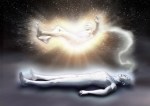
Out of body experience

Plato explains through the words of Socrates that those who are involved in following philosophy correctly “‘are practicing nothing other than dying and being dead…truly, then, those who practice philosophy aright are cultivating dying.’” The only difference is that one returns to this world. It sounds very similar to a Near Death Experience.

At the point of death, Themistius informs us, “[the soul] has the same experience as those who are being initiated into great mysteries.”

This definitive assertion can be taken as a true expression of one who had himself been through the great mysteries. This is not just an intellectual belief but something learned from participating in such a journey to the Far-World.

Themistius continues:

At first one wanders and wearily hurries to and fro, and journeys with suspicion through the dark as one uninitiated: then come all the terrors before the final initiation, shuddering, trembling, sweating, amazement: then one is struck with a marvelous light, one is received into pure regions and meadows, with voices and dances and the majesty of holy sounds and shapes: among these he who has fulfilled initiation wanders free, and released and bearing his crown joins in the divine communion, and consorts with pure and holy men.

The Healer-Priests

In 1958 evidence was uncovered among the ruins of the ancient city of Velia in Italy of healer-priests of Apollo who survived the fall of that city. One of these was the Presocratic philosopher Parmenides. The date 446 A.D. was the latest date inscribed on the stone base of a destroyed statue, indicating a time somewhere around the beginning of the Christian period. Baigent describes their ritual practice:

These healer-priests were important: one of their titles was Pholarchos—“Lord of the Lair.” This is revealing, as these priests were specialists in an initiatory technique once well known in the ancient world as the technique of incubation.

In antiquity the best way of actually making contact with divinities of the underworld was through the practice of “incubation”—of awaiting a dream or vision while sleeping, as a rule, either on or even inside the earth.”

The ritual practice of incubation involves lying down in complete stillness and silence in an underground room, or perhaps a cave, in order to have a prophetic dream or to fall into a state of consciousness that is neither waking nor sleeping. It was here in the enclosed dark spaces that the seekers might have experienced passing across to the Far-world, where they could receive a vision from the Divine, the Source of all. The god of incubation was Apollo.”

. . . . The sacred journey was undertaken for healing or for a revelatory experience. These healer-priests of Apollo were experts in incubation and, as Kingsley explains, “used incantations to enter other states of consciousness.”

We can see here that the practices of ancient Greece, using such sites as found at Baia or the deep caves or underground sites that must have existed in Velia, were not so different from the uses made of the crypts beneath the temples in ancient Egypt. Such dark secluded places were chosen by seekers who, after dutiful preparation and appropriate ritual and incantation, lay in the stillness and entered another state of consciousness. We are left with little alternative but to seriously consider that they did indeed leave their bodies in their Ba form (according to the Egyptians) or in their psyche, or soul (according to the Greeks), and travel to the Far-World.

We can also see that by the time of Jesus the two traditions were drawing ever closer together. In fact, during the Greek and Roman domination of their country, the Egyptians despaired of their secrets surviving; the first-or second-century A.D. Hermetic text the Asclepius laments:

“A time will come when it will appear that the Egyptians paid respect to divinity with faithful mind and painstaking reverence to no purpose. All their holy worship will be disappointed and perish without effect, for divinity will return from earth to heaven, and Egypt will be abandoned…. When foreigners occupy the land … a prohibition under penalty prescribed by law (so-called) will be enacted against reverence, fidelity and divine worship. Then this most holy land, seat of shrines and temples, will be filled completely with tombs and corpses…. Only words cut in stone will survive to tell your faithful works.”

And so did it come to pass: Egypt became a land of darkness and stone-engraved mystery simultaneously with the rise of Christianity.  This ended the “First Sacred School” initiated by Abraham and cleared the way for the “Second Sacred School” initiated by Jesus.  I will leave it there for now. Until my next posts then,

Be love. Be loved

Anthony

Read my Health Light Newsletter online at LiftingTones.com


The “Jesus of History” vs The “Jesus of Faith” part 2: The Missing Years, page 3

My Chorale Pic

 The Secrets of Egypt

The veil is thinning. The veil of which I speak is the cloud in the human heart and the fixed structures in human consciousness that have obscured our vision of the oneness of heaven and earth and our oneness with one another. I see evidence of this thinning  among the gays and lesbians of the LGBT community who recently won their Supreme Court case for marriage equality in the state of California and in all 50 states. I was moved by the television show “When We Rise” watching these men and women embrace one another in a powerful display of unconditional love. The light of their unfettered joy in victory lit up the veil of judgment in my own heart as I felt the repulsion homosexuality triggers inside of me seeing men kissing men on the lips, while at the same time feeling a compelling spirit of joyful celebration in my confused emotional realm. Scars from thwarted encounters with homosexuality during my youthful years in Catholic seminar tearing loose from the fabric of my heart. The veil is definitely thinning. Healing is underway. The truth of human relations is being revealed. We are rising in love with one another.

With some there is no veil at all. Heaven is “so close as not even to be near,” as one poet put it – and we can enter in while we yet live. This is what  the Egyptians were into with their mysticism. What science fiction writer H.G. Wells proclaimed in 1895 in his story “The Door in the Wall” the Egyptians had discovered a way to go through that portal and enter what they called the “Far-World.” They had a secret ritual into which one could be initiated and guided through that would open a door into that world and allow one to visit for a while and then return. This ritual was called the “incubation.” More about that later in my next post.

This was a message that the Master Jesus brought: “The kingdom of heaven is at hand and all around.” He was even more specific than that: “The kingdom of heaven is within you.” We were instructed to “repent” – literally turn around – see it on every hand and enter in. Then he apparently went through that door himself and returned to say “Follow me.” I don’t think he was messing with us.  I believe he meant exactly what he said. I know he did.

I have a friend who had a near death experience (NDE). His impression was that the veil is very thin and heaven is indeed right at hand. His experience was so exquisite that he was terribly saddened upon being resuscitated and brought back to life on this plane.

Here’s another interesting NDE story: “Dead for 48 minutes, Catholic Priest claims God is female” .

Jewish Mysticism in Egypt

In his extensively researched book The Jesus Papers, religious historian Michael Baigent shares his exploration into the mysticism of Egypt in his chapter “The Mysteries of Egypt.” I read and re-read this chapter with a deep curiosity and desire to know what might have really transpired during those eighteen years of Jesus’ young adulthood that are peculiarly missing from the Four Gospels. Baigent places Jesus in Egypt, brought there by his parents, where he may well have received an education in Jewish mysticism, which was an adaption of Egyptian mysticism whose sole purpose was to potentiate and facilitate ecstatic union with God by way of a process called “incubation.” Michael Baigent describes this cultish practice in haunting detail.

THE MYSTERIES OF EGYPT

The Egyptians saw themselves as keepers of the balance and harmony of our universe.  I find this most fascinating and pertinent to our times of global climate crises.

In the beginning, according to the ancient Egyptians, everything was perfect. Any fall from this state of eternal harmony, called Ma’at, was due to mankind’s imperfections, and the greatest of these human imperfections were those caused by greed.

Greed is a human “imperfection” that continues to create an imbalance in our world to this day. We haven’t yet emerged out of those dark ages in our governance, which is based on greed for power and control. It’s all coming to a head, like a pimple on our collective forehead, with the 1% of our population that embody the focus of the spirit of greed, which the majority of the remaining 99% embody as well. The pimple is bursting, however, ejecting the pus of corruption out of the body of mankind; and what a stink that is making. Baigent continues:

It was the task of everyone, the great as well as the humble, to work toward maintaining this perfection and restoring any imbalance in it. But the ultimate responsibility lay with the pharaoh, aided by a network of temples that covered all of Egypt.

Every morning saw the same ritual of awakening the gods in the temples at the moment of sunrise, when the doors of the Inner Sanctum would be opened. The director of the Petrie Museum in London, Dr. Stephen Quirke, has likened the Egyptian temple, only half in jest, to “a machine for the preservation of the universe, a technical operation that requires technical staff or knowledge … in order to ensure that the crucial task of survival is never impaired.”

I am reminded of a passage from the 38th chapter of the Book of Job, a powerfully haunting passage: “Canst thou bind the sweet influences of the Pleiades, or loose the bands of Orion? Canst thou bring forth Mazzaroth in his season? Or canst thou guide Arcturus with his sons. Knowest thou the ordinances of heaven? Canst thou set the dominion thereof in the earth?”

We are supposed to know these things – and we once did. There was a Science of Mazzaroth at one time in our ancient past, a remnant of which lingers on today in what we know as astrology. It is the reality behind the Zodiac. The seasons of Mazzaroth still govern the cycles of creation in our Solar Entity, only without our conscious participation. We do continue to influence these cycles through our self-destructive behavior and are impacted by them. In our ignorance, we’re getting clobbered by their unalterable activity.

I believe what Michael Baigent has shed light on in this book in the last attempt of ancient civilizations to restore man’s engagement with the Science of Mazzaroth. Only the Egyptians couldn’t pull it off as mere humans living on the physical plane.  Greed for power and control spoiled the process of restoration of the governance of the ordinances of heaven upon the Earth through human beings.

Further, I believe Jesus was aware of their foolishness and failure – a failure that actually dated back to King Solomon and the failure of the “chosen people” of Israel to allow that restoration to occur on the physical plane by way of the cycle initiated by Abraham in that pivotal moment when he reportedly ended human sacrifice by not sacrificing his son – and Jesus set about to initiate a second opportunity for the cycle of restoration of human consciousness to its rightful place of dominion in heaven – a dominion founded in love rather than greed. The Egyptians were at least aware that they needed to rise to a higher mental plane in their earnest endeavors to travel to the Far-World to gain knowledge from their gods that would help them maintain a balance between the two worlds they knew at that time. But that opportunity was no longer available. Surely Jesus was well aware of their endeavors – and was not without compassion for their state of blindness.

Baigent goes on to elaborate on their cosmology and culture:

At the same time the temple was a gateway to the Beyond: it was the place where the earth and the sky joined as they seem to do on the horizon, and for this reason many texts refer to the temple as a celestial horizon. The ancient word for “horizon,” akhet, had a number of significant meanings: it referred not only to the joining of the sky and the earth but also to a specific part of the horizon where the sun god rose from the Far-World, the Duat, every morning and returned to it every evening.” Clearly, for the Egyptians, the horizon marked a portal into the Far-World.

Pyramids too were imbued with this quality: the Great Pyramid of the pharaoh Khufu at Giza was termed the “akhet of Khufu.” Furthermore, the root of the word akhet means “to blaze, to be radiant.” On one level this term referred to the blaze of light at sunset or sunrise, but it also had a much more secret meaning, which we will discover.

The primary role of the pharaoh was to serve as the guarantor of Ma’at. The only – and greatest – thing asked of human beings was to live in Ma’at, bringing the cosmos and the physical world into harmony This perfectly balanced state was personified by the goddess Ma’at, who was depicted with an ostrich feather in her hair. She brought truth and justice, the fruits of harmony, into the world.

Coexisting within this universal perfection were two worlds: the physical world, which we are born into and within which we live, and the other world to which we travel when we die, the Duat, or the Far­World. The Far-World was not seen as separate, as some heaven or hell far away from or unconnected with mundane existence. Rather, the Far-World was ever-present. It was believed to exist simultaneously with the physical world, intertwining with it like the two snakes around the caduceus of Hermes. It was with us all the time even though we could not normally see it or travel to it until we died.

These two worlds occupied the same space, in some mysterious and unexplained manner, except that the physical world remained within time whereas the Far-World existed beyond time. Time began with creation, but the Far-World was seen as eternal, not in the sense of being an infinite stretch of time reaching forever into the future and stretching from a past forever distant, but rather eternal in that it was outside of time. The ruler of the Far-World was the god Osiris, and the guide for the dead was Thoth, who led them up to the kingdom of the gods.

A further aspect of the Far-World is that it was understood to be the eternal background to everything in the visible universe. It was considered the divine source of all things, the source of all power and all vitality Life itself was believed to come from the Far-World, which seeped into the physical world and revealed itself in all the forms we see about us.

For the ancient Egyptians, the world of the dead was always very close to the world of the living – there was an intimacy between the two. Paradoxically, the world of the dead was the source for the world of life. Indeed, the dead were believed to be the truly living ones.

A tomb inscription dating from the New Kingdom (around 1550-1070 B.C’) reminds us that “a trifle only of life is this world, [but] eternity is in the realm of the dead.” An earlier Middle Kingdom (around 2040 – 1650 B.C.) tomb of the priest Neferhotep in Thebes-now Luxor-contains several “Harper’s Songs,” the second of which ends:

“As for a lifetime done on earth, it is a moment of a dream. It is said: ‘Welcome, safe and sound’ to the one who reaches the West.”

The “West” for the Egyptians was the land of the dead. Tombs and pyramids were always built on the west bank of the Nile, where it was thought that the sun vanished at night into the Far-World.

To understand this, it is useful to look at the ancient Egyptian concept of time: they understood that two types of time were operating simultaneously. There was the kind of time they called neheh, the cyclical time involved in natural patterns – the seasons, the movement of the stars, and so forth. The other was known as djet, which was no time at all – a state of being outside of time entirely. Only in neheh did time move; djet represented time in suspension. While neheh might be infinite, only djet was eternal; one inscription reads:

“The things of djet-eternity do not die.”

This dual perspective is very different from our modern concept of time in which we are ever tumbling onwards into a future that we can only hope will be perfect – a hope that for many religions rests upon the fulfillment of a promise that a messiah will someday appear to win the final battle against the forces of evil and in so doing will usher in a perfect world. Our political philosophy too is very dependent upon linear time, on a trajectory stretching from the past into the future where, if we manage our legislation correctly, we will achieve satisfaction for all citizens, as if legislation is something that does more than plaster over cracks.

And yet, those of our culture who have stepped out of time – the mystics – report, like the ancient Egyptians, that the world of the dead is indeed a world of the living, that it is ever-present and very close. Making allowances for the great differences in culture and language, we can see this same sense of proximity to the divine world stressed in the reports of the great sixteenth-century mystic Saint Teresa of Avila, who often fell into a mystical “rapture” wherein she was utterly “dissolved” into the divine kingdom. Speaking of God she stressed:

“There was one thing that I was ignorant of at the beginning. I did not really know that God is present in all things; and when He seemed to me so near, I thought that it was impossible.”

From what Baigent presents here, perhaps one can readily see how the roots of Christianity grew out of the soil of Egyptian and Jewish mysticism. Jesus’ attempt to initiate a new cycle of restoration with his disciples failed to interrupt the status quo. Christianity became simply a new name and practice of Egyptian and Jewish mysticism, with all of its mysteries, beliefs and cultish practices.  A third and new cycle was destined to be initiated at a yet higher spiritual level of consciousness and is already underway. But that’s getting ahead of our current exploration.

I will leave it there for now. There’s a lot here to ponder. I would love to share your thoughts on what I’ve presented here. For one thing, I would like to know if what I am bringing forward for consideration is of any value to my readers – and I note that there are many visitors to this blog after each new post. So, do drop me a line or two. Until my next few posts – which will come closer together as we approach the Easter Season,

Be love. Be loved

Anthony

Welcome to my Health Light Newsletter online.

The “Jesus of History” Vs the “Jesus of Faith” part 2: The Missing Years pg 2

My Chorale Pic

“WHAT IF EVERYTHING YOU THINK YOU KNOW ABOUT JESUS IS WRONG?” – From the cover of Michael Baigent’s book THE JESUS PAPERS – Exposing the Greatest Cover-Up in History.  Michael Baigent is a religious historian and leading expert in the field of arcane knowledge.

Jesus and Egyptian Mysticism

The Egyptian Mystery Schools were not about cloaking the truth of God in mystery so as to hide it from the uninitiated layman, as a reader recently alluded to in a comment on my last post. Or was it? There does seem to have been a certain secrecy about the “initiation” process which introduced one to Egyptian mysticism.

Now, there’s a word that could use some cleaning up. Mysticism need not imply a cloaking of truth in the illusory clouds of mystery. On the contrary, mysticism dates back to ancient times as a doctrine or belief that one can obtain communion with God, have a direct experience of the Divine Source of Life itself, through contemplation and meditation – “and love without the medium of human reason,” the New World Dictionary adds in its first definition of the word. It’s only the third option that defines mysticism as “vague, obscure, or confused thinking or belief.” The second option defines mysticism as “any doctrine that asserts the possibility of attaining knowledge of spiritual truths through intuition acquired by fixed meditation.” A mystic is a person who has found a spiritual path that takes him/her directly into the Light of the Divine Presence.  This is what Egyptian Mysticism was reportedly all about. So, why would Jesus not be interested in exploring Egyptian mysticism?

According to Michael Baigent, Jesus was more a mystic than a messiah — in the sense that he opened a pathway to the “Kingdom of Heaven” that is within us and all around us for everyone.  He knew the Way.  According to the Gospels, he reportedly said “I am the way, the truth and the life.” Where did he learn the “way” to the spirit world of heaven? Had he mastered Egyptian mysticism?

The “Master”

An essential aspect of the Master’s miraculous healings – and I call Jesus Master with purpose – was in the way he reached out to touch people where they were, not requiring them in any way whatsoever to rise up to where he was in order for him to heal them. These people had been led by the God of Abraham and of Isaac to their City of Habitation in Jerusalem. The Prophets of the Old Testament had foretold that a messiah would come and restore Israel and deliver its people from the bondage of the powers that were at the time, which was the Roman Empire. Jesus knew that and he respected their belief in a messiah – so much so that he took on the role of that messiah in order to touch them where they were in their state of expectancy. He rode into Jerusalem on the back of a donkey, as we saw earlier, in order to fulfill the prophecy and satisfy their expectancy, an event Catholics celebrate even to this day on Palm Sunday. Where did he learn his mastery?

According to Michael Baigent, Jesus was taken by his parents to Egypt where he grew up and spent eighteen years studying Jewish law and the Sacred Scriptures in preparation for his public ministry among the Jews in Galilee and Judea. I resonate with his scenario for the simple reason that it would seem necessary that Jesus fully understand the task he was about to take on with a people steeped in tradition and scriptural beliefs. But beyond his education into the beliefs and traditions of the Jewish people, I see no heresy in allowing that Jesus may have explored the mysticism of the Egyptian people. After all, he came to minister to the entire world and not just to the Jewish people. His deep passion was to lead all souls back to the path that leads to the Kingdom of Heaven – which he said on many occasions, according to the record, is “within.” To enter the kingdom of heaven, one has to turn around, the literal meaning of “repent,” and look within oneself to find the “way” in.

The Egyptian mystics had found a doorway to that kingdom, only they called it the “Far World.” And here is where Baigent treads on sacred beliefs. Dare he, dare I, even consider the possibility that Jesus explored and underwent training in the mysticism of the Mystery Schools of Egypt? Yes, Egypt was a “‘land-of-darkness’ – or the state-of-darkened consciousness, gross darkness,” as a reader characterized Egypt in his comment on my last post. However, there was a light shining in the gross darkness of Egypt in a community of holy men and women.

The Therapeutae

I would like to turn now and consider a contemplative community of healers with whom Jesus may well have lived and studied. Baigent writes about them in his book. I will share the entire story with you mostly in the author’s own words, words that drew me out with a deep sense of deja vu.

On a low hill in southern Egypt, situated between the Mediterranean Sea and Lake Maryut just southwest of Alexandria, lived a small community of Jewish philosophers.  Being situated between two bodies of water, they benefited from the fresh breeze of cool and healthy sea air that swept over the limestone spur.  In an atmosphere of peace and “relative security” in this rural setting with nearby  villas and towns, they lived a contemplative lifestyle. As Baigent describes it best, I will let him tell the story, which is largely based on accounts written by Philo of Alexandria and a couple of other historians.

This community was given the name of Therapeutae, which, as Philo explains, carries both the sense of healing – not only of the body but also of the soul – and a sense of worship. Therapeutae worship centered on the “Self-Existent” – a belief in the One Divine Reality, never created but eternal. This was a concept of divinity far beyond the capability of language to describe.

In one important way, the Therapeutae were very different from the other dedicated groups Philo describes, such as the Essenes. Among the Therapeutae, women were admitted as equal members and participated fully in the spiritual life of the community. By contrast, the Essenes, according to Philo, Josephus, and Pliny, were proud of the fact that they excluded women; women, they believed, were a distraction. We should recall here the inclusive attitude of Jesus toward the women in his entourage and the criticism that this engendered among some of his male disciples in the Gospels, for there have been many questionable attempts to ally Jesus with the Essenes.

Comprised of upper well-educated upper class elite from Alexandria who had divested themselves of all worldly possessions, the Therapeutae’s communal life was one of simplicity – and they were not the only group in all of Egypt that followed a contemplative lifestyle.  They were, however, the only group representing a “Jewish version of a widespread mystical tradition that found expression in all lands.” Baigent gives another distinguishing characteristic of this group.

The implication of the Therapeutae’s inclusion of women, however, is that when a group is dedicated to the contemplation of the highest experience of the soul – to that sight of the soul “which alone gives a knowledge of truth and falsehood” – the gender of the worshiper is irrelevant. This may seem self-evident to us today, but in the world of Philo and Jesus this concept was truly revolutionary.

The Therapeutae were mystics and visionaries: “It is well,” Philo writes, “that the Therapeutae, a people always taught from the first to use their sight, should desire the vision of the Existent and soar above the sun of our senses.”

Members of the Therapeutae wanted to have a direct vision of reality – or of the “Self- Existent,” to use Philo’s term – in order to experience what truly exists behind the rough-and-tumble world of this transitory life. This too was the aim of many groups operating in the classical world, especially in those great and secret cults called “the Mysteries.” Here we appear to have a Jewish version, seeking the same end, but operating in a much simpler manner within the Jewish tradition.

The Therapeutae prayed at dawn and sunset. During the day they would read the holy texts, but rather than taking these as the history of the Jewish nation, they understood them as allegory. According to Philo, they considered the literal text a symbol of something hidden that they could find only if they looked for it.

Every seven days they would gather together and hear a talk by one of the senior members; every fifty days they would have a major assembly where they would all put on white robes, eat a simple sacred meal, and form a choir, men and women together, to sing hymns with complex rhythms and vocal parts. This festival would continue all night until dawn, revealing the solar nature of their worship: “They stand with their faces and whole body turned to the east and when they see the sun rising they stretch their hands up to heaven and pray for bright days and knowledge of the truth.’?”

Clearly this is a very different type of Judaism, one that does not depend upon temple worship at all. In Therapeutae worship, which has a very Pythagorean tinge, there is no concern with the cult of Judaism, which was so important to the priests in the temples of Jerusalem and the Egyptian delta, or with the purity of the high priests serving that cult, which was of such concern to the Zealots, or with the coming of the Messiah of the Line of David. For both male and female members of the Therapeutae, there was simply the possibility of a visionary experience of Divinity.

Their kingdom was truly not of this world: Jesus would have approved.

There is one further implication of the Therapeutae’s beliefs that warrants more discussion, and that is the practice of treating the entire Old Testament as symbolic. They would have read all the messianic predictions made by the prophets symbolically.  There would have been no reason in their minds for an actual messiah to come to liberate Israel; there would have been no reason for Jesus to be the actual king and high priest; the oracular pronouncements of the messiah would have been simply symbolic of something deeper and more mysterious. We have seen before how the “Star” is a symbol of the messiah, but can we now take this concept a little further? Can we see the statement by Peter in the New Testament as reflecting this kind of speculation, albeit in a Christian context? Could the phrase “Let the Day Star rise in your hearts” (2 Peter 1:19) be interpreted as an encouragement to let the mystic light rise from within?

With such attitudes apparently widespread, perhaps even common, it is no wonder that Judaism in Egypt, and Christianity afterwards, had a distinctively mystical quality: it was in Egypt that Christian monasticism first began; it was in Egypt at Nag Hammadi that someone hid the Gnostic texts, that collection of Christian and classical mystical texts – including one by Plato and one from the texts of Hermes Trismegistus, the Asclepius – that had been compiled and used by a desert monastery.

The Christian Church in Egypt had mystically minded figures even as late as the third century – theologians Clement of Alexandria and Origen, for example. We have Egyptian traditions leaking into Judaism from very early days – the times of Joseph and Moses – and in more recent times, as we see in the writings of Philo. In the midst of all this we have groups such as the Therapeutae working a mystical type of Judaism and the Temple of Onias maintaining the true Jewish Zadokite priesthood.

At this point one is tempted to ask “What was it about Egypt that gave this mystical focus to Judaism and the Christianity born out of it? What kind of soil were these foreign faiths growing in?”

The irony of these questions is that it was not so much the land that nourished these faiths as it was the sun, which poured out its life-giving sustenance from above. A clue lies in the fact that both the Therapeutae and the Jewish Zadokites adopted the solar calendar from the Egyptians, whose major deity, Ra, was in fact an expression of the sun as the source of life, the source of all creation. Texts reveal that the pharaoh, at least, sought mystical union with Ra as the “deepest fulfillment of our human divine nature.”

I find this to be a curiously significant aspect of Egyptian Mysticism, as the sun is the central focus of cosmic energy for our solar system – which I would rather call a “Solar Entity” to emphasize its living and breathing nature.  As we shall see in the next post, the Egyptians viewed the visible material world as the cloak of an invisible spiritual “Far World” which governed the world of form.  Their gods lived in that spiritual world.

Could it be that their worship of the sun was prompted by a latent subconscious memory of their origin in the sun. Yes, the sun, the Star at the center of our world.  Is our Judeo-Christian “Heaven” perhaps located in the cool center of our Star?  It that where God lives as the “Lord of lords” and “King of kings,” in his Kingdom that “is not of this world?”  Is the Sun the radiant outer garment of the LORD GOD Creator of our universe – the fire that burns and the light that glows – that gives evidence of the Presence of the One that dwells within – the” Shekinah”? A possibility upon which to meditate and ponder.

The profound mysticism that lay at the very heart of the Egyptian experience of reality clearly influenced many of the other faiths that had established themselves there. This Egyptian mysticism, which employed secret readings of myth and private rituals, often played out in secluded underground chambers and temples, professed to connect this world with the next, to connect heaven and earth.

The approach of the Egyptians was not a kind of philosophy, a speculation on divine possibilities, or a faith built solely upon the hope for a better life after death. The Egyptians were not only mystical but intensely practical. They did not want to talk about heaven, they wanted to go there. And return. Just like Lazarus in fact.

It’s time now to look at the hidden mysteries of Egypt.

Until my next post, when I will tell you about the mysteries of Egypt as Michael Baigent describes them.

Be love. Be loved.

Anthony Palombo


Read my HealthLight Newsletter at LiftingTones.com.

If you are interested in healing oils, I recommend these folks: https://www.ancienthealingoil.co.za/about


The “Jesus of History” . . . . Vs The “Jesus of Faith” . . . . Part 2: The “Missing years”

My Chorale Pic

Eighteen years of Jesus’ life are not accounted for in the four Canonical Gospels. The last we hear of his early childhood is the alleged story about him debating with the chief priests and elders in the Temple of Jerusalem at the age of twelve. Where he went after that is a question that has given rise to much scholarly speculation.

Religious historian Michael Baigent has a very intriguing chapter on the missing years of Jesus’ life in his book The Jesus Papers – Exposing the Greatest Cover-Up in History. Digging deeply and tenaciously into whatever ancient texts and oral traditions he could find—the most resourceful being those of the Dead Sea Scrolls, written by the Jewish Zadokites and Zealots in Egypt, where they were found around 1947-56, and the Nag Hammadi texts discovered south of Cairo in Egypt in 1945—Baigent places Jesus in Egypt where he receives his messianic training in the Egyptian Mystery Schools.

It is in Egypt, Baigent suggests, where Jesus received training in the ancient rituals of Egyptian mysticism that opened heaven’s gate for passage into the Underworld—the “land of the dead,” which was thought more to be the “land of the living”—and re-entry into the physical plane.  Bagent suggests that Jesus was initiated into these mysteries whereby, with the assistance of fellow initiates who attended to the physical body during the soul’s out-of-body journey, one could die to this world, visit the realm of the gods and obtain wisdom, then be resurrected from the “dead.” Not entirely without historical support for his scenario, Baigent’s speculation is quite conceivable and compelling, especially knowing what we know today about “near death experiences” (NDE’s). Was Jesus’ crucifixion, death and resurrection akin somehow to an NDE? Let’s have a look and decide for ourselves whether or not Baigent’s scenario is in the least bit credible, perhaps even likely.

(This is a dense and complex consideration with many political and religious threads weaving through the fabric of the story. I will attempt to condense it into two or three installments. Encompassing the larger part of Jesus’ thirty-three years of life as recorded by the four Gospel writers, it is perhaps the most crucial and important period, as it was his formative years of preparation for the three-and-a-half years of his public ministry, which ended in his personal victory over death—which was the sole interest of the Gospel writers, though not the sole reason and purpose for Jesus’ life and mission, as we will see.)

Where did Jesus live as a young man?

According to three of the four Canonical Gospels (Matthew, Mark and Luke), Jesus was living in the town of Nazareth in Galilee in his youth. Luke says that Jesus grew up there and that he went with his family every year to Jerusalem to celebrate the Passover. It was on one of those occasions that he was found debating with the learned scholars in the Temple. “Unfortunately,” Baigent writes, “there is no evidence whatsoever that Nazareth even existed in Jesus’ day.” Then, as is his style when he comes upon an inconsistency such as this, Baigent’s critical thinking and suspicions kick in. I love the manner in which he goes about questioning everything handed down as history. Here’s a taste of his reasoning and compelling writing:

The first mention of it appears no earlier than the third century A.D. Could this mention of an exchange at the Temple have been placed here as some kind of cover story for a period in Jesus’ life that was otherwise unaccounted for?

As far as the Gospels were concerned, Jesus appears to have vanished during his youth and early adulthood. But it was during those years that he learned the ideas, the beliefs, and the knowledge that he later taught. So where exactly was he? And why have his whereabouts been kept hidden? Had he been “talent-scouted” by priests or rabbis and whisked away for almost two decades of secret training? Surely the disciples must have known where Jesus had been. But what could have possibly been at stake, what problem could have arisen, through sharing this information? In fact, we cannot avoid asking, what were the writers of the Gospels intent on concealing?

Scholars over the years have speculated about this gap in the account of Jesus’ life. Some believe that Jesus traveled with his family to the East,

“far beyond the jurisdiction of the Romans, to Parthia, Persia, or beyond, to Afghanistan, or India. Even today there are many who believe that the shrine of Yus Asaph in Kashmir is that of Jesus himself who, after surviving the crucifixion, returned home to the East to live and ultimately die. There are also suggestions that he studied as a child under Buddhists—this would explain, it is said, the parallels that can be found between the teachings of Jesus and those of the Buddha. And we have the very early Christian community, centered in Malabar on the west coast of India, which claims to have been founded by the apostle Thomas. Surely where Thomas went then so too could Jesus have gone?

Is it possible that the Great Spirit who incarnated in Jesus is the same Divine Being who was also incarnate in the Buddha some six-hundred years earlier in Nepal, India?  Well, that’s getting a little ahead of the current story. There was no reason for Jesus to have fled Roman jurisdiction as he was not involved in the Zealot’s revolutionary activities against the Romans. Baigent reasons:

Any move he made out of Judea or Galilee must have been by choice rather than by coercion. But where could he have ventured, and why?

There is a single clue in the Bible, one in the Old Testament that is echoed in the New. As we have seen, it was important for Jesus to follow, to act out quite specifically, the predictions made by the Old Testament prophets in describing the coming of the messiah. We have already seen the very literal expression of these predictions during Jesus’ entry into Jerusalem when he finally went public with his messianic claims. We can therefore be confident in expecting that every messianic prediction in the Old Testament would be pressed into use in this manner.

In a real sense these predictions by the Prophets limited Jesus. They provided a set of boundaries within which his messianic mission needed to express itself. A particularly interesting prediction was given by the prophet Hosea (II:I): “When Israel was a child I loved him, and I called my son out of Egypt” (emphasis mine). Matthew (2:I5) picks up on this in one of the earliest prophetic predictions he mentions: in a garbled historical account, he records that the Holy Family fled into Egypt when Jesus was still a baby, explaining, “This was to fulfill what the Lord has spoken through the prophet: ‘I called my son out of Egypt.'”

I’ve learned that anywhere in the New Testament when these words “This was to fulfill . . .” are used to preface a Biblical event, one can be sure that what follows is a rationalization by the author(s)inserted into the text in order to connect the event with words of prophecy from the Old Testament. It’s like doing research in order to find something that backs up or proves one’s preconceived conclusion or beliefs.

Why Egypt?

AT THIS POINT, we cannot help but ask, why Egypt? This is a minor detail in Matthew’s Gospel and is treated as such in the Roman Church. But for the Egyptian Coptic Church, which separated from Rome in 451 following the Council of Chalcedon, it is a matter of considerable importance indeed. For almost a thousand years it has maintained a legend about the journey the Holy Family made into Egypt, all the sites they visited or resided at, and all the miracles that accompanied the presence of Jesus. This legend is called “The Vision of Theophilus.” Theophilus was patriarch of Alexandria and leader of the Egyptian church from A.D. 385 to 4I2, but the Vision seems not to have been written down until the eleventh or twelfth century

Given the highly devotional nature of the story and the very obvious use made of it to justify Jesus’ uniqueness and divinity, we can locate its theology far beyond the beliefs of the Jewish community in Egypt—the community that would have been giving refuge to Jesus’ family. What’s more, these same factors place the origins of the theology in an era following the dogmatic decisions of the Council of Nicaea in A.D. 325. It seems fairly evident that the Vision—at the very least—is a product of Christian thought in the fourth century A.D. or later, and certainly not of Judaism or Judeo-Christianity. It therefore cannot be an accurate account of any such journey, although it may very well contain some elements of a real journey. Thus, we need to ask, whom does the story serve? Who would have benefited from its telling?

No one would have benefited more than the author of the Gospel of Matthew himself, as it added credibility to his Gospel. For less obvious reasons, the Coptic Church in Egypt would have benefited by the story of the Holy Family’s travels to the East. “The Coptic Church has been at odds with Rome for over six-hundred years, and its faith was at least tolerated by the Muslim rulers.” There appear to be political and economic factors influencing Mathew’s scenario.

If the Gospel of Matthew is given greater credence, then it stands to reason that various Egyptian holy places within the story would also be validated, thereby opening up a whole new pilgrim route that would include Egypt. With pilgrims, of course, came trade and gold.

Despite its deficiencies, the tale gives every appearance of picking up on local oral tradition or legend. And local legend is dismissed at one’s own peril, for local memories are long. There has certainly been a very ancient and widespread Jewish presence in Egypt—extensive enough to justify the story’s telling well into Islamic times.

There was a legitimate and functioning—although controversial—Jewish Temple in Egypt during the lifetime of Jesus. It was founded by the Zadokite high priest, Onias III, who built it upon the ruins of an old Bubastis temple in the Egyptian delta on the same design as the Temple of Jerusalem.

Onias III, a Zadokite priest, was forced to flee Israel to Egypt when Jerusalem was attacked by the Syrian ruler, Antiochus Epiphane in 170 B.C., and the Temple in Jerusalem was taken over by non-Zadokite priests allied with Epiphane. The Onias Temple with its Zadokite priest became the only legitimate Jewish Temple in the region. That is until his son, Onias IV, a military commander in the Egyptian army and a non-Zadokite priest, succeeded his father as high priest. This made the Onias Temple in Egypt illegitimate, a diminishing of status by Josephus that was used as his rationale for excluding it from serious academic consideration, by Josephus himself as well as by Philo of Alexandria—both of whom had friends in high places in Israel to placate; friends in the upper class wealthy Jewish sector as well as in the ruling class. Both groups wanted to put distance between them and the Zadokites and the Zealots associated with the Onias Temple in Egypt as well as the Temple in Jerusalem.

The Onias Temple was on the road that Jesus and his parents would have traveled from Judea to the city of Heliopolis in Egypt in order to avoid the strongly-influenced Jewish communities in Alexandria and Naucratis to the west. They would then have traveled south along this road that passed by Onias’ temple, where they would most likely have stopped and settled. Baigent reasons:

And it is highly unlikely that Jesus and his family, raised in a Zealot environment, one that hoped and prayed for a reinstatement of a Zadokite priesthood in the Temple of Jerusalem, would have just passed by this Egyptian Jewish temple. All of these observations lead naturally to the thought that the Temple of Onias served as the initial training site of Jesus. It was here perhaps that he received his introduction into the politically active world of the Zealots.

In a sense, we can see the temple as an overseas branch of Galilee where Greek-speaking Zealots could learn their trade. It would have also been a good place for Jesus’ family to bring him so that he could learn what it would mean to be the Messiah of Israel, for all the texts and commentaries on the role of the messiah would have been available there. So we do now have a good reason for the Holy Family to have traveled to Egypt, and a reason for Matthew’s brief comment, disguised as a flight from the dangers posed by Herodian infanticide. In fact, it would seem not to have been a flight at all but rather a positive action undertaken in order to allow Jesus to grow, to study, and to teach away from the troubles in Judaea and Galilee.

Despite his training in the Zealot cause, Jesus, as we have seen, at some point secretly took another path – one revealed only after he had been anointed as messiah [by Mary of Bethany, who was also Mary Magdalene, Jesus’ wife and companion], when it was far too late for anybody to challenge him. That path was a more mystical path. Yet where in the Jewish world of Egypt could he have learned such a path? For the answer to this question, we need to look at one of the mystical groups of the time, one described by Philo of Alexandria.

In my next post I will consider the Therapeutae healers in Egypt with whom Jesus may have studied and developed his own gift of healing. I will also consider a most enlightening chapter of Baigent’s book that tells about the mysticism of Egypt and the rituals of initiation into the Mystery School and what was called “incubation,” a most interesting and exciting consideration that may shed light on what really happened on Good Friday and Easter Sunday. So, stay tuned.

Anthony Palombo

Read my Health Light Newsletter online at LiftingTones.com – shedding light on health issues from a Holistic perspective and paradigm.


The “Jesus of History” . . . . Vs The “Jesus of Faith” Part 1

My Chorale Pic

“WHAT IF EVERYTHING YOU THINK YOU KNOW ABOUT JESUS IS WRONG?” – From the cover of Michael Baigent’s book THE JESUS PAPERS – Exposing the Greatest Cover-Up in History.  Michael Baigent is a religious historian and leading expert in the field of arcane knowledge.

I received a number of “likes” and a few comments on my last post, which I always love receiving. One comment came from a niece that I thought is worth sharing here, since she sent it to me on Facebook rather than posting it to my blog. She says:

“Thanks for having the courage to educate us all about the history that so many choose to ignore. You will probably be burned in effigy…lol. My belief is that we need not be ashamed of our history unless we refuse to learn from it.”

My belief as well. I am not convinced, however, that we have learned from our history – or even explored it at any length so as to know what it is we need to learn from it.  Thus my exploration, which I am somewhat tentative in sharing in a public forum such as this. Some of my readers may, indeed, burn me verbally in effigy, as my niece said, and if that should happen, I extend love and compassion ahead of such time that this may indeed come to pass. Bless you and forgive me for exploring my own Italian/French/Irish Catholic roots, which I’ve taken for granted.

With that said, I will continue my exploration of information that has come to me in a thoroughly researched and well documented book by Michael Bagent entitled The Jesus Papers – Exposing the Greatest Cover-Up in History. My purpose in reading his book – for the second time – is to arrive at a better understanding of who exactly Jesus was and what actually occurred during his brief life and public ministry. Again, from the cover of his book:

In The Jesus Papers, the author reveals the truth about Jesus’s life and crucifixion. Despite–or rather because of–all the celebration and veneration that have surrounded the figure of Jesus for centuries, Baigent asserts that Jesus and the circumstances leading to his death have been heavily mythologized.

One of these myths is that Jesus founded Christianity and that his apostle Peter founded the Roman Catholic Church. Nothing could be farther from the truth, according to Baigent. The “elephant in the room” in any discussion of the origins of Christianity is the obvious improbability that a Jew would be founding a Christian religion. Christianity was not even a concept in Jesus’s mind.  Judaism was the religion of his time, along with paganism. And the apostle Peter did not found the Roman Catholic Church. That was the Roman Emperor Constantine 325 years after Jesus’s time. (More about this episode later.) Baigent helps us look at the political setting into which Jesus was born and in which he lived and ministered to the Jewish people.

Jesus was a Jew, not a Christian

Jesus was born during warring times. The Zealots, a Jewish sect, were battling the Romans over the city of Jerusalem and the Temple that had become a “den of thieves,” as Jesus described it when he drove the merchants and money-changers out of the temple with a whip. They wanted priests in the temple who were descendants of Aaron. They also were looking for the Messiah to appear and restore the kingdom of Israel, as foretold by the prophets. Baigent depicts the setting in which Jesus assumed his messianic role, entering Jerusalem on the back of a donkey:

There is no getting away from it: Jesus entered Jerusalem quite deliberately, pressing all the right buttons in order to put himself forward as the chosen Messiah of Israel, the anointed king, whose arrival had been foretold by the prophets. He knew it. He was open to it.

Jesus was born a Jew from the seed of Joseph, who was a descendant of the House of David. Yes, he had an earthly father who knew his mother, Mary, in the Biblical sense of that word, and brought him forth in the same manner as any other normal birth. It was the Church later on, with its hang up on human sexuality and its “obsession with perpetual virginity and celibacy” that fabricated the scenario of the virgin birth. Jesus had to have Joseph’s genetic heritage from the Line of David in order to be the promised Messiah, along with his mother’s priestly bloodline.

The author goes on to describe how Jesus was groomed by the Zealots from childhood for this role, only to have him later betray them and their revolutionary cause:

Imagine the problem: the Zealots, whose entire focus was the removal or destruction of Rome’s hold over Judea, had organized a dynastic marriage between Joseph, a man of the royal line of David, and Mary, of the priestly line of Aaron, in order to have a child, Jesus–the “Savior” of Israel–who was both rightful king and high priest.

Whether or not the Zealots “organized” Joseph and Mary’s marriage, what is factual is their inheritance of the royal bloodline of King David and the priestly bloodline of the High Priest Aaron. The Jews knew that their Messiah had arrived and all that was left was for Jesus to fulfill the prophecies of Holy Scripture and restore Judea as a nation by driving the Romans from the Holy City of Jerusalem and replacing the priests of the Temple with a High Priest descendant from the line of Aaron.

The big let-down that led to Jesus’s crucifixion

As it turned out, Jesus did not go about fulfilling their expectations. To the contrary, Jesus let them down royally when he failed to excuse them from paying taxes in that pivotal moment when he wisely answered their loaded question about paying taxes by suggesting they “Give back to Caesar what belongs to Caesar and to God what belongs to God.” Taxes were one of the chief contentions between the Jews and the Romans. Their refusal to pay Caesar’s taxes did not sit well with Caesar, as one can imagine. Then there was the issue of Jesus’ failure to be their temporal king and leader of their revolution. “My kingdom is not of this world,” Jesus had told them on more than one occasion, and repeated it at his trial before Pontius Pilate. “They had to get rid of Jesus and find a leader more amenable to their agenda, such as his brother James who was leading the community of messianic Jews in Jerusalem after Jesus was out of the picture.”

We must take note here that it was the Zealots and not the Jewish people in general who were responsible for the crucifixion of Jesus. If they couldn’t have a temporal king, they could at least have a martyr.

The origins of Christianity and Catholicism

Returning to the subject of the origin of the Christian religion, as I stated earlier, it was the Roman Emperor Constantine some 325 years after Jesus’s life and alleged crucifixion who, in a grab for power and control over an increasing Christian populace, and for the sake of unity in his empire, decreed that Jesus was the Son of God and the founder of Christianity. He simply made Christianity the official religion of Rome to unify his empire:

Constantine . . . called the Council of Nicaea to oppose the ideas of the heretic Arius. The aim was to get support for the idea that Jesus Christ was “of one being” with God the Father, a claim that Arius and others disputed; for them, Jesus was not divine. As Princeton’s Professor Elaine Pagels dryly observes, “Those who opposed this phrase pointed out that it occurs neither in the Scripture nor in Christian tradition.” But the objections proved of no consequence to the politically ruthless theologians who traveled to Nicaea with a set agenda in mind.

By this decision, the Council of Nicaea created the literally fantastic Jesus of faith and adopted the pretense that this was a historically accurate rendering. Its actions also established the criteria by which the New Testament books would later be chosen. The Council of Nicaea produced a world of Christianity where a code of belief was held in common. Anything different was to be deemed heresy and to be rejected and, if possible, exterminated.

Enter the “Inquisitors”

What followed is a bloody chapter in the history of early Catholicism. Baigent retells this bloody history of the “Inquisitors,” who became “the Church’s killers — their army of secret informers,ruthless interrogators, and cold judges, all acting in the name of Christ.” Pope Damasus I (366-84) hired a group of killers to spend three days massacring his opponents.”

The next bloody chapters started in the 12th century and lasted over a thousand years of what was called the “Holy Inquisition” by which hundreds of thousands of non-believers – heretics and witches – were massacred, many burned alive for not embracing Constantine’s and Rome’s version of Christianity. The Dominicans played a central role as the Church’s killers. “The Inquisition boasted that over the course of 150 years it burned approximately thirty-thousand women — all innocent victims of a Church-sanctioned pathological fantasy.”

One particularly bloody chapter was the extermination of the Cathars of Languedoc in Southern France. These were

“holy men and women who embraced a life of renunciation, spirituality, and simplicity — les Bonhommes, they called themselves, ‘The Good Men’ or ‘the Good Christians.’ They served a population who craved personal religious experience but whose needs were hardly served by the established church, which had abdicated its spiritual role for one more commercial and venal.”

The fault line between belief in and knowledge of truth

During the Second Century AD there was a “basic fault line that separated two strong traditions…: on the one side were those who sought knowledge [Gnostics], and on the other were those who were content with belief. It is important,” Baigent writes, “that we distinguish between the two since this fault line is one of the primary forces that ultimately crystallized the orthodox Christian position.”

Today we are seeing the emergence of something quite similar to what was then called “Gnosticism” as the truth again emerges through the quagmire of a spiritual revolution in which people the world over are awakening to the realization that we are divine, made in the image and likeness of God – gods incarnate in human form to co-create a Heaven here on Earth, fulfilling Jesus’s sole mission and purpose for incarnating two-thousand years ago. And this is my offering as a worthy and believable alternative to living in a system of belief that has too long denied the truth that the Kingdom of Heaven is at hand, within us and all around us. We are finally repenting – literally turning around – and seeing with new eyes that this truth is true and all is well. Unconquerable Life is prevailing over centuries of lies and deception.

I will end this post on that note, because this does present a worthy and believable alternative to Christianity, which is based on the Jesus of Faith rather than the Jesus of History.

In my next post, I will explore the historical records that shed light on the “eighteen missing years” of Jesus’s life of which there is no Biblical record. Until then,

Be love. Be loved.

Antony Palombo

Read my Health Light Newsletter online at LiftingTones.com.

“The Jesus Papers”

My Chorale Pic

“Jars of spring water are not enough anymore. Take us down to the river.”             — Persian Sufi Jelaluddin Rumi

I spent seven years as a young aspirant to the Roman Catholic priesthood and not one class in all those years of seminary training was dedicated to the study of the corrupt political history of the Roman Catholic Church. We were never told the whole truth about the bloody history of Christianity either. Alleged heretics and witches, we were taught, were evil and had to be burned at the stake. Funny how that bit of history didn’t engender fear in us of the Catholic Church and the Pope. But, that was then and things are different today. Or are they? If you don’t get burned at the stake here you spend eternity burning in hell if you dare apostatize yourself and sin against the Church. But first you are excommunicated and barred from receiving the sacraments. It’s still governance by fear, isn’t it?

Now, do not pity me . . . nor judge me too harshly as I pursue this line of inquiry into the mythical story of Christmas and of the life, death and resurrection of the man Jesus, which form the corner stone dogmas of Christianity. I do so out of a deep and abiding love for truth and a compassionate love for my fellowman. I do not like being lied to. I don’t think anybody does. Please forgive me if I step on your beliefs. I don’t mean to cause anyone insult or injury. I do believe, however, that if we do not remember our past, we are likely to repeat it. Perhaps we are repeating it in the Middle East.

A reader made this comment on my last post entitled “Transcending the Christmas Myth”:

“I think it all might help if it leads towards knowing the truth; otherwise it’s just history of the gods and goddesses made in the image and likeness of mankind. These fear-generations would be well left behind with last year’s resolutions.”

To which I replied:

As you continue reading this series of posts, I think you will see that the truth is exactly what I am leading toward. When we know the truth we are freed up from our illusions created by myths. Knowing the truth about Jesus’s life would disturb a lot of people. In the Gospel of Thomas, one of the findings of the Nag Hammadi discoveries, Jesus is recorded as having said “The seeker should not stop until he finds. When he does find, he will be disturbed. After having been disturbed, he will be astonished. Then he will reign over everything.” It is not fear that is generated by knowing the truth about how our beliefs came to be formed by pagan myths of gods made in the images of man. The God of today is still being made in the image of man. Nothing has changed. We need to be “disturbed” out of our illusions. Then we will reign over everything as promised.

Since this interchange, I’ve given some critical thought to what we both acknowledged: that both ancient and contemporary gods are made – fashioned in human consciousness and beliefs – in the image and after the likeness of humans. We project our human attitudes and characteristics on our God: He is jealous, He is vengeful, He is angry, He is loving, He is forgiving, He is a man, as opposed to being a woman, He punishes us when we’re bad and rewards us when we’re good. All human attributes and characteristics.

Now, the suggestion that my post generates fear aroused in me a curiosity about how many of my readers felt fearful reading my post. Even more curious am I about how many Christians really care about the history of Christianity – or of Christmas, for that matter. Probably not very many. Most are content with their beliefs, especially their religious ones. Alas, does it really matter what happened in the far distant past? What really matters is what we are doing now to created a more authentic and kind world, a world founded on truth rather than beliefs.

Over the years I’ve come to understand that it is easier to take candy away from a child than it is to take away a person’s beliefs. I was glad to let go of mine when a friend came along and provided me a worthy and believable alternative: the truth: that God is to be known and experienced and not just believed in. We human beings seem to love our beliefs more than we love the truth.

I wonder, dear reader, if you will allow me space here, without judgment, to explore some information that has come into my hands pertaining to the apparent fabricated “Jesus of Faith” and the factual “Jesus of history” – to the extent that authentic facts are available for exploration . . and fortunately they seem to be. Several books have recently been written by authors who have done the research and explored the historical evidence that what has been handed down to us by our ancestral religious “authorities” has been less than accurate and truthful. In fact, according to one author, it has largely been a pack of fabricated lies designed to manipulate and literally frighten the “faithful” into obedient subjection. And that’s putting it mildly – not intending to offend anyone. (I do intend to provide a worthy and believable alternative as I complete this series of posts. So, bear with me as we move forward.)

The Jesus Papers – Exposing the Greatest Cover-Up in History by Michael Baigent is one such book – whose subtitle speaks for the theme of the book and the intent of its author. I’m reading it for the second time with highlighter in hand, simply because there are just so many provocative findings in his exhaustive research into historical records – pivotal of which are what he calls “the Jesus papers” that contain letters written to the Sanhedrin by Jesus himself in defense of accusations leveled against him regarding his alleged claim to being divine. Jesus’s answer in strikingly clarifying as to who he was. Here’s the excerpt from Baigent’s book that tells the story of this dogma-shattering historical find:

This figure, the Messiah of the Children of Israel, was defending himself against charges made by the Sanhedrin – he had obviously been accused of calling himself “son of God” and had been challenged to defend himself against this charge. In the first letter, the messiah explained that what he meant was not that he was “God” but that the “Spirit of God” was in him – not that he was physically the son of God, but rather that he was spiritually an adopted son of God. And he added that everyone who felt similarly filled with the “spirit” was also a “son of God.”

The letters referred to here are two papyrus documents found in 1961 that also contained an Aramaic text, along with other objects, that dated the finds at about A.D. 34, which was just after the alleged crucifixion of Jesus. (I will address his “alleged” crucifixion in another post.) The papyrus texts were two letters, written in the Aramaic language that Jesus spoke, addressed to the Jewish court, the Sanhedrin. The writer of the letters called himself “‘bani meshiha’ – the Messiah of the Children of Israel.” The author continues:

In other words, the messiah – who must be the teacher we know as Jesus – explicitly states in these letters that he is not divine – or at any rate, no more than anyone else. This, we can be sure, is some­thing the Vatican would not like to be made public.

While listening to this story, I was struck by the similarity with a very curious incident described in the Gospel of John (10:33-35): in a short passage, it describes the “Jews” as being intent upon stoning Jesus for blasphemy. They hurl an accusation at him, saying, “You are only a man and you claim to be God.” Jesus calmly answers their chall­enge, quoting from Psalm 82: “Is it not written in your Law: ‘I said, you are gods?’ So the Law uses the word gods of those to whom the word of God was addressed.” Is this Gospel reporting some garbled residue of this investigation of the meshiha by the Sanhedrin?

Having discovered these two papyrus letters, my friend showed them to the archaeologists Yigael Yadin and Nahman Avigad and asked their opinion of them. They both confirmed that these letters were genuine and important.

Unfortunately, they also told some Catholic scholars – very likely one or another of the members of the Ecole Biblique, consultants to the Pontifical Biblical Commission – for word reached Pope John XXIII. The pope sent word back to the Israeli experts asking for these docu­ments to be destroyed.

My friend refused to do this, but he was prepared to make a promise that they would not be published for twenty-five years. This was done.

At the time I met him the twenty-five years were long expired, but my friend still refused to release the texts because he felt that releasing them would just cause problems between the Vatican and Israel and inflame anti-Semitism.

In this age of spiritual awakening, these findings should not – and probably do not – shock anyone. I rather suspect that most Christians, and certainly most Catholics, entertain secret doubts about the veracity of church dogmas and their blind faith in them. I do not deny the divinity of Jesus, nor our own divinity as sons and daughters of God – made in the image and likeness of our Divine Creator. I believe that Jesus was a very authentic human being who knew who he was and why he came. He came to bring love back into the hearts of human beings and to restore the connection between Man and our Creator, the Father within. He came to turn people around – the literal meaning of the word “repent” – so that they would see that the Kingdom of Heaven is truly at hand, within us and all around us.

But who factually was Jesus according to historical records? This I will explore in my next post. So, stay tuned. I wish you each one a happy, healthy and prosperous 2017.

Anthony Palombo

Read my HealthLight Newsletter online at LiftingTones.com.


Transcending The Christmas Myth

My Chorale PicMany of our cultural holidays are historically based on ancient mythology. Mythology itself is largely based on myths about gods and goddesses who inhabited ancient skies. In those days, deities were brought down to earth and given human incarnations as sons and daughters of gods and goddesses.

The Greeks had hundreds of deities, one for every human and earthly activity, from Apollo the Olympian God of the sun, light, knowledge, music, healing and the arts, to Zeus the very King of Heaven and god of the sky, clouds, thunder, and lightning. They had female deities as well, such as Hera, Queen of Heaven and goddess of the air and starry constellations, and Artemis, Olympian Goddess of virgins and young women, of the moon, nature, hunt and the wild animals. They had Astriaos, Titan god of stars and planets, and the art of astrology.

There was Aphrodite, “Goddess of beauty, love, desire, and pleasure. Although married to Hephaestus, she had many lovers, most notably Ares, Adonis, and Anchises. . . . Her Roman counterpart is Venus.” (Wikipedia)

There was Athena, “Goddess of reason, wisdom, intelligence, skill, peace, warfare, battle strategy, and handicrafts. According to most traditions, she was born from Zeus’s forehead, fully formed and armored. . . .  She is a special patron of heroes such as Odysseus. . . .  Her Roman counterpart is Minerva.” (Wikipedia)

Then there was Ares, “God of war, bloodshed, and violence. The son of  Zeus and Hera, he was depicted as a beardless youth, either nude with a helmet and spear or sword, or as an armed warrior. Homer portrays him as moody and unreliable, and he generally represents the chaos of war in contrast to Athena, a goddess of military strategy and skill. . . .  His Roman counterpart Mars by contrast was regarded as the dignified ancestor of the Roman people.” (Wikipedia)

They had many female deities, such as Demeter, “Goddess of grain, agriculture, harvest, growth, and nourishment. Demeter is a daughter of Cronus and Rhea, and a sister of Zeus, by whom she bore Persephone. Demeter is one of the main deities of the Eleusinian Mysteries, in which her power over the life cycle of plants symbolizes the passage of the human soul through life and into the afterlife. . . .  Her symbols are the cornucopia, wheat-ears, the winged serpent, and the lotus staff. . . .  Her Roman counterpart is Ceres.” (Wikipedia)

Some of these died and rose from the grave.

Dying-and-Rising Gods

Amazing what one can find on the internet. If you look up “dying-and-rising gods,” for example, you’ll come upon this on Wikipedia:

Examples of gods who die and later return to life are most often cited from the religions of the Ancient Near East, and traditions influenced by them including Biblical and Greco-Roman mythology and by extension Christianity. The concept of dying-and-rising god was first proposed in comparative mythology by James Frazer‘s seminal The Golden Bough. Frazer associated the motif with fertility rites surrounding the yearly cycle of vegetation. Frazer cited the examples of Osiris, Tammuz, Adonis and Attis, Dionysus and Jesus Christ.[6]

Gods Born to Virgins on December 25 Before Jesus Christ

If you Google “Gods born to virgins” you’ll come upon this very interesting article, from which I will excerpt a few paragraphs:

There are common themes in ancient religion that make one wonder if Christianity was not the one exception to the rule that societies tend to adopt beliefs, stories, and traditions from one another. True, it’s not always clear whether common themes are a testament to the human exchange of ideas or to the universal imagination of early human thought (parallels may exist between religions on entirely different continents, for example, but that does not necessarily mean one influenced another).But what is clear is where certain ideas in human history did not originate.

Long before Yahweh and Jesus Christ, many religions had gods who were born in strange, miraculous ways, at times to virgins, who came to earth, and (though these are not the focus of this article) performed miracles, taught about judgement and the afterlife, were killed, reborn, and ascended into heaven. True, these stories are different from those of Christ, but the common archetypes in cultures in close proximity to Palestine suggest pagan influences on the biblical story of Christ’s birth.

December 25 was an important birthday for many human gods.

Most Christians understand Christ was not actually born on this date (biblical scholars believe he was born in the spring, because the Bible mentions shepherds in the fields at the time of his birth).

The idea that Christ was born on December 25 doesn’t appear in the historical record until the fourth century A.D.; the earliest Christian writers, such as Origen, Tertullian, Irenaeus, and the gospel authors, are silent on the subject. . . .

Late December, the time of the winter solstice (in the Northern Hemisphere, the shortest day and longest night of the year), was full of pagan European celebrations. The Roman Empire declared December 25 a holiday to celebrate the birth of their adopted Syrian god Sol Invictus in 274 A.D. Some 50 years later, Roman Emperor Constantine officially adopted December 25 as the day for celebrating Christ’s birth.

Before 1,000 B.C. we have the following gods or demigods born on December 25: Horus, Osiris, and Attis. Before 200 B.C. we have Mithra, Heracles, Dionysus, Tammuz, Adonis, and others (see All About Adam and Eve, by Richard Gillooly). Some of these characters, you will see below, were also born to virgins. . . .

Interestingly, in ancient mythology, many gods are born to women with names derived from “Ma,” meaning mother: Myrrha in Syrian myth, Maia in Greek myth, Maya in Hindu, Mary in Hebrew. . . .

The Magi’s star isn’t unique to Christmas – nor is the Magi.

Stars, meteors, and heavenly lights allegedly signaled the birth of many man-gods, including Christ, Yu, Lao-tzu, various Roman Caesars, and Buddha (see Gillooly). This parallels the strange and fantastic events that surround the births of purely mythological figures, such as Osiris in Syria, Trinity in Egypt, and Mithra in Persia. But nothing was more spectacular than virgin birth. . . .

Virgin birth, and a reverence and obsession with virginity, was a common theme in ancient religions before the time of Christ and near where Christianity originated (see “The Ancient Beginnings of the Virgin Birth Myth,” by Keyser). It marked the child as special, often divine.

Two thousand years before Christ, the virgin Egyptian queen Mut-em-ua gave birth to Pharaoh Amenkept III. Mut-em-ua had been told she was with child by the god Taht, and the god Kneph impregnated her by holding a cross, the symbol of life, to her mouth. Amenkept’s birth was celebrated by the gods and by three kings, who offered him gifts.

Ra, the Egyptian sun god, was supposedly born of a virgin, Net. Horus was the son of the virgin mother Isis. In Egypt, and in other places such as Assyria, Greece, Cyprus, and Carthage, a mythological virgin mother and her child was often a popular subject of art and sculpture.

Attis, a Phrygian-Greek vegetation god, was born of the virgin Nana. By one tradition, Dionysus, a Greek character half god and half human, was the son of Zeus, born to the virgin Persephone.

Persephone also supposedly birthed Jason, a character with no father, human or divine. Perseus was born to a mortal woman named Danae, and fathered by Zeus. Zeus also slept with a mortal woman (though daughter of a nymph) named Io, and they had a son and a daughter. He slept with the mortal Leda, who gave birth (hatched, actually) Helen of Troy and other offspring.

Even Plato in Greece was said by some to have been born to a virgin, Perictione, and fathered by the god Apollo, who gave warning to Ariston, Perictione’s husband-to-be.

Some followers of Buddha Gautama decided he was born to the virgin Maya by divine decree. Genghis Khan was supposedly born to a virgin seeded by a great miraculous light. The founder of the Chinese Empire, Fo-Hi, was born after a woman (not necessarily a virgin) ate a flower or red fruit. The river Ho (Korea) gave birth to a son when seeded by the sun. Krishna was born to the virgin Devaka. In Rome, Mercury was born to the virgin Maia, Romulus to the virgin Rhea Sylvia (see “An Old Story,” Chapman Cohen).

The Persian god Mithra was made the “Protector of the Empire” by the Romans in 307 AD, right before Christianity was declared the official religion. Some versions of Mithra’s story, predating Christianity, make him the son of a human virgin. His birth, on December 25, was seen by shepherds and Magi, who brought gifts to a cave, the place of his birth (see Godless, by former pastor Dan Barker).

Well, what do you think? Is the Christmas story just that, a mythical story, perhaps composed after the life of Jesus to explain and support his messianic divinity?

In closing this post, however, allow me this transcending perspective. We hear a lot about keeping Christ in Christmas during these days of commercialized everything. Personally, I believe that Christ was never omitted from Christmas, commercialism notwithstanding.  The Christ is Love, as we each one are in true identity.  Love is born and reborn every year when we celebrate its birth through the man Jesus two-thousand years ago. Love is very much in our hearts and in expression this time of year. I feel it strongly as we spend time with our children and grandchildren this week. I feel it when friends near and far wish me and others a “Merry Christmas,” or a “Happy Holidays.” I don’t think that Jesus would feel slighted by such a seasonal greeting as “Happy Holidays” if he were around. The Love is there so the Christ is there.  So, I wish you each one a Merry Christmas, a Happy Holidays, a Happy Hanukkah if you’re Jewish, and a Happy Solstice if you’re into celebrating the goddess Gaia’s seasons of the year . . . and while I’m at it, Have a Happy New Year!    ~Anthony Palombo

Read my HealthLight Newsletter online at LiftingTones.com where you’ll find many excellent articles. The current feature is on “Artic Ruby Oil and Fat Reduction.”


The Hero’s Journey, part 2 : The Quest, page 2, The Rainbow Body

My Chorale PicI just received copies of the third edition of Sacred Anatomy from the publisher and it looks and feels great in soft cover. This also allows me to reduce the price from $35 to $25.  I did add a description of the “Rainbow Body” to the last chapter of the book “Patterns of Ascension Established” as a way of updating with more current research on the topic of transformation and transmutation of the physical body. I will use this post to share that additional piece with my readers, especially those of you who have earlier editions of my book.  

This excerpt fits perfectly with the current series theme of “The Hero’s Journey” and the Quest for the Elixir of Immortality.  After all, what we all long for is a life without the pains and sufferings of the present human state — joy and life eternal. It appears that the design for such a life is gradually coming back into place as cosmic factors line up around the dawning design of the “New Heaven and New Earth.”  We are moving through a fourth dimensional shift with our planet. More on this in my next post. For now, consider this excerpt as providing a clue for what we’re all in for over the next relatively brief period of time as we know it. Even time and our experience of time will change drastically as we return to a “time when time was not”– a topic recently aired in an LPB television programHow We Got to Now.”  

Here’s the excerpt from Sacred Anatomy.

The “Rainbow Body”

“Tibetan Buddhists practice the “Rainbow Body,” the apparent dematerialization and transmutation of the physical body. The practice may be spread out over many years of meditation until the actual transfiguration is achieved — although more as a gift of spirit than an achievement of mental effort.  A Biblical passage tells of a “tranfiguration” of Jesus wherein he appeared in a glorious form with Moses and Elijah in the presence of three of his disciples, and another of his glorified body being resurrected from the grave.  What follows here may give up some inkling of the potential inherent in our own sacred anatomy.

The Sufi call it “the most sacred body” and the “supracelestial body.”  Taoists call it “the diamond body,” and those who have attained it are called “the immortals” and “the cloud walkers.”   In various other traditions it is called by such descriptive names as “the divine body” (Trantric yoga), “the body of bliss” (Kriya yoga), “the superconductive body” (Zoroastrian Vendanta), “the luminous body or being” (ancient Egypt), “the radiant body” (Gnosticism), “the perfect body” (Mithraic liturgy), “the immortal body” (Hermetic Corpus), and “the Golden Body” (Emerald Tablets of the alchemical tradition).

Here is a description of the process taken from Dream Yoga and the Practice of Natural Light by Namkhai Norbu Rinpoche and reprinted in David Wilcock’s book, The Source Field Investigations.

This is one of many depictions of the Rainbow Body from Tibet:

Body of Light: Tibetan, ja-lus.  Also known as the “rainbow body.”  Certain realized beings . . . achieve the transformation of their ordinary bodies into a Body of Light. . . . In this process the physical body dissolves into its natural state, which is that of Clear Light.  As the elements of the body are purified, they transform from their gross manifestation (body, flesh, bones, etc.) into their pure essence as the five colors: blue, green, white, red and golden yellow.  As the body dissolves into these five colors a rainbow is formed, and all that remains of the physical body are fingernails and hair. . . .

Over 160,000 documented cases of the Rainbow Body have occurred in Tibet and China alone.  David Wilcock cites a most extraordinary event that took place in Kham, a small village in Tibet, in 1998, when a Gelugpa monk, Khenpo A-chos, died leaving nothing of his earthly form behind.  He was described as having . . .

. . . a warm, spiritual nature that touched everyone he met. . . . he often spoke of the importance of cultivating compassion. He had the ability to teach even the roughest and toughest of types how to be a little gentler, a little more mindful. . . . The witnesses reported a rainbow appearing over Khenpo A-chos’s hut a few days before he died, and that “dozens of rainbows appeared in the sky afterward.  He was not sick and nothing appeared to be wrong with him — he simply chanted a mantra.

According to the eyewitnesses, after his breath stopped his flesh became kind of pinkish. One person said it turned brilliant white. All said it started to shine. Lama A-chos suggested wrapping his friend’s body in a yellow robe, the type all Gelug monks wear. As the days passed, they maintained they could see, through the robe, that his bones and his body were shrinking. They also heard beautiful, mysterious music coming from the sky, and they smelled perfume. After seven days, they removed the yellow cloth, and no body remained. Lama Norta and a few other individuals claimed that after his death Khenpo A-chos appeared to them in visions and dreams … Lama A-chos told Tiso that it takes sixty years of intensive practice to achieve the rainbow body. “Whether it always takes that long, I don’t know,” acknowledges Tiso, “but we would like to be able to incorporate, in a respectful way, some of these practices into our own Western philosophical and religious traditions.” … To our knowledge, says Tiso, the bodies of most Christian saints did not disappear or shrink after their deaths …. However, he adds, bodily ascensions are mentioned in the Bible and other traditional texts for Enoch, Mary, Elijah, and possibly Moses. And there are numerous stories of saints materializing after their death, similar to the widespread phenomenon known as the “light- body. 

As I say, time was when we could “fly beyond the rainbow.”  There was a design in place for such spirit and soul travel. That design was lost, along with the Garden State, and had not been present on earth for many thousands of years when the Lord of Love incarnated on Earth. Perhaps it would be more accurate to say that it was human consciousness that got lost. The design did not go anywhere but was taken away for a season until such time that the Sons and Daughters of God would again emerge on Earth through the sons and daughters of Man.  That time came with the incarnation of the Lord of Love.” (Sacred Anatomy)

The Quest for the Elixir of Immortality has not been without hurdles and challenges to overcome. Immortality itself has been withheld from human experience as some kind of “reward” in the “hereafter” for being “good” and compliant with religious dogma and moral behavior. Religion itself has been the nemesis hiding the Elixir of Immortality from naive and slumbering mortals.   The promise of eternal life has been used to establish and maintain the biggest and most profitable business of modern times — second only perhaps to the medical and insurance industries.  Notice how all three are founded on the concept that we are merely human — mortals that need costly crutches to help us through this “vale of tears” to the other side of the “valley of the shadow of death.” The letter of the law has killed believers’ hopes  for and dreams of a return of Paradise here and now. You have to die to get there, according to the beliefs and doctrines of all the major religions. Tibetan Buddhism may be the only exception.  

In spite of those beliefs and doctrines, a “Golden Age” is scheduled to return on time in accordance with the “cosmic clock” that ticks away the ever recurring cycles of evolution and natural ascension. All things created rise to return to their Creator and origins. Even sound returns to the Silence that gave it utterance.  We will continue along this line in my next post. Until then, 

Be love. Be loved.

Anthony

Read my Health Light Newsletter online at LiftingTones.com.  The current issue features “Don’t Trade Perfect Love for Ebola Fear.” 

The “Hero’s Journey,” part 1: The Story

My Chorale Pic

“THE HERO AND HIS STORY”

I am into my second reading of David Wilcock’s timely book, “THE SYNCHRONICITY KEYThe Hidden Intelligence Guiding the Universe and You.” Chapter nine has captivated my curiosity about how novels and scripts for movies are written. So I thought it would be fun, even insightful, to blog on the topic, which is actually quite fascinating.  I’ll just jump right into the middle of the chapter. But first a little background might be helpful.

The phrase “The Hero’s Journey” was coined by Joseph Campbell in his comparative mythology study, which he published in 1949 in the form of his world classic scholarly work The Hero with a Thousand Faces. In it Campbell explores and analyses myths from all over the world, in all different time periods, and finds that they have remarkable similarities to one another. He calls the overall story “The Hero’s Journey.” Wilcock describes the journey:

It’s how we work through our fears, our weaknesses, our limitations—each and every day. It is ultimately the blueprint of our evolution—and the path to a Golden Age. Anyone who writes an engaging, believable screenplay is tapping into the Hero’s Journey story structure, whether they realize it or not. Those who are aware of it have a much better chance of success. . . . Campbell drew heavily on the legendary work of Dr. Carl Jung, who found that these various ancient myths keep repeating in our dreams with certain ongoing themes he called archetypes. 

And that’s a whole other topic which I may explore at a latter date.  But for now . . .

ON TO THE MOVIES

Every successful Hollywood movie story line follows what is well known by all play-wrights – who want their stories to find favor with their intended audiences – as “the structure.” The structure unravels the story between three acts: beginning, middle and ending. The basic “structure” was first spelled out by Aristotle.  The theme of the structure is the telling and retelling of the story of “The Hero’s Journey,” and it is divided into four parts: 1) The hero’s quest, 2) The hero’s initiation in the quest, 3) Facing and defeating the nemesis, which typically leads to the “dark night of the soul” when all is lost, and 4) The final showdown and triumph over the nemesis, and the seizing of the “Elixir of Immortality,” the prize and goal sought in the hero’s quest.

At least this is how movies with happy endings usually go.  There are some “dark” movies where the hero is defeated by the nemesis and often dies. An outstanding example is the bloody comedy “Sweeney Todd: The Demon Barber of Fleet Street”— which we watched last night as a live performance by the New York Philharmonic from Lincoln Center of Stephen Sondheim’s musical masterpiece staring Emma Thompson and Bryn Terfel. The movie version features Johnny Depp and Helena Bonham Carter in the leading roles.  

The setting is 1831 London and the story is about a skilled barber and alleged serial killer named Benjamin Barker who is falsely charged and sentenced to penal transportation from London by the corrupt Judge Turpin.  Judge Turpin seizes Barker’s wife Lucy  for himself and rapes her.  Lucy, who is said to have poisoned herself, shows up in the drama as an old beggar woman. Judge Turpin takes their daughter, Johanna, as his ward and raises her as his own.  

Fifteen years later, Barker returns to London under the alias Sweeney Todd, sets up a barber shop above a meat-pie shop on Fleet Street owned and operated by Mrs. Nellie Lovett. The two concoct a sordid business in which Sweeney Todd murders his customers in a twisted mission to rid the world of useless human beings and drops their corpses down into Mrs. Lovett’s shop, who then processes them into meat pies. His primary quest focuses on avenging himself against Judge Turpin by luring him into his shop for a “shave.” His second goal is to get his daughter back.  

As the complex plot unravels and thickens, Sweeney Todd does finally have his opportunity to avenge himself by slitting Judge Turpin’s throat in a bloody scene in his barber shop upon his fancy new barber’s chair.  So, our hero does achieve his quest. However, the story takes a dark twist and turn when Sweeney Todd realizes he has also slain his “beautiful” Lucy, after the old beggar woman (Lucy) recognizes his familiar face.  Fearing she might blow his cover and announce his return to the village, Sweeney Todd slits her throat as well not knowing it is his Lucy he has slain.  Studying her face more closely and realizing his horrible mistaken deed, he presents his own throat to Nellie Lovett’s meat pie shop-boy, who has by now discovered the dastardly business at which he has been employed. 

In the grand and gory finale, the boy takes Sweeney’s silver razor in hand and ends the demon barber’s ill-intended quest and miserable life.  The hero is defeated by his own nemesis and, of course, fails to achieve the “elixir of immortality.”

(Although the story itself — which may have some basis in legend*– is now immortalized by Stephen Sondheim. Just as a side note, I am intrigued by, and somewhat concerned about, what archetypes in my own heredity makeup find this movie entertaining. And that goes for all movies and novels I seem to enjoy. Hmm.) 

THE NEMESIS OFTEN MIRRORS THE HERO

The lighter movies typically have a sweet ending where the hero triumphs and wins the prize at the end, usually in the form of riding off into the sunset with the beautiful woman, for whom he had to slay a dragon–usually the nemesis of the shadow of his own character flaw, often reflected back to him in the “bad guy” who stands in the way of achieving his quest.  The hero’s nemesis is often mirrored by the villain in movies and novels. 

The hero, of course, is sometimes a woman, as in “Gone With the Wind” — celebrating its 75th anniversary today. This movie is somewhat complex, however, having both failure and victory in the story line. Whereas Rhett Butler (Clark Gable) fails in his quest to tame Scarlett O’Hara (Vivien Leigh) for himself, Scarlet emerges as the hero of the story who has to face her own nemesis: her self-centered, spoiled female ego. Her quest is to find her man, whom she singles out in Ashley Wilkes (Leslie Howard), who marries Melanie Hamilton (Olivia de Havilland), a generous and kind woman with a compassionate and understanding heart.  When that quest proves unobtainable, Scarlett turns her quest toward her beloved plantation home Tara.

Act I: In her futile struggle  with her nemesis, Scarlet  loses everything as Tara is pillaged by the Civil War and her father dies in a fall from his horse while pursuing a thieving renegade, leaving her with nothing but the land and in a pitiful state of having to scrounge for food and tax money to keep Kara from falling into the hands of the carpetbaggers.  Scarlet has her dark night of the soul, swearing to heaven above that she “will never be hungry again!”  (Intermission)

Act II: During her dark-night-of-the-soul experience, Scarlet remembers what her father had taught her about the land being the most valuable thing in life to possess and cherish. The land, then, on which Scarlet’s beloved Tara sits—restored  to its former elegance with wealth she acquired by marrying Mr. Kennedy right from under of her sister’s nose—becomes a substitute elixir of immortality our hero literally and selfishly seizes in the second act of the movie. The genuine elixir that would fulfill her soul’s quest is the freedom to be her real Self in the wake of the demise of her nemesis, her false human ego.

Act III: Scarlet and Rhett, deserving one another, finally tie the knot and bring a daughter, Bonnie, into their lives, whom her father spoils and treats like a princess, buying her a pony as a final measure of his love and devotion, much against her mother’s wishes.  In the end, Rhett is driven away from Scarlet after they lose Bonnie, who falls off her pony in the shadow of her grandfather’s fateful end, a tragedy Scarlet feared would happen and for which she severely blamed Rhett. This final blow led to their alienation and ultimate and dramatic separation from one another.  Rhett returns to Scarlett, as he frequently does throughout the movie, only to be finally convinced of her incorrigibility.

Grand Finale: Neither of our would-be heroes defeat their nemesis, however, which is mirrored back to them each by the other. This failure turns this world-classic into a modern-day tragedy with Rhett closing the front door of Tara in Scarlet’s face, not giving “a damn” what she does with her miserable life, and Scarlet remains unredeemed from and defeated by her nemesis. Rather than facing her dilemma with Rhett – whom she realizes she has come to truly love – and letting her self-centered ego take a back seat to what had become really important to her, she chooses the path of least resistance by putting off the would-be victory with the classic line “There’s always tomorrow,” a sad but realistic ending for a much loved movie – which in itself makes a statement about the human drama.

 All of it is the complex and sometimes frustrating story of the hero’s journey, a story we all apparently love and live to hear told over and over again in movies and novels, and for one reason only: it is the story of our very own lives.  Even larger than that, it is the story of a nation, a people, and the evolution of the human race itself – all of which we will explore in this series.  

The questions I would pose, then, and leave you to ponder, are: With whom do you most identify in the two stories I’ve cited? Do you see your own hero’s journey playing out?  And where are you in your journey? Let’s take each act and part of the hero’s journey and explore where we are in it, as individuals, as a nation, and as a collective body of humanity.

We’ll start with THE QUEST in my next post .  This will give you time to mull over these stories and reflect on your own hero’s journey.  Until then,

Be love. Be loved.

Anthony

Read my Health Light Newsletter on line at LiftingTones.com. The feature article is “Your Lab Numbers Do Not Measure Your Health.”  As always, your comments are most welcome. Thanks for reading and following my blogs.

* The original story of Sweeney Todd was quite possibly based on an older urban legend that found its way into Charles Dickens’ Pickwick Papers (1836–37).  Dickens tells how “the servant Sam Weller says that a pieman used cats ‘for beefsteak, veal and kidney, ‘cording to the deman’, and recommends that people should buy pies only ‘when you know the lady that made it, and is quite sure it ain’t kitten.’” (Wikipedia http://en.wikipedia.org/wiki/Sweeney_Todd )


Tag Cloud