Creating the New Earth Together

My Chorale PicI learned something today that turned on a light in my mind. Someone posted a video clip on Facebook demonstrating how fire can be extinguished with sound – a very low frequency bass sound. Here’s the demo:

Can you see how and why this works? Think about it for a moment. Fire results when atoms and molecules vibrate at a super high frequency, so high that they emit, or transmit, light so intense that it sets matter on fire. Now, the fuel in the skillet is already a high-frequency fuel, like gasoline or lighter fluid.  Add a little frequency boost with fire and the fuel immediately ignites, consuming the oxygen around it.

So how does the low frequency bass sound put out the fire? One possibility is by lowering the vibration of the fuel to such a low level that the atoms and molecules don’t burn.  In other words, fire results when molecules vibrate at a super high frequency. It would seem logical that if you lower the frequency at which they vibrate, they would stop burning. Another possibility is that the bass sound pushes the air with such a force that it blows the fire out. I am inclined to go with the first possibility.

I’ve been working with energy in my attunement with sound healthcare service for some forty years, researching the use of sound in healing for a book that is presently being released by Amazon: Attunement with Sacred Sound.  Being an energy and sound healer, I immediately saw how this phenomenon of sound extinguishing fire may work – (the first possibility above). You see, high frequencies increase the vibration of molecules whereas low frequencies decrease their vibration. This is why most of my clients love the lower frequencies of my fourteen and sixteen inch quartz crystal bowls. Their sound waves are calming. They put out the fire of anxiety, fear and worry, all high-frequency emotional and mental states.  They also calm down inflammation in the body that’s causing pain. I also use the high frequency sounds for fine-tuning the endocrine and chakra energy centers. After I’ve finished fine-tuning these energy centers, I finish with my fourteen-inch C quartz crystal bowl, which I use to attune the skeletal system along with the organs of the body. The low sound frequency is very grounding.

This brings up another way of looking at this sound healing technique, which is to see high frequencies as facilitating ascension to higher levels of being and low frequencies as facilitating a descent of spirit into fuller incarnation in the physical body.  In other words, low frequencies encourage and facilitate grounding, an essential aspect of sound healing, as sound has a tendency to lift one out of the physical and into a more spiritual state of being. Sound healing tends to be un-grounding — a word of caution to my fellow sound healers.

I like a comment a friend and colleague made about attunement on my FB post. He writes: “Attunement modulates and influences vibrational patterns , allowing a pattern that is out of control to return to it’s natural rate [of vibration].”  Sound can serve as a carrier wave for the attunement or healing current. This is what my book is all about. The following is the announcement of the imminent release of my book:

ANNOUNCING the RELEASE ofmy NEW BOOK

Attunement with Sacred Sound provides a pivotal revelation about the phenomenal connection you and I have to the powerfully grand energies of all creation. The seeming platitude that states, “We are all one,” or “We are one with everything,” is quite true, in fact! Keep reading and you will discover more about just how profoundly this is the case.                   From the Foreword by PenDell Pittman

Sound is a tool for creation.  Not just any sound, but sound that carries a tone and a wave form that is coherent and pure. We call this “music.”  Then there’s the “Musica Universales, or Music of the Spheres” an ancient concept attributed to Pythagoras who reportedly could hear the musical harmonies of the planets. Are these the sound waves that carry the Word that creates all things sent forth by the Creator into the void of space? Pythagoras based our musical theory on this mathematically precise Musica.

Musical sound is being used extensively and increasingly in the healing arts. It can be used effectively with attunement and all forms of energy work. My use of sound in attunement is not so much to heal our physical ills as it is to facilitate the generation and clarification of pneumaplasm, the rarified spiritual substance that connects spirit with form. It is through this substance that spirit has a means of connecting with and managing the world of physical form. This is the medium for the propagation of the Tone that creates all living things and through which Love comes forth out of heaven to touch the earth of our flesh – or, perhaps more accurately, how flesh rises to touch heaven, spiritualized by the radiant current of Love moving in and through it. When flesh is touched by Love it is uplifted, transformed, made whole and holy. What I am suggesting here is that music, harmonic sound, is a tool that can be used as a carrier wave for spirit in the healing and transformational processes.

I emphasize the word resonance in this work to remind us that we are not manipulating physical substance – or mental and spiritual substance for that matter – with sound. We are simply sounding a tone that may engender and give rise to a resonantresponse from within the person’s heart of hearts. It is the vibration of the resonant response within the individual – self or other – that does the ‘work’ in harmonizing and uplifting the vibrations of life in the tissue cells of the body.

My interest in the art of Sacred Sound relates to how it may enhance our attunement energy work as a tool that is vibrational in nature. Beyond the human voice, there are musical and sound-producing instruments that lend themselves to the art of Sacred Sound – such as singing bowls, chimes, tuning forks, drums, and a few others I explore in the book.

My book will be available at www.Amazon.com. Book Price: $35.99 (includes postage within the USA)

Order my book and explore a whole new dimension of sound healing. Purchase a quartz crystal bowl (an 8″ F or a 14″ C bowl) and play it for a few minutes every day. Better still, invest in two bowls, the 8″ F and the 14″ C bowls: F is for the heart Chakra and C is for the bones and whole body.  Play them together and enjoy the harmony they produce. This is a very smart investment in your whole health.

Until my next post, here’s to your good health.

Anthony Palombo, DC

Check out my HealthLight Newsletter on line at LiftingTones.com for a variety of articles on health and wellness.


My Chorale PicIn chapter seven of her powerful book MARY MAGDALENE – Discovering the Woman at the Heart of Christianity, “Reclaiming the Path of Romantic Love,” Episcopal minister Cynthia Bourgeault paints a much different picture of the spiritual path Jesus walked than the one painted by Christian orthodox interpretations of the four gospels. Continuing from where we left off in the previous post, Cynthia speaks to the question “Were Jesus and Mary Magdalene lovers.” I will let you read directly from the final two pages of this chapter.

Having described Jesus’s spiritual path as being anything but celibate, an “enstatic” path of conserving pranic energy, Cynthia makes her case against traditional Christian concepts and beliefs to the contrary.

By contrast, the path that Jesus himself seems to teach and model in his life, and particularly in his death, is not a storing up but a complete pouring out. His pranic energy is quickly depleted; on the cross, as all four gospel account affirm, he does not hold out even until sunset, but quickly “gives up the ghost.” Shattered and totally spent, he simply disappears into his death. The core icon of the Christian faith, the watershed moment from which it all emerges, is not enstatic but ecstatic — love completely poured out, expended, squandered. In contrast to clarity, it is the arche­typal image of purity, the complete self-giving of the heart.

THE PATH JESUS WALKED

And right here, I believe, we come to the fundamental problem with these celibate models of transformation. It’s not merely their monochromatic viewpoint or the implicit devaluing of a whole other stream of Christian spiritual wisdom whose roots are in passionate human love. Rather, it is the fact that at key points they seem to be slightly out of kilter with the path of transformation that Jesus himself walked and taught. One might say that this model points us toward John the Baptist rather than Jesus: to­ward those ancient and time-honored practices of renunciation, asceticism, and self-concentration through abstinence, whereas if we really look closely, we see that Jesus himself seemed to be con­stantly pushing the envelope in the opposite direction — toward radical self-abandonment, reckless self-outpouring, and the trans­mutation of passion in complete self-giving.

But it is right there, at the center of that cognitive dissonance, that a window of opportunity opens up. Rather than trying to smooth it over and pretend it does not exist, as the church has done for nearly two thousand years, we need to tune in and listen to it very carefully, for it gives us exactly the tool we need to proceed.

Were Jesus and Mary Magdalene lovers? To date, nearly everyone seems to be trying to solve that riddle from the outside, like good investigative journalists. It’s all about finding new evi­dence: secret documents and societies, new gnostic gospels, purported lost tombs, hidden mathematical messages embedded in the lines of existent texts — some new piece of data that would settle the issue one way or another. Equally, those who are ap­palled by the very notion of a romantically involved Jesus build their case by recourse to doctrines and templates that did not exist until three or four centuries after he had left the planet. It’s all external logic.

But there is another possibility, which has been sitting there right under our noses all along yet so far seems to have been consistently overlooked. That is to evaluate the evidence from the inside, on the basis of the path itself. For Jesus was, after all, a teacher, and the teaching itself is there to be consulted. Once one has compensated for the negative set and drift of the celibate current, it is merely a matter of asking a single question: In the light of what Jesus actually seems to have been teaching, is there anything in the teachings themselves that would have precluded such a love relationship?

If Jesus were indeed walking the path of classic monastic brahmacharya, then the answer is obviously yes; celibacy is an essential requirement of this path, and to diverge from this requirement would violate his integrity and sabotage his spiritual power.

But what if in fact he was walking a different path? A path difficult to identify because it was so close to its own headwaters that it was missed by nearly everyone both then and now? What if he was not an ascetic at all, but was in fact following a whole new trajectory, previously unknown in the West and with its own ways of understanding integrity and purity? Along this other trajec­tory, it might indeed be conceivable for him to be in a human love relationship, although that love would probably not look like what most of us are familiar with.

Let’s see what the teachings themselves have to say.

Thus ends chapter seven with a segue to chapter eight, and to the rest of Cynthia’s provocative treatise, for that matter. The title of chapter eight is “The Great Identity Theft.” Who was Jesus and how was his presentation of himself perceived by the world he came to save from itself?  There are two brief paragraphs midway through this chapter that speak to these questions.

In the Aramaic language of Jesus’s immediate followers, one of the earliest titles given to him was Ihidaya, “the Single One,” or the “Unified One.” In context, it speaks unmistakably of this state of inner oneness; it designates the anthropos, the fully realized human being: the enlightened master of Eastern tradition, or the monad or “undivided one” of hermeticism.

The “great identity theft” to which the title of this chapter refers is that in remarkably short order this term, which was so clearly intended to designate Jesus’s attained state of inner oneness, should come to be interpreted as “singleness” in the sense of being unmarried, “the celibate one.”

Jesus was not necessarily monastic nor ascetic, which leaves him available to a romantic relationship. Actually, according to Islamic scholar Ibrahim Gamard, monasticism was not mandated by the Koran. In a letter to the author in 1998, Gamard shared the insight that “in the Islamic tradition monasticism was disapproved of in the Qur’anic verse which states that the monasticism of the followers of Jesus was invented by them and was not something commanded by God.” As I said, this leaves Jesus with the option at least of having a romantic relationship with Mary Magdalene as his wife and partner in a shared service to Humanity: personal transformation via a path of romantic love.

I will leave it there for now and continue with “The Path that Jesus Walked” in my next post . . . . or not. This series seems to be complete, so I may let this be the concluding post to the series on Human Relations. We’ll see what the Current of Inspiration brings us for exploration. Thanks for sharing this consideration with me. As always, your comments are welcome.  Until my next post,

Be love. Be Loved

Anthony

Read my Health Light Newsletter online at LiftingTones.com for helpful information about health and wellness.


“Without the quicksilver of eros nothing transforms . . .”

My Chorale PicIn the previous post I presented and considered the first two of four propositions, or myths, that are all “firmly rooted in the soil of celibate spirituality–that together have subtly sabotaged our ability to see romantic love as an authentic path of spiritual transformation” presented by Cynthia Bourgeault in her boldly provocative book The Meaning of MARY MAGDALENE — Discovering the Woman at the Heart of Christianity.  In this post I will present and consider the third and fourth myths and share some of Cynthia’s thought provoking views and commentary from her book — which I highly recommend to my readers.

Myth Number Three: Human love is inherently different from divine love

This is what has been handed down through Christian church teachings. Actually, it was Plato who classified love by types: agape and eros — although he didn’t attribute agape exclusively to divine love nor eros exclusively to human love. After all, the Greeks had their riotous gods who were capable of both human and divine passions. Rather, agape love to Plato was impartial, disinterested love and eros desiring love, which both the gods and humans were capable of experiencing. Plato’s delineation, non-the-less, set the foundation for such discussions for two-and-a-half millennia since, writes Cynthia Bourgeault.

It was a Swedish Protestant theologian in the 1930’s by the name of Anders Nygren who relegated eros to human desiring. His “monumental” three-volume work Agape and Eros, in which he writes “eros is man’s way to God; agape is God’s way to man,” had a powerful and pervasive influence on contemporary Christian spirituality. Cynthia writes:

According to Nygren, eros is by its very nature filled with desire and neediness, hence impure; by contrast, God’s way of loving is free, clear and impartial, motivated only by the goodness of the giver. With one deft stroke of the theological scalpel, Nygen essentially divided the core energy of love into two separate species and assigned to erotic love (the only love humans are by definition capable of) a permanent second-class status that essentially negates its value as a spiritual path. It is hard to escape the implication that if one is following a path of passionate commitment to a beloved, one is on an inferior spiritual track, or no track at all. This despite love’s unassailable record as the most potent force at our disposal to unify the heart and transform the soul.

Fortunately, the damaging pronouncements of Nygren has impacted only the modern era. Earlier generations of Christian teachers considered eros a “wellspring” of transforming energy that one simply had to learn to work with in one’s spiritual path. Cynthia quotes John Climacus’ sixth-century writings to exemplify this historical fact:

“I have seen impure souls who threw themselves headlong into physical eros to a frenzied degree. It was their very experience of that physical eros that led them to interior conversion. They concentrated their eros on the Lord. Rising above fear, they tried to love God with insatiable desire. That is why when Christ spoke to the woman who had been a sinner he did not say that she had been afraid but that she had loved much, and had easily been able to surmount love by love.”

The goal of “surmounting love by love” for a thousand years formed the heart of the Christian mystical program of transformation, culminating in the twelfth century in the magnificent “monastic love mysticism” of St Bernard of Clairvax and those following in his wake (and notice that whenever eros is mentioned in a text, the figure of Mary Magdalene hovers right in the background). To the extent that it still conceives of God as an object that one can “concentrate one’s eros” on, it ultimately falls victim of that same dualistic fallacy we have already seen in the first myth. But it is far, far better than what has been served up today in the name of religious and psychological health; a gutless, passionless numb “agape clone” that goes nowhere at all. Without the quicksilver of eros nothing transforms: a secret which I believe Jesus himself knew and worked with in his teachings in a profound way, only at a unitive rather than a dualistic level.

Now, of course, if you were fortunate enough to escape such indoctrination in your upbringing, then none of this serves you very much, excerpt perhaps as an educational piece at an intellectual level. I am intrigued by perspectives on historical events that shed light on the path I have traveled over the last seventy plus years. You see, I was born into a Catholic family, groomed for a priestly vocation — which was more my father’s desire for me than my own — and educated in the hallowed halls of Roman Catholic seminary. Only the halls of Catholic seminary were not so hallowed as they were hollow and empty of any transforming energy. Eros was a path to a life of mortal sin, the punishment for which was eternal damnation and separation from God. So, it thrills me to have someone like Cynthia Bourgeault articulate so eloquently some of the undercurrents that were churning beneath the turbulent and confusing terrain upon which I spent the formative and developing years of my life, as well as their origins in history.

Don’t worry for me, however, for the Church’s brain-washing, for some strange reason, seemed like water poured over a duck’s back. It didn’t penetrate the core of me. My guardian angel was apparently protecting me. However, I did not escape the damage to my human psyche and the spoiling of my physical enjoyment of a fully enfleshed life of healthy sexuality as a young man. That came later after awakening to the truth of love and of life.

But enough about me. Let’s look at the fourth myth, the one that lured me into the seminary and, ironically, disillusioned me at the age of 21 and sent me in search for the truth of love in human relations, both with the divine and with one another, a search that would last only seven years. Let me share some of her thoughts and perspectives right from her powerful book.

Myth Number Four: Celibacy is a state of greater purity.

The mistake here–and it is one commonly made in spiritual teaching — is to confuse purity with clarity. Clarity has to do with attuning the mind. Purity is about awakening the heart. The two can overlap each other, but they are not synonymous.

I enjoy her distinction between purity and clarity. She goes on to give a little history of the practice of celibacy.

In Hinduism, where the practice of celibacy as an applied spiritual technology (known as brahmacharya)  arose more than three thousand years ago, the objective has to do with conserving and concentrating prana, the vital energy or life force, so that it can be utilized for spiritual transformation. The modern Hindu master Swami Chidananda has restated the traditional wisdom by explaining it in this way: “Prana is the precious reserve of the seeker. Any sense activity or sense experience consumes a lot of prana [the sex act most of all, he claims] . . . The highest of all goals in life, spiritual attainment, requires the maximum pranic energy on all levels.”

For Swami Chidananda, the practice of celibacy harnesses pranic energy much like a dam harnesses the force of water for the purpose of turning huge turbines, and like a lens concentrates the rays of the sun to burn whatever they are focused on. Cynthia continues:

In the most ancient and powerful understanding of the practice, celibacy belongs among practices that can be classified as enstatic — those that have to do with conserving, collecting, concentrating. The positive side of this kind of practice is a significantly enhanced clarity — a relative freedom from the energy-consuming turmoil of the physical lusts and emotional passions and thus a greater capacity to stay present to the higher frequencies of spiritual energy.

For exactly this reason — that celibacy is a “storing up” process — its shadow side is avarice. One must be alert to a subtle tendency to withhold or “preserve”oneself, to hold oneself back from full engagement in the human sphere in order to have access to those higher realms of truth and light. Under all the aura of “selfless giving” with which the practice of celibacy generally cloaks itself, there can be a subtle spiritual acquisitiveness at work, betrayed in the very phrase “spiritual attainment.” Which “I,” one wonders, is this “I” who attains?

Cynthia gives her reader pause to consider what’s really at work in spiritual attainment. She then turns toward the life and death of Jesus in a most remarkable portrayal of him as being anything but enstatic in his public ministry.

By contrast, the path that Jesus himself seems to teach and model in his life, and particularly in his death, is not a storing up but a complete pouring out. His pranic energy is quickly depleted; on the cross, as all four gospel accounts affirm, he does not hold out even until sunset, but quickly “gives up the ghost.” Shattered and totally spent, he simply disappears into his death. The core icon of the Christian faith, the watershed moment from which it all emerges, is not enstatic but ecstatic — love completely poured out, expended squandered. In contrast to clarity, it is the archetypal image of purity, the complete self-giving of the heart.

Such is the character of unconditional love: “. . .the complete self-giving of the heart.” This reminds me of Jesus’s words to his disciples during his sermon on the vine and the branches: “Greater love hast no man than this; that he lay down his life for his friends.”  He was giving them all that he had to give, and for a truly selfless reason: “. . . that my joy might remain in you, and that your joy might be full.” (John 15:13)

The joy of giving fully of oneself is like no other joy.  It’s a joy that utterly sets one free. This, I believe, is what’s really behind the mad rush to buy presents for loved ones and friends at Christmas time every year. We do get much joy out of giving.  I’ve actually read of a tribal community where there is no word in their language for “Thank you.” Such is their awareness that the pleasure and joy of giving are the giver’s as much as, if not more than, the receiver’s. I love Cynthia’s portrayal of this great Teacher as one who spent himself fully during his three-and-a-half years of public ministry. It is the Jesus that I can easily hold as a hero and model of true manhood.

In my next post I will share Cynthia Bourgeault’s view of and commentary on “The Path Jesus Walked.” So, stay tuned for more inspiring posts on my Healing Tones blog.

Wishing for you a Happy New Year and a healthy and happy 2016!

Anthony

Read my HealthLight Newsletter online at LiftingTones.com.


My Chorale PicFar from keeping one earthbound, romantic love, not celibacy, was exemplified and touted by Jesus as the highest path to spiritual enlightenment and union with the divine. From the very Genesis we were created male and female so that through our union as one flesh we could bring forth life. That was the original template.  We’ve obviously altered and thwarted the original template for the creation of human beings and produced a species of human doings who put achieving ahead of being and compete with one another in a “battle of the sexes.”

I’m in my second reading of THE MEANING OF MARY MAGDALENE – The Woman at the Heart of Christianity, a most provocative book written by episcopal priest Cynthia Bourgeault, in which she weaves the scenario of a romantic human relationship between Jesus and Mary Magdalene. That alone should give you a clue about its provocative subject matter. To write this series of posts I dove right into the book to share poignant excerpts from chapter seven: “Reclaiming the Path of Romantic Love.”

In my last post I left my blog followers and readers with four options offered by the author to consider and choose from. They are:

1. That Mary Magdalene was Jesus’s mistress;

2. That theirs was a politically arranged marriage, strictly for dynastic purposes;

3. That they were sexual consorts in some Gnostic Mystery religion, ritually reenacting the sacred hieros gamos, or union of the opposites;

4. That the whole story is purely archetypal, a great Sophianic myth depicting the integration of the masculine and feminine within the human soul.”

I chose the third option. Here’s what Cynthia offers:

Sex, power, cult, or myth: not a great set of choices.  I have yet to see considered what in a sexually healthy culture would surely seem to be the obvious possibility: that they were faithful beloveds, whose lives were joined together in a fully enfleshed human love which was a source of strength and nurturance for both of them; which far from diminishing their spiritual integrity, deepened and fulfilled it. Why is it so hard to go there?  Well, obviously: because that is the one possibility our celibate template will not allow us to consider.

The “celibate template” of which she speaks is the scenario handed down to us by a patriarchal church and its celibate priesthood that portrays Jesus as a celibate bachelor, who had a virgin birth, and who gave himself utterly and completely to God and his mission without the “distraction” and high maintenance of a human relationship. Obviously, human sexuality has been a problem for the church for the past two-thousand years.

In this post, I will present the author’s four “propositions” or “myths”– all “rooted in the soil of celibate spirituality — that together have subtly sabotaged our ability to see romantic love as an authentic path of spiritual transformation.” Handed down as “gospel truth,” these myths in fact have “little or no scriptural authorization in the teachings of Jesus himself but instead draw their credibility entirely from the circular logic of his presumed celibacy.”

MYTH NUMBER ONE — Celibacy is the preferred means of giving oneself entirely to God

This myth as been promulgated and fostered by the church almost from the beginning of priesthood and monastic life.

Like so much else in church’s teachings on human sexuality, its scriptural origins lie in Paul’s oft-cited admonition, “The unmarried man cares for the Lord’s business; his aim is to please the Lord. But the married man cares for worldly things; his aim is to please his wife; and he has a divided mind” (Corinthians 7:33). Clearly this is a highly effective recruitment tactic for the religious life. Virtually every Christian monastic I know has entered upon the vocation espousing some variation of Thomas Merton’s impassioned outpouring: “I want to give God everything.” Of course, from an operational standpoint Paul is quite correct: being in partnership makes the logistics of spiritual discipleship a good deal more complicated.

But the theology underlying this principle, if you really consider it, is monstrous. In fact, it seems to be saying that the wholehearted love of God and the wholehearted love of another human being cannot coincide; as our love for a particular human being increases, our love for God is proportionately diminished. Not only is this a theological nightmare; it is also a flat-out contradiction of Jesus’s own dual commandment: “You shall love the Lord your God with all your heart and with all your soul, and with all your mind . . . and you shall love your neighbor as yourself” (Matthew 22:37-39). Whatever the difficulty in juggling these sometimes contradictory demands, collapsing the tension between them is not an option.

I love her articulate way of stating the obvious in her writing style.  What she writes next, and the way she turns the usual perspective on its head, sends a delightful burst of sunshine into my heart:

The real solution to this paradox, I believe, comes in the gradual discovery that one cannot love God as an object. God is always and only the subject of love.  God is that which makes love possible, the source from which it emerges and the light by which it is recognized. Thus, “love of God” is not one love among others, not love for a particular “one” to whom my saying “yes” requires that I say “no” to another. Rather, God is the all-encompassing One who unlocks and sustains my ability to give myself fully to life in all its infinite particularity, including the excruciating particularity of a human beloved.

. . . God is the divine giving, who flows out and through our human expression to manifest love in all its fullness.  And so the way to give oneself fully to God would be to give fully of oneself

MYTH NUMBER TWO — Love divides the heart

The notion that erotic love divides the heart is so deeply engrained in monastic spiritual formation that renunciation becomes not only the imperative course of action but even a spiritual opportunity: the direct route to spiritual wholeness. The modern Jesuit John S. Dunne reflects this traditional view when he writes: “If I set my heart upon another person, then I cannot live without that person. My heart becomes divided. On the other hand, if I give my life to the journey with God, then my heart becomes whole and I can be whole in relationship with another.’ [Dunne, Reasons of the Heart].

. . . And yet the question remains: does love divide the heart? If God is considered an object of one’s love vying with other objects, then the crucial premise on which this theology hangs is true: yes, love would divide the heart. But if God is the subject of love, the place from which love emerges, then one could more reliably claim—as poets, mystics, and lovers have claimed throughout the ages—that love does not divide the heart, but is in fact the sole force strong enough to unite it. What divides the heart is not the love relationship itself but the passions: the strong emotions and shadow side that are always present when love runs strong. But these are not grounds for renunciation; rather, they are grounds for purification.

This story Cynthia shares next my wife and I can personally relate to, as she has spent the larger part of this year undergoing chemo therapy for breast cancer. Our hearts have been opened wider by this crisis so that we have been able to easily and gratefully give fully of ourselves to one another in a mutually loving and caring way. We have both been transformed in this challenging crisis so that we don’t see cancer as an enemy to fight against and conquer. Rather, by embracing it, the tumor has become a messenger bringing us an opportunity to grow spiritually and more intimately together in life . . . as well as to realize how many wonderful friends we have surrounding us and holding us in their love and prayers.

In closing this consideration, Cynthia writes:

What this purification might look like is captured with wrenching power in the memoir “Grace and Grit” by the contemporary philosopher Ken Wilber. In this remarkable autobiography he shares the story of his own love and transformation as he and his wife . . . wage a five-year battle against her ultimately fatal breast cancer. As their ordeal intensifies, one watches them each being melted down and refashioned in the refiner’s fire of their love for each other. Egotism, clinging, resentment—and other, darker shadows—rise to the surface and are released. Particularly in the last six months of [her] life, Wilber writes, “We simply and directly served each other, exchanging self for other, and therefore glimpsing that eternal spirit which transcends self and other, both ‘me’ and ‘mine’”

If this sounds like something you recall Jesus saying in the gospels, you’re right.

I do enjoy Cynthia’s style of writing and her bold expression of truth in the face of her own congregation and of the larger religious field in which she ministers. Fearless is perhaps the appropriate word to describe her writing. She is clearly in love with love leaving no room for fear of criticism and sanction.

The next two myths: “Human love is inherently different from divine love” and “Celibacy is a state of greater purity” I will leave for the next post. See you in a couple of weeks. Until then,

Be love. Be loved.

Anthony

Read my Health Light Newsletter online at LiftingTones.com. 

My Chorale PicAn intimate, romantic, and sexual relationship with another human being, far from distracting one from spiritual attainment, can open a fast-track path to spiritual transformation: the path of romantic love.

This path is cluttered with signposts bearing moral Christian doctrines that warn of a sinful destination for those who seek erotic pleasure in natural sex drives that were designed to bring couples into a state of ecstatic union, along with the function of propagating the human species — sex solely for gratification not withstanding. The church is solely responsible for the degradation of sex from sacrament to sin in human relations, using Jesus, the celibate divine redeemer, and Mary Magdalene, the human “sinful prostitute,” as models upon which to base its thwarted and therefore false premise.

I’m in my second reading of Cynthia Bourgeault’s profoundly insightful and thought-provoking, if not controversial, rendering of  “The Meaning of MARY MAGDALENE – DISCOVERING THE WOMAN AT THE HEART OF CHRISTIANITY.”

This is unequivocally the most powerful book I have yet read on the story of Mary Magdalene and her role in the life and ministry of Jesus. The author, an Episcopal priest, literally plumbs the depth of my soul and awakens dreams of a “perfect world,” almost to the point of disturbing my default inner peace by arousing once again that painfully familiar longing for a seemingly unattainable state of “singleness” as a whole human being — ironically, a singleness that can only be obtained, according to her insight and perspective, in the state of holy matrimony. Cynthia’s Jesus came to “reclaim the path of romantic love” and to uplift marriage between a man and a woman to its original state of “one flesh” that no man can “put asunder”– and he walked his talk. He was not celibate by any connotation of that word. Nor did he recommend celibacy as the higher path to spiritual transformation. His was a life fully “enfleshed” as a whole human being, and that’s what made him such a powerful magnet and lightning rod. The people loved him for his authenticity. The governing religious leaders of that time hated him for the same reason.  Actually, in their gross darkness, they simply did not comprehend his light, and it frightened them and threatened their self-serving authority.

This book has a Voice. One that speaks from out of the ancient past, spanning time from the “beginning”– the Edenic origins of Man and Woman — up to and including the life, public ministry and death of Jesus the Nazarene, only not the Jesus introduced to us when we were children and foisted upon the Christian world since the fourth century Council of Nicea.  Cynthia’s Jesus is a whole human being who “emptied” himself fully of both his humanity and his divinity, leaving no part of his soul and body unused in service to his heavenly Father and to Humankind. And it was his intimate relationship with Mary Magdalene to which Cynthia attributes the fulfillment of his mission and purpose for incarnating on the planet when he did. I should say the fulfillment of their shared mission and purpose.

That said, I don’t think that I can do Cynthia’s book justice in a blog-long book review. So, with the thought in mind that my readers may be inspired to read Cynthia’s book to fully enjoy her viewpoint on these timely issues, I will simply share a few passages from her book that moved my soul to the point of shouting “YES! That rings so true!” I will share and comment on them as they come up in my second reading. Enjoy and be blessed.

I will start at the beginning of Chapter 7, “RECLAIMING THE PATH OF ROMANTIC LOVE,” just to give you a sense of the tone of Cynthia’s voice, along with the context in which she writes. Here she speaks to the issue of celibacy in a priesthood supposedly modeled after Jesus and his celibate apostles — or were they?

NEARLY TWENTY YEARS ago, long before The Da Vinci Code uproar broke, I was serving as parish priest in a small Episcopal congregation in Colorado. When the gospel appointed for one particular Sunday in August was Luke’s account of that anonymous “sinful” woman with her alabaster jar, I decided to take the risk of breaking open some of the insights that even back then were beginning to emerge from a growing spate of Mary Magdalene studies. My parishioners were a bright and intellectually curious bunch, so why not? During my sermon, I gently presented Margaret Starbird’s assertion (in her book The Woman with the Alabaster Jar, named after this very gospel passage) that the anointing of Jesus’s hands and feet described in the text was not simply a random act by a penitent woman, but an exquisitely symbolic ritual enacted between two lovers about to be separated.

The fire storm was predictable.

I had tried to pave the way as carefully as I could. My point in raising those issues, as I made clear both in the sermon itself and in the discussion that boiled over afterward, was not to argue the case one way or another, but rather to get at some of the attitudes underlying the way we Christians do theology — and more important the way we do love. “How do you feel about the possibility that Jesus had a human beloved?” I asked these parishioners. “Does it make you feel uncomfortable? Why?”

The responses were pretty much what I expected: “But if Jesus had sexual relations with a woman, he couldn’t be sinless.” “If he loved one in particular, he couldn’t love us all impartially.” “How could he be the son of God unless he gave himself completely to God?” The overwhelming consensus was that if Jesus had known erotic love, he could not possibly have also been the full embodiment of divine love. It would somehow disqualify him as the divine redeemer.

I could hardly blame the congregation for feeling that way.

After nearly two millennia of reinforcement, these assumptions have become so much of the landscape of Christianity that they appear to be part of the seamless structure of revealed truth. But in fact, assumptions are what they really are — not core tenets of the faith, not anything that Jesus himself taught, but superimpositions of a male, celibate, priestly theology which for nearly two thousand years has been the only game in town.

The complicated history of how this situation came to be could fill a book in itself (and in fact has several times over). The short version is basically this: during those first four centuries of Christian life, as leadership moved from a charismatic eldership model to the threefold sacramental ministry we know today (bishops, priests, and deacons), part and parcel of this evolution was an increasing tendency to view both Christ and his apostles through the prototype of celibate priesthood. This is of course a flagrant anachronism in light of the unambiguous scriptural references to Peter’s mother-in-law (Matthew 8:14) and the only slightly more ambiguous allusions in Luke to the other disciples’ “companions.?”

But counterbalancing the testimony of the gospels themselves was a growing discomfort with conjugal intimacy, a discomfort whose roots probably lie in the extreme Essene asceticism out of which Jesus himself most likely emerged (we will be exploring this topic in greater detail in the following chapter). Beginning as early as Paul, this unease was magnified in each succeeding generation by a chorus of Christianity’s most influential thinkers including Marcion, Tatian, Jerome, and Augustine. The consensus grew stronger and stronger that sex and the sacraments simply didn’t mix. By the fourth century edicts were in place forbidding married priests to have conjugal relations with their wives. Not long thereafter married priesthood itself dropped astern in Western Christendom, and celibacy became the entrance requirement for admission to the power structure of the church.

It gives one a bit of a start to realize that for the better part of two millennia, Christian theology has been written, shaped, formulated, and handed down almost exclusively by celibates talking to other celibates. In that respect, it is extraordinarily monolithic. And from this exclusively celibate template emerges the only image of Christ our tradition has allowed us to entertain: of a celibate renunciate whose “sinless” purity would necessarily entail sexual abstinence.

At the age of twenty-one, this very requirement barred my own entrance into the Roman Catholic priesthood after seven years of seminary life, during which I tried in vain to suppress my body’s natural erotic urges and my soul’s longing for a feminine soul mate.  Cynthia goes right to the heart of the highly emotionally charged premise that in addition to all the roles attributed to Mary Magdalene — apostle, visionary, healer — “there is still one remaining to her, which may just be the most important of them all: soul mate.”

Were Jesus and Mary Magdalene lovers? Were they secretly married? That, of course, is the claim laid out in  The Da Vinci Code and a number of other books and documentaries and which the church angrily refutes.

The question would never have a fair hearing in Christian circles, she goes on to say, where the “mote” has not yet been cast out of our own eyes while we dare to pass judgement on those who entertain a different view from our own.

It is one thing to argue the case for reclaiming Mary Magdalene as apostle and wisdom-bearer, purveyor of a sorely needed feminine presence in the church; it is quite another to tie this claim to the theologically taboo subject of a romantic involvement with Jesus. Two-thousand years of dogma and tradition have left the field so thoroughly land-mined with negative assumptions and stereotypes that it is virtually impossible to see anything other than red, like my congregation that morning. The question will inevitably be heard as an attack on Jesus and as an act of sabotage upon the Christian faith itself.

After two-thousand years of programming that celibacy is the highest Christian way when compared to the second-rate path of committed spousal love, “it is hardly surprising that our Western anthropology of human sexuality is abysmal.”

In the secular version relentlessly foisted upon us by contemporary culture, it’s all about pleasure, performance, gratification. In the bedroom of the faithful, it’s still all too often about duty and shame: a begrudging debt to future generations which, even when carefully managed, is still tainted with carnal sin. Mention “erotic love” and people will immediately hear “sex,” then immediately thereafter, “dirty.” The idea that there could be anything holy about this kind of love is too alien to even consider. That’s simply the way our ears have been trained to hear it; we are all children of a cultural stream whose vision of human love  has been shaped by the shadow side of celibate spirituality.

From the gutter, the view of the gossip and speculation around Mary Magdalene and Jesus in various studies is less than holy and rather “scandalmongering,” Cynthia writes.

We are really presented with only four options:

1. That Mary Magdalene was Jesus’s mistress;

2. That theirs was a politically arranged marriage, strictly for dynastic purposes;

3. That they were sexual consorts in some Gnostic Mystery religion, ritually reenacting the sacred hieros gamos, or union of the opposites;

4. That the whole story is purely archetypal, a great Sophianic myth depicting the integration of the masculine and feminine within the human soul.”

With that, I will leave you to ponder these options for yourself and return in two weeks to compare your choice of options to Cynthia’s in my next post as we continue to explore romantic human love as a path to spiritual transformation. I will present four “propositions” or “myths”– all “rooted in the soil of celibate spirituality — that together have subtly sabotaged our ability to see romantic love as an authentic path of spiritual transformation.” Until my next post, then . . .

be love ~ be loved.

Anthony

Read my Health Light Newsletter on-line at LiftingTones.com.


My Chorale PicThe current refugee crisis in the Middle East and Europe unveils a crisis in human relations that has been smoldering in the heart of humanity yea these many, many centuries. The emotional and mental eruptions of fear, anger and a sense of threat to our heretofore protected way of life we’ve taken for granted offer viable opportunities for unprecedented change in the ways we view and treat one another.  We see some countries welcoming the refugees with open arms, even celebration. Other countries are treating them as invaders, even criminals, denying them their human rights to asylum as escapees from certain death in their war-torn homelands.  Such hostile attitudes have been part of the human psyche as far back as the Biblical days of tribal warfare, still going on. They are not going to be abandoned without deliberate action in thought, word and deed on the part of all the players in this crisis.

If you look closely at this crisis, the one attitude all the players exhibit is that of survival. The refugees are driven by survival, both in their own country and in a foreign land. Countries being “invaded” are concerned with survival of their culture and way of life. Let’s face it: we are all feeling put-upon and damn uncomfortable with this unprecedented migration of millions of Arabs out of the unsettled Middle East pouring into the well-settled and comparatively comfortable Western world. We worry about where it will all end up. Will we be forced to take in refugees into our homes, feed them and help them find work and a place in our society? Will we be faced, in other words, with the same question Cain faced after he slew Able: “Where is thy brother?” Are we being reminded in this refugee crisis that we are our brother’s keeper?

What are the solutions being considered?  One is to impose a quota on all countries so that the refugees will be given sanctuary. Another is to simply deport the “illegal immigrants” back to their homelands. That raises the problem of whether an immigrant is migrating for a better way of life or fleeing from war and death by starvation. Another solutions is to stem the violence in Syria that is driving the refugees out of their homes and lands–deal with the cause, in other words, so that the refugees can return home and resettle their lands. I like that solution. But how are we going to bring insane rulers to negotiate sane agreements and policies?

As I write this blog post I am envisioning this last scenario as a viable one: deal with the cause of the refugee crisis, which is President Assad and the Islamic State called “ISIS.”  Somehow I must work out this resolution in my consciousness, see it as possible, envision it as already happening. Pray it into manifestation, in other words.

I propose that this resolution to the refugee crisis through peaceful negotiations between President Assad in Syria and the League of Nations be adopted and allowed to manifest.  I invite you and all of your friends to join me in this prayer. A thousand people praying and meditating can shift this crisis toward peaceful resolution in Syria.  Join me in this prayer.

Anthony Palombo

My Chorale PicSecretary of State John Kerry and Foreign Minister Mohammad Javad Zarif, negotiators for their nations, the US and Iran respectively, had become friends. Their relationship was interfering with their work. The story as told by Robin Wright in the July issue of THE NEW YORKER, is one every adult American needs to read in order to understand the larger picture: that of the people of Iran who, after living in a “pariah nation” for decades “crave normalcy,” re-entry into the world community, and a relationship with the outside world — but on their own terms. In my previous post, I conveyed their story, noting that in ten to fifteen years, when the Iranian Nuclear Deal will expire, there will be a new generation at the helm of government in Iran. The old hard-liners of today will have aged or passed away. In this post I wish to tell the rest of the story of how the members of the negotiating teams found their new-found relationships and friendships getting in the way of their negotiations. It’s a story well worth the read. It’s all about human relations. Enjoy the read.

The final deadline was supposed to be June 30th. The negotiating teams worked throughout June to get the talks back on track. Kerry and Zarif returned to Vienna for the final round on June 28th, two days before the deadline. They missed it. The major powers had to extend it three times. Ministers from other countries flew in and out of Vienna as the U.S. and Iranian teams debated their differences.

The diplomacy was supposed to be transactional. But at moments it was transformational, for two countries at odds about so much else. For twenty months, the Americans and the Iranians ate separately, often in small, adjacent dining areas. ”At a certain point, it just started to feel strange that they had never actually shared a meal together,” Kerry’s aide said. Zarif invited Kerry and his team to lunch on July 4th in the Iranians’ dining room, where he had ordered Persian food. “It was ten times better than the food we ate on our side of the house,” the aide told me. “It was a moment where it was clear–we knew it, sort of, without remarking on it–that these relationships had really developed over time.” Kerry and Zarif commiserated about pressures at home. Kerry mentioned members of Congress who were complaining that local political ads already opposed any deal with Iran. Zarif told Kerry about an Iranian newspaper warning that he shouldn’t come home if he compromised too much with the Americans.

The chasm was still deep. “Even when we can be, you know, just conversational with each other, there can come a moment in the middle of that–I would say them, more–when we revert back to form,” the State Department official said. “It can all of a sudden come out of the blue, when I think they can realize they’ve gotten too familiar.”

The next meltdown was on July 5th. The Iranians regularly griped about the indignity of international sanctions tarnishing a historic civilization and causing unnecessary suffering. During one long-winded tirade by Zarif, Kerry cut him off: “You know, you’re not the only nation with pride.”Tensions increased that afternoon. When Kerry and Zarif started shouting at each other, a Kerry staffer slipped in to say that they could be heard down the corridors of the Palais Coburg.

The next night, with another deadline imminent, Kerry offered Zarif a package deal, to get beyond the inteminable issue-by-issue squabbles. In a meeting with the major powers, Iran accused them of pulling back from agreed terms. At one point, Zarif shouted, “Never threaten an Iranian!” (When news of the flap spread, #neverthreatenaniranian quickly became a popular Twitter hashtag.)

“Or a Russian!” Sergey Lavrov, the Russian Foreign Minister, said, in an attempt to break the tension. Subsequent reporting implied that Russia sided with Iran, a long-standing ally. In fact, the Americans claimed, Lavrov regularly played a constructive role in calming the emotional Zarif.

The U.S. and Iran remained so far apart that Kerry told Zarif and the other foreign ministers that he was prepared to leave the next day. He would be available by phone if Zarif wanted to negotiate seriously. ”A lot of us felt, at that point, like we were in real trouble,” Kerry’s aide said. The next day, Zarif brought a point-by-point response to the proposal.

”It’s such a complex set of relationships,” the State Department official said. “We know each other. All of the mistrust that has been there for these decades remains. It’s not gone. It’s incredibly present all the time. But it fights against the fact that we’ve spent two years getting to know each other.”

Over the next week, negotiations sometimes drifted, as the parties nibbled away at differences. The terms to limit Iran’s nuclear program were wrapped up first. The most sensitive issues often had a link to Iran’s milltary, especially the powerful Revolutionary Guards. The final differences were sorted out in a meeting, shortly before midnight, on July 13th, with Kerry, Zarif, and Federica Mogherini, of the European Union. “They basically kicked everybody out who wasn’t a minister and figured out the end,” Kerry’s aide said.

The next morning, Iran and the six major powers met to formally confirm the terms. The final statement read, “With courage, political will, mutual respect, and leadership, we delivered on what the world was hoping for: a shared commitment to peace and to join hands in order to make our world safer.”

Afterward, each minister made remarks about the collaboration. Kerry, who spoke last, recalled going off to war as a young man, the traumatic experience of Vietnam, and his commitment, when he returned, to end that war. The diplomacy with Iran, he told his peers, was one time that he could prevent the horrors of war.

At the end of Kerry’s comments, his eyes welled up, his aide said. Others teared up, too, including the Iranians. Then everyone applauded.  Zarif went off to make a brief announcement with Mogherini, while Kerry watched, on an iPad, President Obama’s remarks from the White House about the potentially historic deal. When Zarif finished, he walked backstage and patted Kerry on the shoulder. They shook hands, the aide recounted. “And that’s how he said goodbye.”

Robin Wright ends her article — yes, the author is a woman, who alone could write an article such as this conveying the emotional climate that permeated these negotiations with so much insightful detail — with promising, though typically conservative patriarchal, comments from General Martin Dempsey.

“We will always have military options,” General Martin Dempsey, chairman of the Joint Chiefs of Staff, said during the final days of diplomacy. “And a massive ordnance penetrator is one of them.” A new bomb to take out a future Iranian bomb.

“Everyone who believes that overnight this relationship is going to change is naive as hell,” the senior State Department official told me. “It’s not. It’s just too deep–particularly among Iranian government officials, many of whom were part of the revolution. So there may be a generational shift that has to take place everywhere. It’s going to take time. It’s going to take a lot of time.”♦

Yes, “a generational shift” is underway already, both here in America and in Iran and the rest of the world. The new generation calls for an end to wars. Enough is enough!

I don’t know about you, but I get choked up reading this report. I suppose it’s because I know that, left to ourselves, we the people would find a way to live in peace and harmony with one another. I long for that, as I’m sure we all do. Seeing these human beings torn between their own natural inner compulsion to relate to one another as people just like themselves, even as friends, and their nations’ political agendas, that had ironically brought them together in this crucible, just pierces my heart and brings tears to my eyes. O God, let it be so for the peoples of all nations! Let us relate to one another as members of one species with one common purpose: the creation of the beautiful and harmonious world on this beautiful harmonious planet. Let it be so. ♥ (See the video link below for Colin Powell’s interview on Meet The Press.)

Anthony Palombo, DC

Read my Health Light Newsletter online at LiftingTones.com. Current topic: Update on cell phone hazards.

http://www.addictinginfo.org/2015/09/06/colin-powell-says-what-many-conservatives-wont-admit-obama-made-good-deal-with-iran-video/

“TEHRAN’S PROMISE  — The revolution’s midlife crisis and the nuclear deal.”

My Chorale PicTHE NEW YORKER this month features an excellent and well written article by Robin Wright on the Iranian Nuclear deal. I’m bringing it into my blog, and particularly into this series on human relations, because it’s about the personal relationship between Secretary of State John Kerry and Iranian Foreign Minister, Mohammad Javad Zarif, a relationship that, in my opinion, was made in heaven for the specific purpose of bringing about this Nuclear deal with Iran—and more. It opened a window to the world through which the promise of a new relationship between the people of Iran and the rest of the world can be clearly seen, even through the distracting and manipulative cloud of propaganda Washington Conservatives have been putting before the American people via the media.

The relationship between these two men had its beginnings back in 2003 when Zarif was Iran’s United Nations Ambassador.  Kerry and Zarif “played pivotal roles in getting the process (of the Nuclear deal) started, through back channels: in 2003, as Iran’s U.N. Ambassador, Zarif orchestrated a secret overture, nicknamed ‘the grand bargain.’” This initiative is what set things in motion and led to an unannounced trip in 2011 by John Kerry, then chairman of the Senate Foreign Relations Committee, “to explore an offer by the Sultan Oman to host covert diplomacy. That led to five secret rounds of lower-level U.S.-Iran talks, in Muscat, in 2013.”

Here’s what really piqued my interest in this relationship.

The most serious diplomacy since Washington severed relations with Tehran, in 1980, began shortly after Kerry and Zarif were appointed as their nations’ top diplomats. Their first meeting, in September, 2013, was supposed to be a handshake and an exchange of pleasantries in a United Nations hallway. The idea was to “get out without causing any incidents and build from there,” a Kerry aide recounted. But, at the last minute, Kerry decided to pull Zarif into an empty office, near the Security Council chamber, for a substantive conversation.

“Kerry’s whole approach to diplomacy . . . is premised on the belief that personal relationships matter, because they enable you to get things done, even in very difficult situations,” the aide said. “It was Kerry’s belief that this was going to be a relationship that would really matter.” Zarif was willing. The two men talked, alone, for almost thirty minutes.

The rest of the story is now copy for the history books. “The Iran deal, announced on July 14th, capped a dozen years of secret overtures, false starts, clandestine meetings, and unpublished correspondence between Washington and Tehran.

THE POLITICS OF THE PEOPLE

A huge transition is underway in Iran between the old revolutionary leadership and the new generation. The article’s parallel and probably more significant theme is about the people of Iran, the next generation of young people who represent more than sixty percent of Iran’s eighty-million people, “A baby-boom generation, born after the revolution, (that) doesn’t share all of its priority.” Iran’s youth are not so enamored by the hard-liners’ religious fanaticism over an ideal Islamic state.  They are more interested in pursuing and engaging the rising tide of modern technologies flooding Iran via the internet. Wright offers a canny insight into the climate being generated by Iran’s public that “clearly wants reentry” into the larger world of commerce and culture they have been insulated against for decades by their revolutionary elders, the majority of which are “over the hill” in age and soon to be on their way out literally.  The Supreme Leader, Ayatollah Ali Khamenei, himself turns seventy-six this month.

“The original generation of revolutionaries will disappear in the next ten years,” Saeed Laylaz, an economist and a former adviser to President Khatami, said. Laylaz, who was imprisoned for a year after the 2009 election, added, “The new assembly [the Assembly of Experts, a group of eighty-six theologians] will reflect the new generation.”

All of Khomeini’s grandchildren—there are fifteen—back reformers. . . .  Half a dozen of the grandchildren were educated in the West. Some of the grandchildren have considered running for parliament of the assembly. . . .  A loose coalition of reformers, moderates, and centrists hopes to flood the field with candidates, so that even if they are disqualified in large numbers many of them can still compete.

As Robin Wright describes the rising tide of liberal youthful energy,

“It’ a tsunami,” Said Rahmani, the C.E.O. of Sarava, Iran’s first venture capital fund, told me. “This generation is worldly. They’re educated. They work. They have spending power. They’re not dependent on anyone. They have a different range of thinking.”

These days, the energy—and the locus or charting Iran’s future—is less in heady debates about the ideal Islamic state than in a practical scramble to exploit twenty-first-century technology to change society. More than a third of the population uses the Internet. Giant billboards for a new smart-phone model were plastered across Tehran this summer: “NEXT IS NOW.”

Iran has its Amazon.com in Digikala, which accounts for more than eighty percent of online retail, valued recently at a hundred-and-fifty million dollars, started up by a set of thirty-six year old twins. Online commerce is increasingly defining market prices in Iran.

WESTERN INFLUENCE

“America, particularly, haunts Iran,” Robin writes. “. . . After decades of living is a pariah nation, Iranians seem to crave normalcy—but on their own terms. Figuring out their relationship with the outside world is a big part of the transition. They have tried repeatedly and failed.”

The chant “DEATH TO AMERICA!” we hear so much talk about in the arguments against the Iranian Nuclear Deal in the halls of Congress and in Western media propaganda is limited only to Friday night Islamic prayer meetings. It is not the cry of the people.

“’Death to America’? This is politics and not related to people’s thinking,” Elnaz Mobahat, the owner of Manhattan Grill, one of Tehran’s chic new restaurants, told me. The place is adorned with American kitsch. One wall features photographs of sports stars, including Tiger Woods. “There are fourteen million people in greater Tehran, and maybe one hundred thousand attend Friday prayers,” she said. “Most people say we should talk to the Americans and solve our differences. We can both benefit. There are many investments opportunities in the oil and food industries.” She pointed to the ketchup bottles on every table. “Look, we use Heinz!”

A RELATIONSHIP FORGED IN FIRE

John Kerry and Mohammed Karif brought to the negotiating table the raging undercurrents of their nations’ turbulent warring histories and deeply scarred collective psyches conditioned by a track record of dishonesty, deception and consequent mistrust and paranoia. They were thrust by the gods of fate into a crucible together to process the relationship between their respective nations and between Iran and Israel and all the other nations in the world. And that crucible served its purpose by giving space for the many factors that make up human relations to be brought forth and released under pressure into the cauldron of heated debate and negotiation. The Iranian Nuclear Deal was not made in peaceful interchanges. It was forged in fire.  Robin Wright tells how it went down in all of its emotional and frustrating details.

It got much harder over time. The world’s five other major powers—Britain, China, France, Germany, and Russia—were technically equal players. But the United States increasingly took the lead in one-on-one meetings with the Iranians. More than a year after that first encounter, the chasm on core issues was still deep, despite an interim Joint Plan of Action, a confidence-building step that curtailed Iran’s nuclear program in exchange for modest sanctions relief. It did not address long-term limits or rewards.

As the original deadline for a final deal loomed, last November, Kerry and Zarif met in Oman. The senior State Department official described the meeting as “extremely contentious.”

Kerry’s aide said, “Both sides left thinking that we had just spent a lot of hours and a lot of time under very tense conditions and in very tense conversations that made little progress.” A deal looked doubtful. A few days later, the six powers agreed to extend the deadline until June 30th.

In February and again in March, Kerry was on the verge of backing away from the conversations entirely, US officials told me. On February 21st, as Kerry was scheduled to fly from London to Geneva, Wendy Sherman, the Under-Secretary of State and chief nuclear negotiator, called him to say, “We are nowhere.” Iran was backtracking. “I really don’t think you can come under these circumstances,” she said. Kerry instructed her to tell the Iranians that he would skip Geneva and fly home. The next morning, Iran was more forthcoming, and Kerry subsequently flew to Switzerland.

On March 27th, in Lausanne, tempers flared three nights before the deadline of a so-called Framework to define what each side would accept in a final deal. At the last minute, negotiating with the Americans, Iran took an important matter off the table. The five other major powers were supposed to show up within a day, but there was so much left unresolved that Kerry decided he might have to abort. He arranged to go to Zarif’s suite. At 10 P.M., they met alone. Kerry’s style is to coax rather than threaten. But this time, two US. officials told me, Kerry was blunt. He told Zarif that unless there was progress the sessions were “basically done.”The next day, the issue was back on the table. Six days later, the major powers and Iran
announced the outlines of a potential agreement.

“There were moments when you just had to push through,” Kerry’s aide said. The most confrontational exchange took place on May 30th. The talks were “brutal, just brutal,” the State Department official recalled. According to Kerry’s aide, “It was a lot of the two sides banging their heads against each other.” At one point, Zarif got up, walked around the room, and announced, “I have to leave.” He then sat on a chair against a wall and put his head in his hands.

Kerry, known for being unflappable, lost it, too. Toward the end of six difficult hours, he slammed his hand down on the conference table so hard that his pen flew across the table and hit one of the Iranians. “It stunned everyone, because it was so out of character,” the State Department official said.

Both sides left Geneva feeling deeply pessimistic. The next day, Kerry vented his frustration by taking a vigorous ride from Geneva into France on his racing bike, which he often brings on trips.  As he was starting up the challenging Col de la Colombiere, he rode into a curb and flew off the bike. His right femur was badly broken, and he had to be medevaced to Boston for surgery. After the news broke, one of the first e-mails he received was from Zarif, wishing him well.

Love and mutual respect held these two men together through thick and thin. Few if any in our halls of Congress know what took place at these negotiations. Nor do they seem to care. Who among them takes into account that in ten years when this deal expires the old hard-line leaders in Iran will have been replaced by the younger generation of reformers who want more than anything to be in a peaceful and fruitful working relationship with the other nations of the world, particularly with America? And I don’t think they want to annihilate Israel, nor develop nuclear bombs. We simply need to trust that the process that brought these two men together will help us forge a new relationship with Iran. An irresistible force was set in motion based on mutual love and respect. And love never fails.  It’s at the heart of all meaningful relationships.

I will share more from this important article in a couple of weeks. I hope you have enjoyed reading about this historical and significant development in the Middle East as much as I did. Until my next post,

Be love. Be loved

Anthony Palombo, DC

Read my HealthLight Newsletter online at LiftingTones.com.

I think what we see here is more about cosmic energies, driven by love, seeking a balance in human relationships and affairs and equal partnership in co-creating a beautiful world.

My Chorale PicIn my last post, I offered my perspective and take on the seemingly phenomenal explosion of same-sex relationships. Much of the “explosion,” however, seems to be more about public awareness due to social media than actual increase in terms of numbers. Homosexuality has likely been around since the separation between man and woman in the Garden of Eden. Biblical references abound in both Old and New Testament scriptures. I think what we see here is more about cosmic energies, driven by love, seeking a balance in human relationships and affairs and equal partnership in co-creating a beautiful world.

As I understand their nature, cosmic energies are both positive and negative, or masculine and feminine, and that is by divine design in order to foster Creation itself. It is the Law of Love at work. Positive energy is by nature radiant, a masculine characteristic, and negative energy is by nature responsive, a more feminine characteristic. Creation involves equal partnering between masculine and feminine energies.  It is governed by the Law of Balance, which Walter and Lao Russell wrote so eloquently about in their books I’ve been reviewing and referencing in this blog series. If that partnering is prevented between men and women — as is surely the case in today’s male-female relationships where the man lords it over the woman yet in a social order that denies women equal privilege, pay and participation in decision making and governance — then these cosmic energies, which obey only divine order and the cosmic laws of Creation, will rise up to partner in same-sex relationships. Ideally, these co-creative energies seek to partner in a balanced way in each individual human being, where they are equally operative, and will do so as the individual pursues and completes a spiritual path that leads to true Self awareness and activation.

Mind you, these individuals are “same-sex” only in physical appearance and not in spiritual or vibrational essence and reality. These energies have no persona, no respect of person. Nor do they have ego, either male or female.  In other words, they are not the person. They are cosmic energies, pure and simple, and they belong together bringing forth Creation as equal partners in a balanced relationship.

The problem arises out of our insistence on identifying with them. Our correct identity is as a Human Being. I am a Human Being incarnate in a male form. My wife is a Human Being incarnate in a female form. We were drawn together by Love, as are most couples. It has been our conscious choice to find a balance in our relationship and to learn what it means to partner in life. This “Work” is an ongoing process.

This balance is obvious between Walter and  Lao Russell when you read their writings. They worked at it and succeeded in achieving man-woman equality. Jesus and Mary Magdalene established the pattern of spiritual intimacy and equality that manifested itself in their mental and physical relationship. They were full partners in their shared ministry — and it was a shared ministry, as I will write about when I review Cynthia Bourgeault’s timely and provocative book The Meaning of MARY MAGDALENE — Discovering the Woman at the Heart of Christianity

But let’s read a little more from Lao’s chapter on Man-Woman Equality. At the end of this chapter, Lao takes an action step toward creating a movement in the USA that could change the status quo.

In her own words . . .

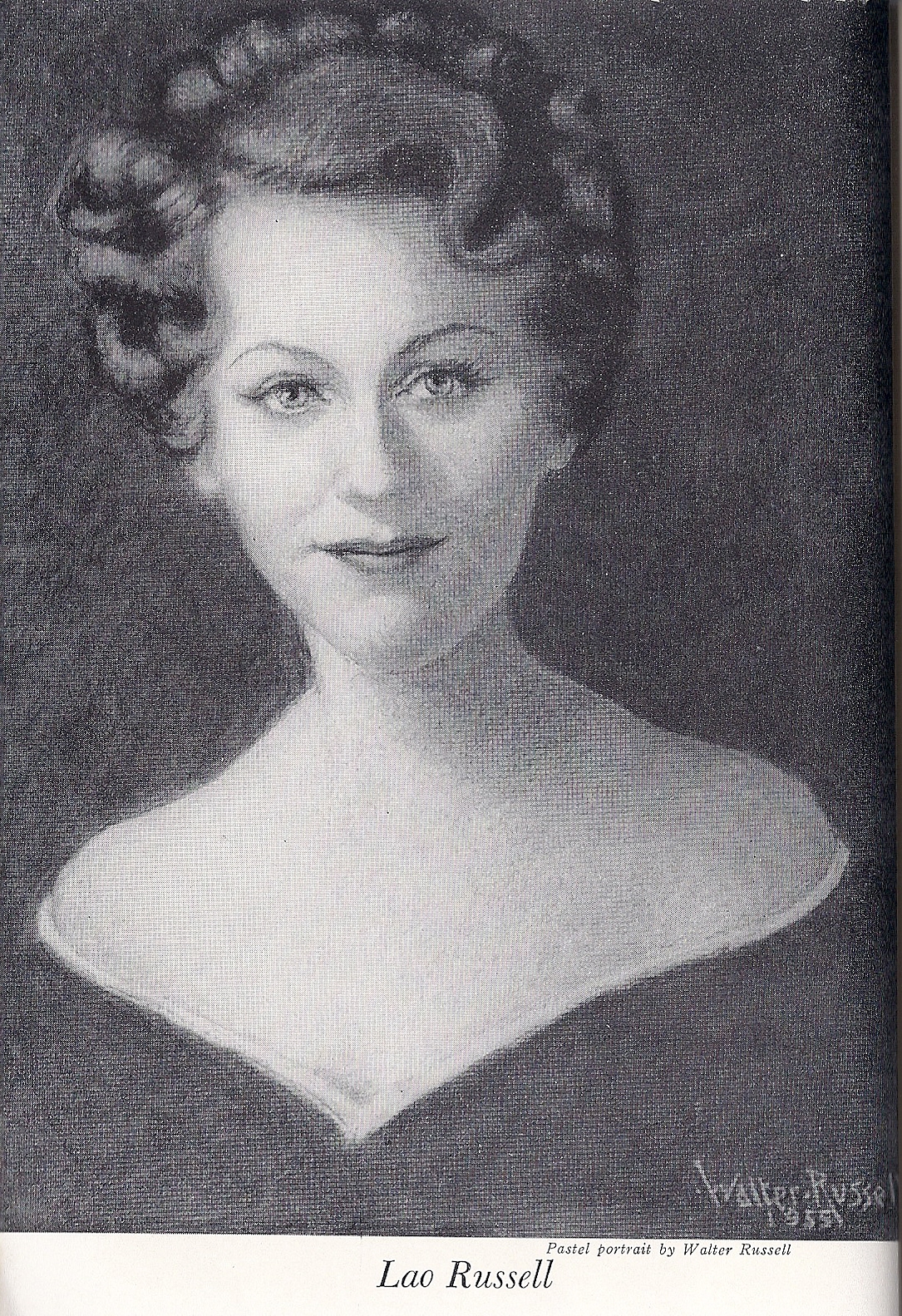
Portrait of Lao Russell

Portrait of Lao Russell

Our present unbalanced civilization is scientifically impossible to endure. It is fast disintegrating even now and its decay has accelerated very dangerously since 1900. It is so badly unbalanced in so many departments and institutions that any attempt to balance all of them simultaneously would not be effectual, besides which there is not time to do it that way. The most necessary and the most hopeful one of the unbalanced conditions is man-woman equalization.

This essential to world happiness could become a living flame which would illumine the whole world with a new light if every woman started immediately to “do something about it,” aided by every man who believed in it. Such a movement can succeed only if organized into strength of numbers. One alone can do but little but if everyone joined together in a multiple ONE UNIT of twenty millions or more before the next election, it might be quite possible to make the first great step in that direction by electing many women senators and congresswomen, and even the Vice President for the next Presidential term. Such a world innovation adopted in this country would arouse the whole world of women in other countries where such an innovation would be impossible at the present time. This country should lead the world in this respect as it has in so many respects.

The way to do this speedily and powerfully is for you and every woman everywhere, to call a few friends to gether and form themselves into a unit of the Man-Woman Equalization League. It must be started by
women but every man who is in sympathy with the movement should become an equal member of it. Every truly great man will immediately realize its import and become an enthusiastic working member of it. That UNITY is its very purpose

The League never got off the ground. However, one can go to the Foundation website and find there ways to participate in various programs and projects. I will end this excerpt with a few final words from Lao.

The appeal for this organization is so strong that its growth would become millions in one year if every woman would but realize that women have the power to save the world from another chaos by merely asserting themselves as equal inheritors of the earth and of the business of managing all earthly affairs equally with men. . . . 

When women once realize this saving power which is theirs, and the responsibility which is theirs, this movement will become the mighty crusade which it ought to be. . . .

It is hardly necessary to call your attention to the power which is vested in so many million votes.Unless something of this nature is initiated at once we shall go farther and farther into the chaos which a man-made world is so fast falling into. It is scientifically impossible for peace and happiness to come to such an unbalanced world as this is, where the physical values are so preponderant over spiritual values. We have either got to balance the FatherMother basis of Creation or perish over and over again until we dobalance it.

I therefore say to every woman who reads this book: Will you start today to dedicate yourself to this world service? And I also say to every man: Will you help woman to give birth to this man-woman equalization movement for world unification and peace, and become a member of the Man-Woman Equalization League?

I will leave you with this video interview of Lao Russell.

You can also view it at : Lao Russell Interview PM Magazine  https://youtu.be/mTCQf3iVssQ

Reference: “GOD WILL WORK WITH YOU BUT NOT FOR YOU” By Lao Russell.

Read my Health Light Newsletter online at http://LiftingTones.com

My Chorale Pic

In GOD WILL WORK WITH YOU BUT NOT FOR YOU, Lao Russell writes to the inequality between man and woman in high places where women’s spiritual nature would offer a depth of perspective that would help bring about a balanced approach to decisions that impact both men and women, such as decisions about war and environmental issues. It is not enough simply for men to see women as physical objects for his comfort and pleasure and for the purpose of procreation, child rearing and homemaking.

(Clearly, society’s view of homosexuality and lesbianism has undergone radical transformation since Lao wrote and published these words in 1955. This was just prior to the sexual revolution of the 60’s. Bear this in mind as you read this first paragraph.)

Lao Russell

Lao Russell

No great achievement of world import ever comes from countries where women are openly denied any approach to equality with men and they stand still for centuries. Physical interchange with women, unaccompanied with mental interchange, holds a nation to a physical level, just as it does with an individual. Neither individuals nor nations ever progress through physical interchange alone. Miscegenation ruined Greece. Thallic worship ruined many cities and countries while homosexuality, which resulted from such unbalanced conditions, created many a Sodom and Gomorrah.

My take on this view of homosexuality is, first of all, that it is outdated, but nevertheless based on historical and Biblical rocord. In the days of Sodom and Gomorrah, man had devolved to a lower animal nature, having lost sight and experience of his spiritual nature. Over the eons of time, man has evolved from his purely physical identity to a more integrated sense of identity.  In other words, physical man has given birth to Spiritual Man during the current phase of our evolution and awakening in consciousness to the multi-dimensional nature of the Whole Man. What we as a race of Human Beings are experiencing is the integration of the masculine and feminine energies in both men and women — along with the imbalances that appear in the evolutionary process. Let me elaborate on what I mean by imbalances.

Spiritual Man is both male and female, made in the image and likeness of the Creator.  Form notwithstanding, whatever sexual energy is dominant in an entity will determine the individual’s sexual orientation. There will be confusion and incongruencies in form until Spiritual Man fully emerges as a Light Being. These human bodies are temporary, substitute forms and they are giving way to the emergence of our original forms for incarnation. These were spiritual forms made of pure light. Evolution is leading to the restoration of our true state of being as co-creators with God on this physical plane. In the transitional phase, which we are currently undergoing and have been for some time, imbalances are experienced. This necessitates a non-judgmental state in our hearts and minds. We cannot judge what is emerging.

This was the original condition we were given in Eden if we were to have access to the Tree of Life: that we not judge the Creative Process that brings forth good out of evil–or evol, if you will.  The Tree of the knowledge of good and evol is the Creative Process, and that tree belongs to the Creator. We were told not to eat of its fruit lest we should die. Of course we disobeyed the Creator and ate of the “forbidden fruit”—which is simply judgement. The rest is history — or his story; the story of the rise and fall of the man-made, mind-made world. As I said, this is my take on these matters of very current concern, considering the recent Supreme Court decision on same-sex marriage.

Lao writes with a woman’s understanding heart about the primary and pivotal imbalance in this man-made world.

Within the last fifty years, countries like Turkey, Lebanon, Egypt, Iran and Japan which gradually added to the status of woman by giving her greater dignity, progressed very rapidly from almost static levels. The countries which have risen to the highest levels in culture, invention, science, industry and engineering are the ones in which its women interchange mentally with men as well as physically. Middle Europe and the United States have given almost all of the world’s great
achievements to the world, while the Slavs, Mongols, Arabs, and other Asiatic and African nations have given practically none of it. Whatever scientific, engineering, industrial or inventive advancement has come to Slav countries has been subsidized from Anglo-Saxon countries.

The advancement of women to mental esteem has been encouraging but there has been too little of man-woman equality in high places, such as industry and government. In these important departments of life the world is still a man’s world, made by man for man, and in man’s image. It is not a peaceful world, or a united one in any of its many departments, and it never will be as long as it is a man’s man-made world. Until women become the acknowledged mental equal of man and share with him the executive management of industrial and national responsibilities, it will be impossible to have an enduring civilization of happy, peaceful, successful people.

An unbalanced civilization is as operatively impossible as it would be for a man to continually walk and work while even three degrees away from perpendicular. Wherever one sees world and national affairs being discussed and weighed for decisions which affect all peoples, both men and women, you see great rows of men occupying the seats of judgment as to how the world must act. Everyone is familiar with pictures of man-groups in such high places as Senate and Congressional gatherings, the great conferences of The United Nations, the international assemblies at world conferences, the English Parliament or the cabinet of the President of the United States. With but few exceptions here and there all these managers of world affairs are men, all engaged in making a man’s unbalanced world which is as divided against itself as Man and Woman are divided against each other in a home where man is “master in his own house.”

I am quite sure that present-day man has not given serious thought to this man-woman equality in high places—especially here in the United States where men revere their women so highly. I feel that those thinking ones who read this book and remembering the great import of their wives in their work will do all in their power to commence what could be the greatest movement the world has even known. This action would be the spiritual rebirth the world is seeking and which all thinking men have been desiring to come into being to save it.

Our present state of world affairs is not in harmony with God’s One Law. That means that the whole human race is endeavoring to build a civilization by working against God instead of working with Him. It is a defiance of God’s command which Nature will not tolerate. Man alone can never manifest His Creator. Every creation of God or man springs only from unity, not from separateness. Creation stems only from united Father-Mother-hood. Man can no more create an enduring civilization without woman than he can create a baby without woman.

All ideas of the Mind, as well as all created bodies which manifest Mind, must have a mother as well as a father. The great error of man in this respect lies not so much in selfishness and ego as it does to the hold-over of his pagan memory of woman’s value to him as being purely physical. Until man and woman can equalize their mental relations and work together for spiritual unity, a balanced civilization is impossible.

We have long heard the hackneyed phrase that woman’s place is in the home. To organize, beautify and manage a home requires a great deal of executive ability which women perform with great credit when they must do it alone, but gloriously so when mates work together. Women have been called upon in war emergency meassures and asked to fill places unfamiliar to them, places which none but men have ever filled. They not only did the work with equal skill and merit but very often with greater efficiency than men.

When women fought for equal suffrage, one of the most familiar criticisms used to ridicule the idea of women as voters was the claim that they would vote for the man who had nice curly hair rather than the one who had brains. Then there was the ridicule of woman as statesman or as industrial director. “What would a woman know about government? What would she do in a conference of trained diplomats?”

Looking upon the results of our all-men world conferences since the end of World War I is it not fair to ask if the present dreadful plight the world finds itself in could not have been avoided if the balancing influence of women’s spiritual nature had been present? Every man and woman must realize that it is not in woman’s nature to kill, for her purpose on earth is to give life, not take it.

That alone is crucial to the survival of the human race. Women would find a more civilized way of settling issues between nations than war. Indeed, there would likely be fewer issues to settle between world nations if the feminine nature of Mankind was given equal place at the table of governing bodies.  More on this in my next post.

Read my Health Light Newsletter online at LiftingTones.com. The current topic is “The Cholesterol Myths.”

Tag Cloud