Kenosis: Self-Emptying Love 2, “The Gift of the Magi”
“Jesus said: Whoever has found the world and become rich should renounce the world . . . . The world is not worthy of one who finds himself.” — From The Gospel of Thomas
THE GIFT IS LOVE
Continuing with Cynthia Bourgeault’s insight into Jesus’s chosen kenotic path, I will forgo any introductory comments so as not to clutter the space with thoughts other than those presented in this excerpt from her book THE WISDOM JESUS:
A Pointless Sacrifice?
To flesh out a bit further what this path actually looks like, forgive me if I make a sudden leap into the world of modern literature. Kenosis does not lend itself easily to spiritual theorizing. By far its most powerful and moving enactments have come in the form of story and drama.
One of the most precise descriptions of this path, believe it or not, is the familiar and well-loved story “The Gift of the Magi” by the American author O. Henry. You probably remember the tale. Della and James are newlyweds; they’re madly in love with each other. They are also poor as church mice, and their first Christmas together finds them without sufficient funds to buy each other gifts. But each of these lovers does have one prize possession. James owns a gold watch given to him by his grandfather; Della has stunning auburn hair falling all the way to her waist. Unbeknownst to Della, James pawns his gold watch in order to buy her beautiful silver combs for her hair. Unbeknownst to James, Della cuts and sells her hair in order to buy him a gold watch chain. On Christmas eve the two of them stare bewilderedly at their completely useless gifts. It has been a pointless sacrifice—pointless, that is, unless love itself is “the gift of the magi.”
And of course, this is exactly what O. Henry is getting at. In the voluntary relinquishing of their most cherished possessions, they make manifest what love really looks like; they give tangible shape to the bond that holds them together. That’s what kenosis is all about.
Another profoundly kenotic parable of our times is the tale that forms the 1987 movie Babette’s Feast, adapted from a short story by Isak Dinesen. As the drama unfolds we discover that its heroine, Babette, had until recently been one of the most celebrated chefs in Paris, but during the political riots of 1871 she loses everything—restaurant, livelihood, and family. She flees for her life to rural Denmark and is taken in by two aging sisters who have given their lives to religious work, trying to hold together the spiritual community that their father founded. When Babette arrives, the remaining believers have grown old and weary, lost in petty bickering. Babette tries as best she can to lift their spirits, but nothing seems to be turning the situation around. Out of the blue a letter arrives informing her that she has won three million francs in a lottery back in Paris, and then and there she decides to treat these Danish peasants to a proper French dinner. She imports all the necessary ingredients: not only exotic gourmet delicacies for the seven-course meal itself (each with its appropriate wines, champagnes, and liqueurs) but the china dinnerware, silver cutlery, damask table cloths, and crystal glassware. The film zeroes in on the banquet table as the astonished Danish peasants are suddenly faced with this extravagant abundance. At first they are frightened and suspicious, but little by little the mood mellows as they slowly relax into gratitude and forgiveness. The last scene of that banquet night has them all stumbling, a bit drunk but very happy, out into the village square, where they form a circle around the fountain (a vivid image in its own right) and begin to sing and dance together. After all these years they have finally touched the wellspring, and their hearts are overflowing. Then someone says to Babette, “Well, I guess you’ll be leaving us soon, won’t you, now that you’re a rich woman?” She says, “Rich? I’m not rich. I spent every penny I had on that banquet, three million francs.”
Again we see the same leitmotif as in the O. Henry story. An extravagant sacrifice is in one sense wasted, because these poor peasants cannot really comprehend the magnitude of the gift, and by morning, when they’ve sobered up, they will probably have lost most of its beneficial effect. But no matter; the banquet table is set before them anyway. In her no-holds-barred generosity Babette offers these broken, dispirited souls a taste of reassurance that their long years of faithfulness have not been in vain. She mirrors to them what God is like, what love is like, what true humanness is like. And she does it precisely by throwing away her entire escape route in a single act of extravagant abundance, extravagant beyond the bounds of earth (and therefore invoking the presence of heaven). That’s the kenotic path.
Theologians have sometimes commented that if the goal of ascent mysticism is to bring about union through convergence at the point of origin, the effect of the kenotic path seems to be. self-disclosure and new manifestation. The act of self-giving brings new realms into being. It shows what God is like in new and different ways. Some of the most intuitive theologians of our times say that this is how the world was created in the first place—because, in the words of Karl Rahner, “God is the prodigal who squanders himself.” The act of self-giving is simultaneously an act of self-communication; it allows something that was coiled and latent to manifest outwardly. “Letting go” (as in non-clinging, or self-emptying) is but a hair’s breadth away from “letting be,” and our Judeo-Christian tradition remembers that it is through God’s original “Let there be . . . ” that our visible world tumbled into existence.
I love Cynthia’s authentic thinking and writing outside the box of conventional belief. She presents a theology that I, as a former Catholic seminary student, can easily accept and understand at a heart level. In my own published writings and blogging, I have ascribed to “ascent mysticism” as the path of ascension to the “point of origin” we think to be up in some Heaven, a point that Jesus himself taught is within. When he reportedly ascended into Heaven, did he go up or within?
There is a passage in my SACRED ANATOMY book where I contemplate this paradoxical dynamic. The word “up” can be both dimensional and non-dimensional, or vibrational, as in moving up to a higher frequency. The same is true of the word “down.” The biblical account of Jesus’s ascension indicates that he ascended into “the clouds of heaven.”
For example, I mentioned the “clouds of heaven.” Jesus was seen by his disciples as ascending into the clouds above their heads. These clouds may have been the conditions in their own (transforming) collective consciousness through which the Lord of Love was making his royal exit from the earthly planes back into the higher planes of being from which he had come, and from which we all come—the “kingdom of heaven” which he had told them more than once “is within you.” This could also be the inference made by the two men in white apparel whom they reportedly saw standing with him and whom they heard say to them: “Ye men of Galilee, why stand ye gazing up into heaven? This same Jesus, which is taken up from you into heaven, shall so come in like manner as ye have seen him go into heaven.” This may well be a classic case where the dimensional state simply did not comprehend the non-dimensional. The darkness did not comprehend the light. The lower planes simply cannot comprehend the higher. But the one who stands in the midst of the seven golden candlesticks, the seven planes of being, in the fourth dimension has both physical and spiritual eyes and can see and comprehend the non-dimensional as clearly and easily as the dimensional.
I can appreciate Cynthia’s inference that Jesus descended down all the way—actually “into hell” according to the biblical text—in order to encompass and include all the dimensions of the vast spectrum of Creation in both heaven and earth, in the cycles of restoration, which he was very intentionally in the process of initiating. In so doing he opened the gates to the Garden of Paradise here on Earth. As Cynthia states so well in the next excerpt from this chapter, which I will publish in my next post:
It was not love stored up but love utterly poured out that opened the gates to the Kingdom of Heaven.
Until my next post, be love, be loved and be blessed.
Anthony
tpal70@gmail.com
 IN THIS SERIES, I will explore the path of “Kenotic Love” as seen through the passionate heart and
 The “fire” that Jesus threw on the world was not wild fires like we’re experiencing along the West Coast. It’s the all-consuming flame of love, the atomic power at the heart of creation. In this series I will explore how the design of true community unfolds naturally and organically, fueled by atomic power released under the control of the stabilizing design and dynamics of the atom. Without further intro, I’ll dive right into it.
 Consider what we now know about the structure and dynamic operation of this fundamental building block of Creation. At the center of the atom dwell one or more positively charged Protons and one or more neutral particles called Neutrons. Orbiting around this central hub of focused power are a number of Electrons carrying a negative charge. Looming behind this nuclear structure lies a potential of awesome power held in check by the integrity and stability of the tiny atom. We know this by reason of our experience destroying that integrity and releasing that awesome power to destructive ends.
 Transmutation of substance precedes resurrection and ascension. In order for substance to ascend to a higher vibratory level, it has to be refined. There is only one creative force that can refine and transmute substance so that it can ascend to a higher vibratory level, and that’s the gentle, subtle energy of the fire of Love.
  We have been considering the resurrection. The womb may be said to be the means by which life is born. The substance of love was first necessary if there was to be the substance of the womb. There is nothing else but love substance, all the way through—love substance but at different vibratory levels. And the substance of the womb is the heaven in relationship to the life that is to be born. We find at every level there is a heaven involved—a connection. You may remember that the second day of the creative cycle described in Genesis spoke of the firmament, the heaven, the connection between the waters above and the waters below, between the truth above and the truth below—the means by which what is below may be brought forth. The heaven at any level is rightly a state where there is a particular atmosphere and a particular enfoldment and a particular control, by which the creative process may continue. All that indicates the presence of what is called truth. So there is a heaven connecting the substance of love above with the substance of life below. There is one heaven.

 Transmutation is by the unified radiation of love. In this post I will push the envelope a bit to contemplate further the process of transmutation and ascension. We have completed the process of transformation of consciousness sufficiently to move on to what’s next. I will share a presentation by contemporary spiritual teacher Lord Martin Exeter (1909-1988), whom I was honored and privileged to know as my mentor in transformation—words that may bring to remembrance the commission we signed up for as angels before incarnating on Earth. I will share a part here and another part next weekend. I started sharing this consideration in a blog post back in
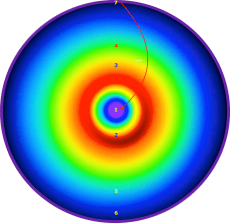


 Transmutation is by fire—the fire of love. Continuing in this series “Crucibles for Transmutation and Ascension,” and sharing excerpts from my book SACRED ANATOMY—where spirit and flesh dance in the fire of creation. This post delves deeper into the chemistry and alchemy of transmutation, which begins deep within the soil of the earth and continues on up into and through our body temples where ceremonial vessels render gifts of Nature up to pay homage to their Creator.
 Completing the story of King Solomon before continuing in the theme of this series, it is significant in the historical context that Solomon’s kingdom was a failed opportunity for Paradise to be restored on Earth and Man restored to his original role in Eden as co-creator with God.
 Continuing to do what is mine to do amid the pivotal turbulence in the world—and joining my many friends and colleagues who are holding a space of love and right expectancy for a creative resolution to the current crises playing out—I invite you to join me in exploring how the biblical temples of old reflect the design inherent in our physical bodies, temples inhabited by angels for the presence of God on Earth. Let us not forget who we are and what our purpose is for being here at this crucial time of purification of the body of mankind by the fire of Love. These are end-time days for this mind-made world. There is no way forward for it, nor for those who are trapped in its deceitful ways. A passage from the last chapter of the Book of Revelation comes to mind:
 How consciously aware are you that the eggs and bacon, or yogurt and fruit, you had for breakfast this morning are being transformed and transmuted into flesh and bone and lifted up to a higher vibratory level, seeking a path back to the Creator? A rather lofty thought to begin one’s day . . . and why not?
 I received several responses to my
  As angels, we do not wish to behave in a brash manner. At the same time we should never deny our stature in our dealings and relationships with the people. It seems that very often emissaries have felt at a disadvantage somehow when working with people in the world. What is meant when it is indicated that one should be spiritual? In the human view this means innocuous, unimportant, unnecessary. The attitude of human nature is that it can get along very well without anything spiritual, except possibly as some sort of an adjunct to human nature. If spiritual things can be used to advantage in what human nature wants to do, well let’s include spiritual things. But it is all self‑centered, isn’t it? As angels, we are certainly not at any disadvantage with respect to people. Our stature is vast relative to the stature of any particular human nature. And while this should not make us conceited—this is angelic nature—we certainly would not deny our authority or our ability to handle what needs to be handled as angels.
 Healing Tones