Biocentrism 2: Where is the Universe? part 2
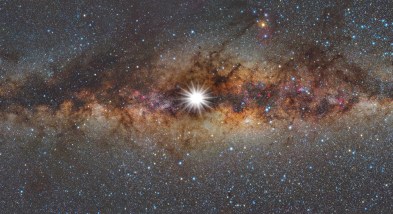
A Galaxy with photoshopped central star
“We can will ourselves to act, but we cannot will ourselves to will.” Albert Einstein
 THIS ENTIRE CONSIDERATION reminds me of something a scientists once concluded at the end of his article: “We may never find the seat of consciousness, because what we are looking for is who is looking.” An axiom of ontological studies is “A state cannot observe itself.” If you can see it and observe it, then it isn’t you, no matter how close it is to you or how pleasant or unpleasant. We really can’t “work on ourselves.” We can only work on changing our expression and our behavior, as well as our opinions and beliefs about ourselves. The truth of you is that you are perfect, made in the image and likeness of the Creator — which fact makes you a creator who has a free will and choice about what you will create. We cannot change who we are, nor escape the responsibility for our creations. We are who and what we are: a Human Being — a creator Being incarnate in a Human form, come here from the Creator in the Heaven to create beauty on the Earth. These words by my spiritual mentor, the late Martin Cecil, shared by Jae Hyoung Lee on Facebook today, express this truth in a more specific way:
We need to learn not to be disturbed. We need to stop responding to the external thing. We can relinquish human judgments of all kinds, critical attitudes one toward another, because our sole concern is with the kingdom of God and His righteousness, maintaining the heavenly atmosphere, that which is divine. It is not important that you should try to correct someone else, try to make someone else behave the way you think they ought to, according to your concept of what would be good presumably–but good for whom? Well usually it is “good for me,” is it not? Self-centered. Our concern is not with trying to change our fellows or ourselves. Our concern is simply with maintaining the atmosphere which will allow the right divine change to occur. if the divine atmosphere is provided in the spiritual sense we will just naturally grow up too. The process will unfold just as surely as the process of physical growth.
FROM MY READERS
Jerry Kvasnicka from Sunrise Ranch in Loveland, Colorado, wrote in a comment to my previous post:
Once again, Anthony, you have hit the nail right on the head! I love the way you put it: “I am consciousness and I create my world. Collectively, We are Consciousness and We create our world together as one body of Man, male and female, made in the image and likeness of God.” Yes, I am a representative of the Creator here in human form on earth to bring the wonders of Heaven into the earth of my living.
Here in the spiritual community where I live we have recently been meditating on the statement: “The mystery of God is finished on earth.” God has been a mystery to human beings because God is thought of as being separate–up there, over there, anywhere but here. So in an effort to connect with God human beings develop religions, philosophical systems and all manner of beliefs and practices to somehow bridge the perceived gap between themselves and the Divine.
The deplorable state of humanity on earth is the result of this ignorance. Not until we individually and collectively take responsibility for finishing the mystery of God on earth by revealing Divine character in living will the body of humanity (which in reality is the Body of the Creator) begin to thrive again and return the earth to its rightful status as a sparkling gem in the cosmos.
♦ ◊ ♦
CONTINING from where I left off in my review of Dr. Robert Lanza’s book BIOCENTRISM in my previous post, I will conclude the author’s consideration of this chapter. Earlier on the author asks: “Where are the sensations of life?” — a question we might ask in our efforts to pin down and understand the sense of self. Repeating what I wrote earlier: “I know that my brain does not decide nor originate my body’s movements. It is clearly used in the process, along with all the other anatomical parts — and there are habitual patterns of movement developed simply by repetitive practice, such as in piano playing and typing. But the brain is not the author nor originator of my movements. The author and creator of my body’s movements is the immortal being that I AM incarnate in this earthen form — and, believe it or not, this has been proven scientifically” — as the following excerpt elucidates.
♦ ◊ ♦
Finally, some revert to the “control” aspect to assert the fundamental separation of ourselves and an external, objective reality. But control is a widely misunderstood concept. Although we commonly believe that clouds form, planets spin, and our own livers manufacture their hundreds of enzymes “all by themselves,” we nonetheless have been accustomed to hold that our minds possess a peculiarly unique self controlling feature that creates a bottom-line distinction between self and external world. In reality, recent experiments show conclusively that the brain’s electrochemical connections, its neural impulses traveling at 240 miles per hour, cause decisions to be made faster than we are even aware of them. In other words, the brain and mind, too, operate all by itself, without any need for external meddling by our thoughts, which also incidentally occur by themselves. So control, too, is largely an illusion. As Einstein put it, “We can will ourselves to act, but we cannot will ourselves to will.”
The most cited experiment in this field was conducted a quarter century ago. Researcher Benjamin Libet asked subjects to choose a random moment to perform a hand motion while hooked up to an electroencephalograph (EEG) monitor in which the so-called “readiness potential” of the brain was being monitored. Naturally, electrical signals always precede actual physical actions, but Libet wanted to know whether they also preceded a subject’s subjective feeling of intention to act. In short, is there some subjective “self” who consciously decides things, thereby setting in motion the brain’s electrical activities that ultimately lead to the action? Or is it the other way ’round? Subjects were therefore asked to note the position of a clock’s second hand when they first felt the initial intention to move their hand.
Libet’s findings were consistent, and perhaps not surprising: unconscious, unfelt, brain electrical activity occurred a full half second before there was any conscious sense of decision-making by the subject. More recent experiments by Libet, announced in 2008, analyzing separate, higher-order brain functions, have allowed his research team to predict up to ten seconds in advance which hand a subject is about to decide to raise. Ten seconds is nearly an eternity when it comes to cognitive decisions, and yet a person’s eventual decision could be seen on brain scans that long before the subject was even remotely aware of having made any decision. This and other experiments prove that the brain makes its own decisions on a subconscious level, and people only later feel that “they” have performed a conscious decision. It means that we go through life thinking that, unlike the blessedly autonomous operations of the heart and kidneys, a lever-pulling “me” is in charge of the brain’s workings. Libet concluded that the sense of personal free will arises solely from a habitual retrospective perspective of the ongoing flow of brain events.
What, then, do we make of all this? First, that we are truly free to enjoy the unfolding of life, including our own lives, unencumbered by the acquired, often guilt-ridden sense of control, and the obsessive need to avoid messing up. We can relax, because we’ll automatically perform anyway.
Second, and more to the point of this book and chapter, modern knowledge of the brain shows that what appears “out there” is actually occurring within our own minds, with visual and tactile experiences located not in some external disconnected location that we have grown accustomed to regarding as being distant from ourselves. Looking around, we see only our own mind or, perhaps, it’s better put that there is no true disconnect between external and internal. Instead, we can label all cognition as an amalgam of our experiential selves and whatever energy field may pervade the cosmos. To avoid such awkward phrasing, we’ll allude to it by simply calling it awareness or consciousness. With this in mind (no pun intended), we’ll see how any “theory of everything” must incorporate this biocentrism—or else be a train on a track to nowhere.
To sum up:
First Principle of Biocentrism: What we perceive as reality is a process that involves our consciousness.
Second Principle of Biocentrism: Our external and internal perceptions are inextricably intertwined. They are different sides of the same coin and cannot be separated.
♦ ◊ ♦
In my next post, I will present the Third Principle of Biocentrism, which delves into the mysterious and magical realm of quantum physics and the materialization of energy in the presence of an observer. As always, I welcome your thoughts. Until then,
Be love. Be loved
Anthony
tpal70@gmail.com
You may enjoy reading articles in my HealhLight Newsletter blog: LiftingTones.com. The current article is entitles “Our Unified Creating Field.”

 For as far back as I can remember, I’ve had a vivid awareness of being an immortal spiritual being. This awareness emphasizes itself as I move my arms to reach out and my legs to walk — presently as I move my fingers across the keyboard typing out the thoughts emerging through my mind while composing this blog post.
 THERE IS A UNFIED CREATING FIELD enveloping our physical bodies. It’s a large part of who and what we are. In fact, this field IS who we are, and it’s at our command. Whether knowingly or unknowingly, we create our worlds and our physical forms by every spirit-imbued thought, word, intention and emotion we entertain and utter and every enactment we perform within our creating field.
 THROUGHOUT THE RECORDED HISTORY of man’s sojourn on Earth—and it has been a sojourn, a temporary visit to the lower planes of being—a pattern has been weaving itself around the theme of resurrection and ascension of the body of mankind from out of the depths of perdition and death and into the restored Edenic state of eternal life, not merely in some imagined hereafter but here and now while we have living, breathing flesh to bring it and to enjoy it. It seems evident, by the direction this civilization is headed, that our sojourn in these lower levels of mere existence is near completion. We are being awakened, if not by Spirit then by dire circumstance, to the necessity of ascending to a higher frequency and a more heavenly state of consciousness. We are being invited to return to Eden.
 (The poem is my attempt at sonnet writing in English Lit Class. I got an A− on it. I thought it deserved an A+ of course. But I was pleased anyway to have the teacher’s recognition of my budding poetry writing talent. I loved English Literature.)
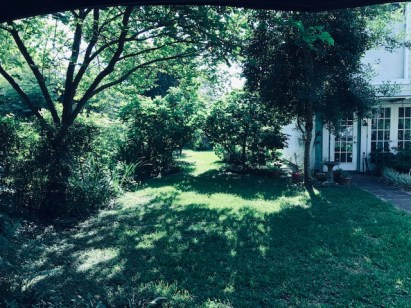
 Co-creation At Home
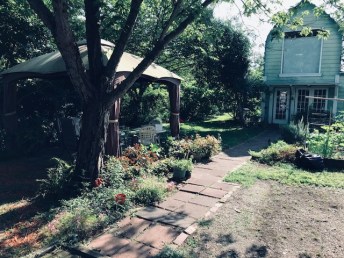


 William Erwin Thompson penned those words. The Paradise myth, along with all the legends and stories about the “First People” handed down through the ages, are vivid and haunting reminders of our origins. Who among us does not have a deep desire to live in Paradise—or for Paradise to be restored here on Earth? It’s the unconscious impetus in our quest for the American Dream: “Life, liberty, and the pursuit of happiness.” It’s what we seek and hope to find in most of our endeavors to make a comfortable and happy life for ourselves and for our families—and why we go to the wilderness and camp out in the forests and national parks. We want to be in Paradise, if only for a few days and nights filling our eyes and hearts with “Kodak moments,” camping out under the stars, and sitting by a stream of cool, clear water drinking in the golden silence and peaceful beauty of the Natural World.
 Healing Tones